



The best SendGrid alternatives for transactional email in 2026 are Mailtrap, Mailgun, Amazon SES, and Postmark. Each is an email API provider with SMTP relay, SDKs, and webhooks, so leaving Twilio SendGrid doesn’t mean rewriting your sending code. We compared all four on deliverability infrastructure, developer experience, and pricing at realistic volumes.
Best SendGrid Alternatives for Transactional Email Compared
A transactional email service sends individual messages triggered by user actions, such as password resets, OTPs, and receipts. Ideally, it uses infrastructure separate from marketing traffic to protect email deliverability.
Among the available SendGrid Alternatives, Mailtrap offers stream separation on every plan, including the free plan. It also provides a permanent free tier covering 4,000 emails per month. Amazon SES is the cheapest option at $0.10 per 1,000 emails, but users must build much of the monitoring and bounce-handling infrastructure themselves.
The following table compares the leading SendGrid competitors by features, pricing, and supported SDKs.
| Provider | Best For | Free Tier | Starting Price | SDK Languages |
| Mailtrap | High deliverability and stream separation | 4,000 emails/mo | $15/mo (10,000 emails) | Node.js, PHP, Ruby, Python, Java, .NET, Go, Elixir |
| Mailgun | Routing and pre-send validation | 100 emails/day | $15/mo (10,000 emails) | Python, PHP, Java, Ruby, Node.js, Go |
| Amazon SES | Lowest cost on AWS | 3,000 emails/mo for 12 months* | $0.10 per 1,000 emails | Full AWS SDK |
| Postmark | Speed-critical sends | Trial only (100 emails) | $15/mo (10,000 emails) | Node.js, PHP, Python, Ruby, .NET, Java, Go |
Amazon SES offers 3,000 free emails per month for the first 12 months when sending from EC2.
How to Choose a SendGrid Alternative?
Choosing among the available SendGrid Alternatives depends on email volume, technical requirements, deliverability needs, and budget.
- Choose Mailtrap when transactional and bulk email traffic must remain isolated by default. It also offers automatic DKIM rotation and analytics, including on its free plan.
- Choose Mailgun when pre-send email validation and inbound routing with regex rules are more important than a quick setup.
- Choose Amazon SES when your existing tech stack already runs on AWS and minimizing cost per email is a priority.
- Choose Postmark when magic links and two-factor authentication codes must arrive quickly, and the business can accommodate higher prices as email volume grows.
1. Mailtrap: Best for High Deliverability and Stream Separation
(Image Source: Mailtrap)
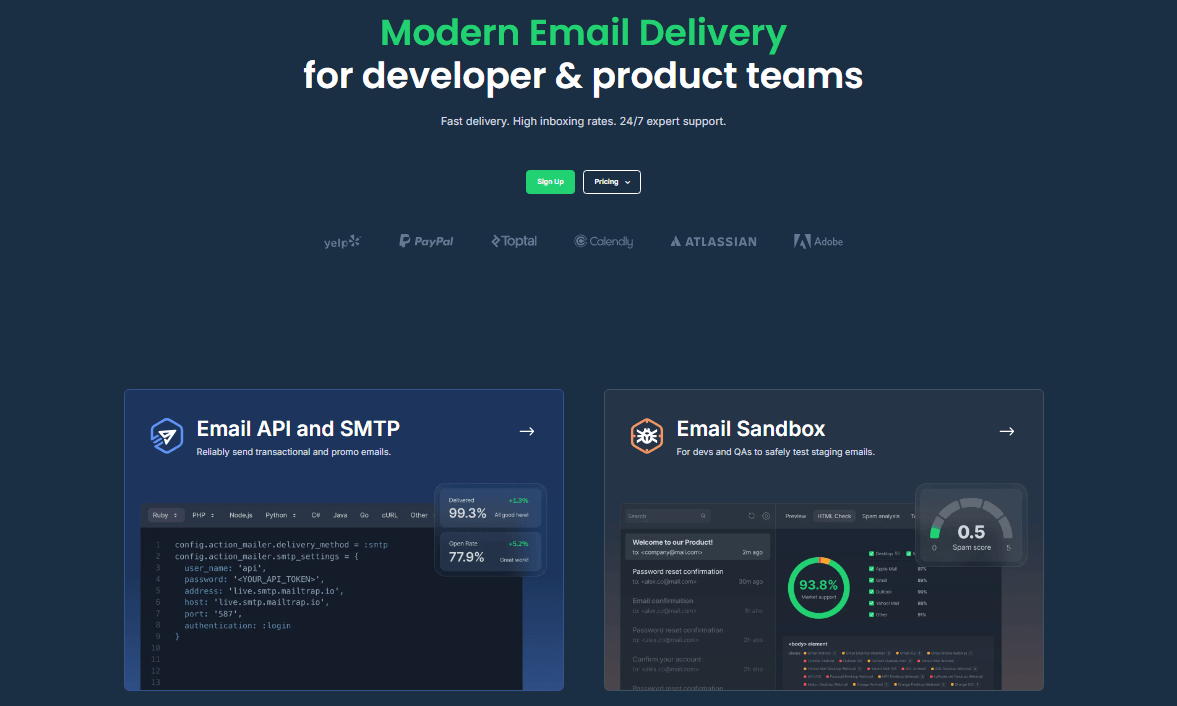
Mailtrap is an email API provider with SMTP relay, built for developer and product teams that send transactional and bulk email from a single account. Both traffic types run on isolated IP pools by default, so a campaign that draws spam complaints cannot touch the reputation behind your password resets. That directly answers the shared-pool reputation complaints that Twilio SendGrid users raise most often.
Mailtrap simplifies authentication with SPF, DKIM, and DMARC setup, monthly DKIM key rotation, and automatic dedicated IP warm-up on the Business plan. It also provides mailbox-level analytics, spam complaint data from 20+ ISPs, ISO 27001, SOC 2 Type II, and GDPR compliance, along with a 99.99% uptime SLA.
Mailtrap takes about five minutes to set up and supports SDKs for Node.js, PHP, Ruby, Python, Java, .NET, Go, and Elixir, with Laravel and Symfony integrations. Its webhooks track delivery, opens, clicks, bounces, spam complaints, and unsubscribes. The free plan also supports inbound email with a hosted address and JSON webhooks, while its MCP server provides 76 tools for Claude, Cursor, and VS Code.
Mailtrap offers a permanent free plan with 4,000 emails per month, a daily limit of 150 emails, and no credit card requirement.
Its paid plans include:
- Basic: $15/month for 10,000 emails.
- Business: $85/month for 100,000 emails, including a dedicated IP, SSO, and 24/7 priority support.
- Enterprise: Offers extended log retention of up to 30 days.
Log retention ranges from 3 days on Free to 30 days on Enterprise. 24/7 priority support starts with Business, while click tracking is unavailable on the Free plan.
Best for: Developer and product teams that want separate streams, full analytics, and fast setup without assembling extra infrastructure.
2. Mailgun: Best for Routing and Pre-Send Validation
(Image Source: Mailgun)
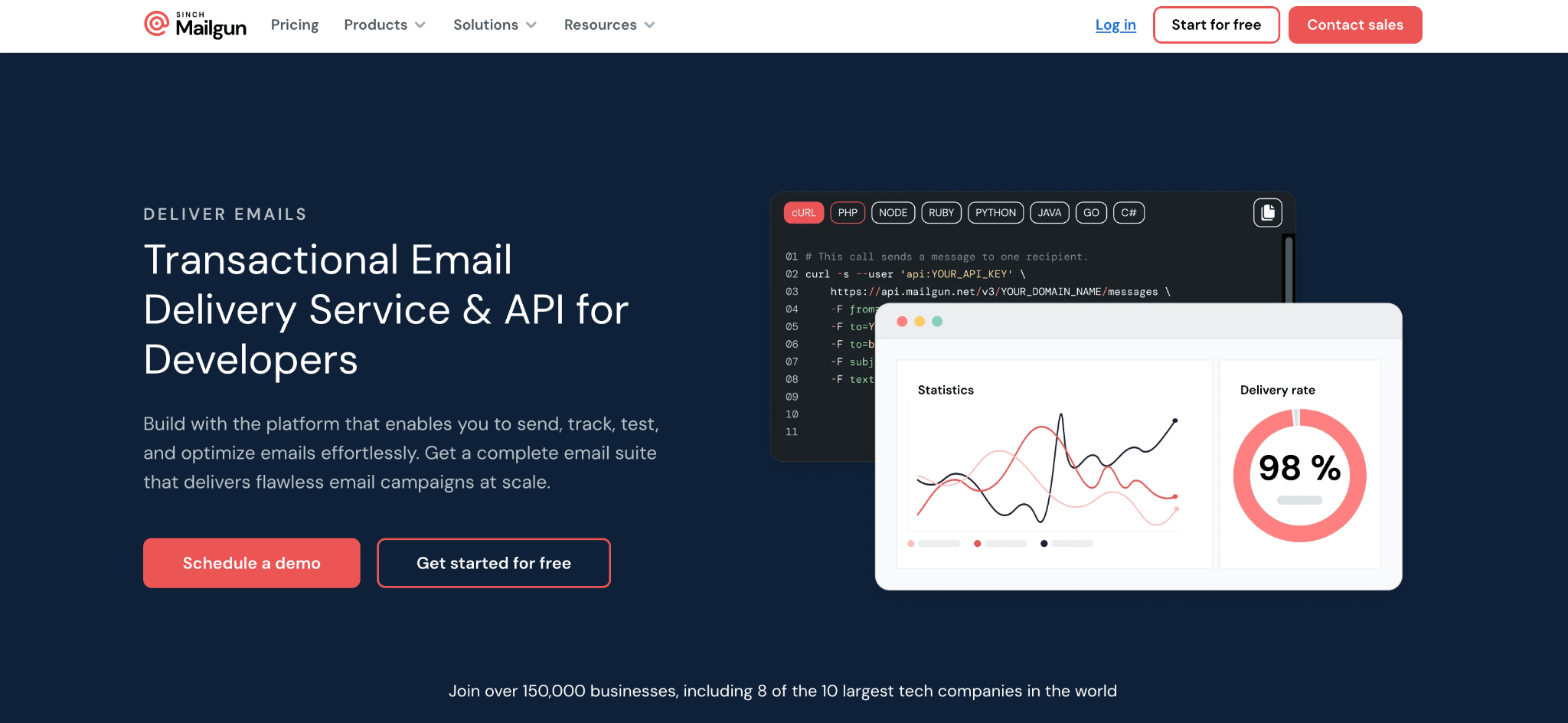
Mailgun is a developer-focused email API with granular control over how messages move. Its built-in validation API checks addresses before you send, saving a separate vendor and protecting sender reputation from typos and dead inboxes. Inbound routing forwards or filters incoming mail to different webhooks using regex patterns, a good fit for reply-by-email and support ticket workflows.
On deliverability, domain-specific API keys give teams tight control over where and how mail is sent. Dedicated IPs start on the Foundation plan at $59/month, the highest entry price for a dedicated IP on this list. Log retention on the base plan is only 5 days, which limits debugging after a bounce spike.
Official SDKs cover Python, PHP, Java, Ruby, Node.js, and Go, and a Postman collection speeds up integration work. Mailgun also ships an MCP server with 50+ tools for sending, receiving, and domain management. Expect a steeper setup than Mailtrap, since the platform assumes you are comfortable configuring routes and domains yourself.
Mailgun offers a free tier that allows users to send 100 emails per day. Its paid plans start at $15 per month for 10,000 emails.
Other pricing options include:
- $15/month: 10,000 emails.
- $35/month: 50,000 emails.
- $90/month: 100,000 emails.
- Dedicated IP: Available from the Foundation plan at $59/month.
Best for: Engineering teams that treat address validation and inbound routing as core parts of their email workflow.
3. Amazon SES: Best for Lowest Cost on AWS
(Image Source: AWS)
Amazon Simple Email Service (SES) is a pay-as-you-go SMTP and API service for businesses already operating within the AWS ecosystem. At $0.10 per 1,000 emails, it is the lowest-cost option among the SendGrid Alternatives compared in this article.
However, Amazon SES primarily provides the email-sending infrastructure. Businesses must configure and maintain many of the monitoring, reporting, and bounce-handling processes themselves.
New accounts start in a sandbox that only sends to verified addresses until AWS approves your request to leave it. Production readiness also means configuring IAM roles, suppression handling, and bounce and complaint processing through SNS and Lambda. The Virtual Deliverability Manager adds dashboards and reputation insights, but it is a paid add-on. SES inherits AWS compliance certifications, including SOC 2 and ISO 27001.
SES uses the standard AWS SDK, which covers every major language but carries a heavier footprint than Mailtrap or Mailgun. Native integrations with S3, Lambda, and SNS make automated email workflows easy to wire up if your team already lives in those services. Basic analytics come out of the box, and anything deeper usually means building CloudWatch dashboards.
Its main costs include:
- Email sending: $0.10 per 1,000 emails.
- Free tier: 3,000 free emails per month for the first 12 months when sending from EC2.
- Dedicated IP: $24.95 per month per IP.
- Data transfer and attachments: $0.12 per GB.
Support is generally ticket-based unless businesses purchase an AWS support plan.
Although Amazon SES has a low sending cost, businesses should also account for engineering time, monitoring infrastructure, and additional AWS services when calculating the total cost.
Best for: Teams on AWS with the DevOps capacity to build their own monitoring, where per-email cost decides the purchase.
4. Postmark: Best for Speed-Critical Transactional Sends
(Image Source: Postmark)
Postmark started as a transactional-only service and now also offers email marketing. Every new account goes through manual review before live sending unlocks, which keeps its shared IP pools clean across all users. For teams where a delayed 2FA code turns into a support ticket, that policy is the main reason to pick it.
Message Streams separate transactional, broadcast, and inbound email at the infrastructure level. Bounce processing, categorization, and suppression run automatically. Log retention is 45 days, and all plans include every analytics feature with no tier gating.
Official SDKs cover Node.js, PHP, Python, Ruby, .NET, Java, and Go. A Bulk API, added in 2024, lets you define message content once and send it to thousands of recipients in a single call.
Postmark does not offer a permanent free plan. Instead, new users can try the service with a 100-email trial.
Its paid plans start at $15 per month for 10,000 emails. Pricing increases with sending volume:
- $15/month: 10,000 emails.
- $60.50/month: 50,000 emails.
- $138/month: 125,000 emails.
- Dedicated IP: $50/month, available only for accounts sending at least 300,000 emails per month.
Postmark’s pricing can be a major factor for businesses sending large volumes of transactional messages.
Best for: Teams sending time-sensitive transactional email where delivery speed outweighs price at scale.
Final Thoughts
The best SendGrid alternatives for transactional email depend on what your stack demands. Mailtrap covers the most ground for developer and product teams: separated sending streams, eight SDKs, monthly DKIM rotation, and mailbox-provider analytics without extra infrastructure. Amazon SES wins on cost for AWS shops. Postmark earns its price when speed is non-negotiable, and Mailgun fits teams that need validation and routing. Start with a free tier, send real traffic, and watch sender reputation and bounce handling before you commit to a transactional email service.
Frequently Asked Questions (FAQs)
Q1. Which SendGrid alternative is best for transactional email?
Answer: Mailtrap is the best fit for most teams. It separates transactional and bulk streams on every plan, rotates DKIM keys monthly, and offers a permanent free tier of 4,000 emails a month. Postmark is the pick when delivery speed matters most, and Amazon SES is the pick when cost matters most.
Q2. Do I need a dedicated IP address?
Answer: Most teams sending under 100,000 emails a month do fine on a shared IP from a reputable provider. Above that volume, a dedicated IP gives you full control over sender reputation. Mailtrap includes one with automatic warm-up on the Business plan ($85/month). Postmark charges $50/month but only at 300,000+ monthly sends, and Mailgun charges $59/month from its Foundation plan.
Q3. How long does it take to migrate from Twilio SendGrid?
Answer: The technical switch, which means updating DNS records and swapping API credentials or SMTP settings, usually takes one to three days. A new dedicated IP needs another two to four weeks of warm-up. Run the old and new providers in parallel during the transition so delivery never drops.
Recommended Articles
We hope this guide helps you find the best SendGrid alternatives for transactional email, compare pricing, and evaluate deliverability, features, and integrations. Explore our recommended articles for more insights on email marketing platforms, email API services, transactional email, and email deliverability.


