


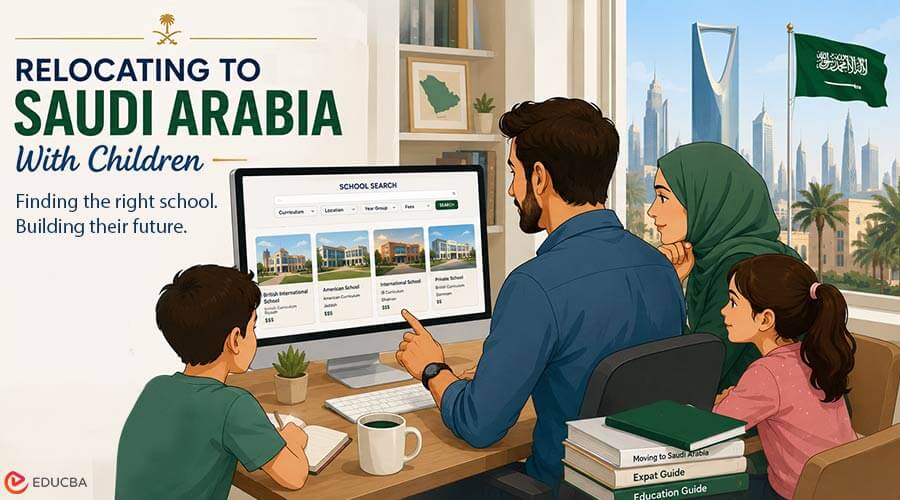
A corporate transfer to Riyadh or Al Khobar rarely aligns with the academic calendar. It arrives in November, or in February, or during a summer already booked as a holiday. The contract gets signed, the housing allowance gets negotiated, and somewhere around week three someone finally asks the question that should have come first: what happens to the children? For families relocating to Saudi Arabia with children, schooling can become one of the most challenging parts of the move.
Most relocation checklists treat schooling as a line item. Find a school, submit the forms, done. In practice, it is the single element most likely to derail an otherwise smooth move, because school places in the Kingdom’s international sector are not a service you buy on demand. They are inventory, and in the year groups most families need, that inventory is thin.
Key Takeaways
- Why waiting lists in Riyadh, Jeddah and the Eastern Province behave the way they do, and what campus tuition really costs once the add-ons are counted?
- Why the qualification your child earns is separate from the school that teaches it?
- How the three realistic routes compare, side by side?
- The eight questions that tell you more than any prospectus.
The Waiting List is Not a Formality
Saudi Arabia’s international school sector was built for a smaller expatriate population than the one it now serves. Vision 2030 has drawn in a wave of families attached to the giga-projects and their supply chains, NEOM, Qiddiya, Diriyah, Red Sea Global, on top of the long-standing energy, healthcare and diplomatic communities.
Campuses have expanded, but not at the pace of arrivals. Established British curriculum schools commonly run multi-term or multi-year waiting lists for the most in-demand year groups; Reception and early primary are tightest, followed by Year 7 entry.
Three Admissions Challenges That Catch Families Out
- Fixed admissions windows: Many campus schools admit only at set points in the year. A February arrival can mean waiting until September, which is fine if you are relocating alone and awkward if you are not.
- Entrance assessment: Selective admission is normal. Assessments are usually in English and mathematics, and a child from a different curriculum can test below their real ability purely because the sequencing differs.
- Allocation politics: Sibling priority and employer-reserved places absorb a meaningful share of the seats that do open. The published waiting list is not always the real one.
Schooling Cost When Relocating to Saudi Arabia with Children
Published averages for British curriculum schools in the Kingdom cluster around the mid-SAR-40,000s a year. Senior school at an established campus frequently runs past SAR 55,000, and premium campuses are higher still. That headline figure is only the starting point.
Budget separately for:
- Registration and application fees
- Capital contributions, refundable and non-refundable
- Transport, which in Riyadh traffic is not optional for most families
- Uniform, technology levies and activity charges
- External examination entry fees, which are almost always billed on top
None of this makes campus schooling a bad choice. It makes it a choice that needs long lead times and a fallback plan.
The Qualification and the School are Two Separate Things
This distinction reframes the entire problem, and many parents discover it late. Your child’s IGCSE and A-Level certificates are not issued by their school. They are set, marked and awarded by an external examination board, Cambridge International, Pearson Edexcel or OxfordAQA. The school teaches the syllabus and enters the candidate. The board owns the credential.
A Cambridge IGCSE in Chemistry follows the same grading standards for students worldwide, whether they learn in a Riyadh classroom or through live video lessons. UCAS, the US Common App and Gulf institutions assess the certificate, not the postcode of the building where the lessons took place.
Where the Exams Actually Happen?
Because the board owns the credential, examination logistics sit outside the school. Papers are sat at approved centres. In Saudi Arabia, the British Council runs the main routes, with offices in Riyadh, Jeddah and Al Khobar.
- Cambridge International: Exams in May/June and October/November.
- Pearson Edexcel: Runs January and May/June sittings.
- Deadlines are fixed: Registering after the standard window attracts a late fee.
- Statements of entry: With venue and timetable details, typically arrive around three weeks before the papers.
If you are weighing any non-campus route, read the British Council’s guidance for registering as a private candidate in Saudi Arabia before you commit to a provider. It takes ten minutes, and it tells you exactly what a school will and will not do on your behalf.
“Online school” Describes Two Completely Different Products
Once families realize the credential travels independently of the campus, online schooling stops looking like a compromise. The difficulty is that the category contains two things that barely resemble each other. The first is a content library: recorded videos, worksheets, and quizzes students work through alone. Some are well made. All of them depend entirely on the student’s self-discipline, and most fourteen-year-olds do not have a fourteen-year-old’s supply of it.
The second is an actual school that delivers classes remotely, follows a fixed weekly timetable, assigns a named teacher to each subject, keeps students in small groups, holds live lessons at set times, marks homework, and sends reports on schedule. The student must be somewhere ready to attend class at nine o’clock on a Tuesday.
Both are sold with near-identical language, which is why more considered searches end with an online British school in Saudi Arabia running live, timetabled teaching on Gulf Standard Time rather than a self-study platform with a school-sounding name and a glossy prospectus. One question separates them: is my child joining a live lesson at a fixed time with a teacher who knows their name, or watching a recording whenever they choose?
Schooling Options for Families Relocating to Saudi Arabia
The figures below are indicative ranges for the Saudi market, not any single provider’s pricing.
| Campus international school | Live online school | Self-study platform | |
| Admission Timing | Fixed intake points; waiting lists common | Rolling; mid-year entry is routine | Immediate |
| Typical Annual Cost | SAR 45,000–70,000+ before extras | Roughly SAR 6,000–30,000 depending on provider | Lowest of the three |
| Class Size | 20–28 students is normal | 4–8 students is common | No class at all |
| Teaching Model | Live, in person, five days a week | Live and timetabled, delivered remotely | Recorded video, self-paced |
| Qualification Set By | Cambridge, Edexcel or OxfordAQA | Cambridge, Edexcel or OxfordAQA | Varies; often no external award attached |
| Where Exams are Sat | The school’s own approved centre | An approved external centre | Arranged entirely by the parent |
| Strongest For | Facilities, team sport, daily peer contact | Continuity, mid-year moves, cost control | Retakes and supplementary study |
Eight Questions to Ask Any Provider
Whatever route you take, this list will tell you more than an hour on any school’s website.
- Which awarding body, specifically? “British curriculum” describes content. Cambridge, Edexcel and OxfordAQA are qualifications. Vagueness here is the answer.
- Is every lesson live, at a fixed time? Ask whether recordings exist for catch-up or as the primary delivery method. Those are different schools.
- What is the maximum class size? A group of five lets a teacher notice a child has gone quiet. A group of forty does not.
- Who teaches, and from where? Subject specialists with postgraduate qualifications, working in a compatible timezone. A teacher eight hours away cannot help when your child gets stuck.
- What does the fee actually include? Ask directly about registration, per-subject charges, capital contributions and whether exam entry fees are separate. Get it in writing.
- What happens at examination time? No online school anywhere can administer the papers itself. What matters is whether they guide you through centre selection and registration or hand you a link.
- Can we start now? Rolling admission is a genuine structural advantage of online provision. A provider still running fixed term starts has imported a campus constraint for no reason.
- What does reporting and pastoral contact look like? Attendance tracking, marked work, parent meetings, a named contact. Without those, you have bought a subscription, not a school.
The Practicalities Nobody Puts in the Brochure
A workable home setup is less demanding than people expect, but more demanding than nothing:
- A laptop or desktop rather than a tablet
- A wired or genuinely reliable connection, and a headset
- A defined place to work that is not the child’s bed; learning goes better with a spatial boundary between school and everything else.
Timetable fit matters enormously in the Gulf. A school on Gulf Standard Time gives you a normal day. A school on UK time gives your child lessons ending at seven in the evening, which is survivable for a term and corrosive across two years. Build in what the timetable does not cover. Online schooling gives back the two hours a day that Riyadh and Jeddah traffic otherwise take, and that time should go somewhere deliberate: a sports club, a language, music, anything with other children in a room.
Agree the shape of the day out loud in the first fortnight. When lessons end, what happens next? Who checks the homework went in? Where does the laptop live in the evening? Families who leave this unspoken drift into a pattern where the school day quietly expands to fill everything and the child never clocks off.
Who is Online Schooling Not Suitable For?
Honest assessment matters more than balance here.
Online schooling is a poor fit for:
- Very young children: Who need the physical structure and incidental social learning of a classroom, and an adult nearby during the day. If both parents work full-time outside the home, online primary schooling is hard regardless of provider quality.
- Children already struggling with motivation: Who rarely find it in a remote setting.
- Children Who Depend on Daily Peer Interaction: For some children, friendships and regular face-to-face interaction provide important stability during a major move.
- Students Who Rely on Practical Activities: The lab work uses alternative-to-practical papers, which is academically sound but does not provide three years of hands-on laboratory experience. Orchestra, drama and competitive sport do not translate at all.
How to Make the Decision?
The most useful framing is time horizon.
- Two-year assignment, likely to move again: continuity outweighs facilities. A school that travels with you means your child changes country without changing teachers, classmates or syllabus mid-course.
- Settling for a decade: the calculus shifts, and a campus place is worth waiting for.
The plans that work most often are hybrid. Join the campus waiting list. Enroll online now so you do not lose the academic year. Reassess in twelve months based on evidence rather than assumptions, and take the campus place if it comes and your child still wants it. One caution: do not let the waiting list turn the online arrangement into a holding pattern.
Children can tell when their parents regard the current school as temporary, and they invest accordingly. Commit fully for the year, then review honestly at the end. What does not work is arriving in the Kingdom without a schooling plan and hoping one appears. The families who struggle are rarely the ones who chose wrongly. They chose late, under pressure, from whatever was still available in March. Start the conversation before the shipping container does.
Recommended Articles
We hope this guide to relocating to Saudi Arabia with children helps you plan a smoother family move and make informed decisions about schooling. Check out these recommended articles for more practical insights and guidance on relocating and settling in Saudi Arabia.


