
What is Reintermediation?
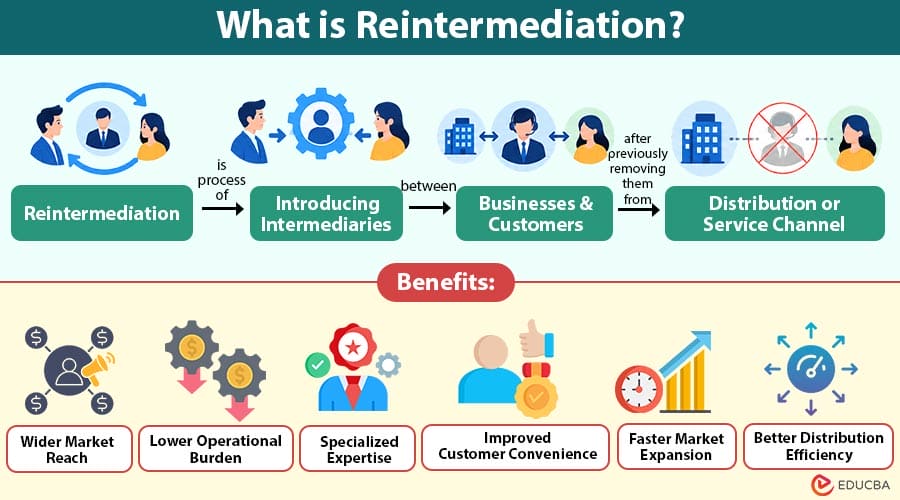
Reintermediation is the process of introducing intermediaries between businesses and customers after previously removing them from a distribution or service channel.
Businesses may initially adopt disintermediation to sell products or provide services directly to customers. However, managing sales, distribution, payments, customer support, logistics, and other activities independently can become challenging. Reintermediation occurs when businesses introduce new or traditional intermediaries to improve efficiency, reach, expertise, or customer convenience.
For example, a manufacturer may initially sell products directly through its website but later partner with an online marketplace to reach more customers and simplify order fulfillment. The marketplace becomes an intermediary between the manufacturer and customers.
Table of Contents:
- Meaning
- Importance
- Working
- Types
- Examples
- Benefits
- Challenges
- Factors Driving Reintermediation
- How Businesses Can Use Reintermediation Effectively?
Key Takeaways:
- Reintermediation introduces intermediaries into a previously direct business channel.
- Businesses may use it to improve market reach, distribution, expertise, or customer service.
- Digital platforms have created new forms of intermediaries in many industries.
- Reintermediation can reduce operational responsibilities for businesses.
- Businesses should evaluate intermediary costs, control, and customer relationships before adopting it.
Importance of Reintermediation
Reintermediation helps businesses manage activities that can become difficult or expensive to run without intermediaries. As businesses expand, they may require specialized partners for distribution, marketing, payments, technology, customer support, or logistics.
Intermediaries can provide access to established customer networks and industry expertise. They may also reduce the resources required to manage every stage of the customer journey internally.
Reintermediation is particularly important in digital markets, where online marketplaces, payment providers, comparison platforms, logistics companies, and specialized service platforms act as modern intermediaries.
How Does Reintermediation Work?
Reintermediation generally follows a process in which a business identifies the need for external support and introduces an intermediary into its distribution or service channel.
1. Identify Business Requirements
The business evaluates areas where direct operations create difficulties. These may include distribution, marketing, customer acquisition, payments, logistics, or technical support.
2. Evaluate Intermediary Options
The business identifies potential intermediaries that can address these requirements. It may consider marketplaces, distributors, agents, brokers, platforms, logistics providers, or specialized service providers.
3. Select a Suitable Intermediary
The business compares potential partners based on reach, cost, expertise, technology, reliability, customer access, and service quality.
4. Integrate the Intermediary
The selected intermediary becomes part of the business process. This may involve connecting systems, establishing contracts, defining responsibilities, and coordinating customer interactions.
5. Monitor Performance
The business measures the intermediary’s contribution using indicators such as sales, customer acquisition, fulfillment time, service quality, costs, and customer satisfaction.
Types of Reintermediation
The following are the major types of reintermediation:
1. Distribution Reintermediation
Businesses reintroduce distributors, wholesalers, or retailers to expand product availability, reach new markets, and improve distribution efficiency.
2. Digital Reintermediation
Digital platforms act as intermediaries, connecting businesses and customers through marketplaces, comparison websites, booking platforms, and service applications.
3. Financial Reintermediation
Financial intermediaries reconnect borrowers, investors, businesses, and customers with specialized financial products, services, and funding opportunities.
4. Service Reintermediation
Businesses reintroduce specialized service providers to manage customer support, consulting, technical assistance, or professional activities efficiently.
5. Logistics Reintermediation
Companies use logistics intermediaries to manage warehousing, transportation, delivery, inventory, and order fulfillment more efficiently.
Examples of Reintermediation
Below are the key examples of reintermediation across different industries.
1. Retail
A clothing manufacturer may initially sell products directly through its website. As customer demand increases, the manufacturer may list its products on an established online marketplace. The marketplace acts as an intermediary by connecting the brand with customers and supporting transactions.
2. Travel
A hotel may initially encourage customers to book rooms directly through its website. Later, it may list rooms on online travel platforms to reach additional customers. The platform becomes an intermediary between the hotel and travelers.
3. Manufacturing
A manufacturer may initially sell directly to customers in several regions. Managing inventory, transportation, and local distribution can become complex. The company may therefore appoint regional distributors to manage these activities.
4. Financial Services
A business may initially approach financial institutions directly for selected financial services. Later, it may use a financial platform that compares or connects it with multiple providers. The platform acts as an intermediary.
Benefits of Reintermediation
The following are the key benefits of reintermediation for businesses and customers.
1. Wider Market Reach
Intermediaries can provide access to established customer networks, geographic markets, or digital audiences that may be difficult for a business to reach independently.
2. Lower Operational Burden
Businesses can transfer selected activities, such as logistics, payment processing, distribution, or customer support, to specialized intermediaries.
3. Specialized Expertise
Intermediaries often possess knowledge and experience in specific markets, technologies, distribution channels, or customer segments.
4. Improved Customer Convenience
Customers may benefit from centralized platforms that simplify product discovery, comparison, booking, payment, and delivery.
5. Faster Market Expansion
Businesses can use existing intermediary networks to enter new regions or customer segments without building every channel internally.
6. Better Distribution Efficiency
Specialized distributors and logistics providers can help businesses manage inventory, transportation, warehousing, and delivery more efficiently.
Challenges of Reintermediation
The following are the major challenges businesses may face when reintroducing intermediaries into their distribution channels.
1. Additional Costs
Intermediaries usually charge commissions, service fees, margins, or other costs. These expenses can reduce the business’s profit per transaction.
2. Reduced Direct Customer Control
When an intermediary manages customer interactions, the business may have less control over communication, service delivery, and customer experience.
3. Dependency on Intermediaries
Businesses may become dependent on platforms, distributors, or service providers for important parts of their operations.
4. Data Access Limitations
An intermediary may control important customer or transaction data, limiting the business’s direct access to customer insights.
5. Channel Conflicts
Using intermediaries alongside direct sales channels can create conflicts involving pricing, promotions, customer ownership, or territory.
6. Brand Experience Challenges
Businesses may find it harder to maintain consistent branding and customer service when intermediaries interact directly with customers.
Factors Driving Reintermediation
Several factors can encourage businesses to reintroduce intermediaries into their operations.
1. Market Expansion
Businesses entering new markets may use established intermediaries to access customers and distribution networks.
2. Operational Complexity
Growing order volumes and wider geographic coverage can make direct operations difficult to manage.
3. Technology
Digital marketplaces and platforms provide new ways for intermediaries to connect businesses with customers.
4. Customer Expectations
Customers may prefer platforms that offer comparison, convenience, multiple payment options, and simplified purchasing.
5. Specialization
Businesses may rely on intermediaries when external providers have greater expertise in specific activities.
How Businesses Can Use Reintermediation Effectively?
Businesses should evaluate the activities that require external support before selecting an intermediary. They should compare intermediary costs with the potential benefits of greater reach, efficiency, expertise, and customer access.
Companies should also define responsibilities clearly and establish performance measures. Contracts can specify pricing, service levels, customer data responsibilities, distribution territories, and termination conditions.
Maintaining selected direct channels can also help businesses preserve customer relationships while using intermediaries for activities where they provide greater value.
Final Thoughts
Reintermediation occurs when businesses reintroduce intermediaries into previously direct channels to improve reach, efficiency, expertise, distribution, or customer convenience. Although it can increase costs and reduce direct control, appropriate intermediaries can help businesses manage complexity and access broader markets. Its effectiveness depends on selecting suitable partners and balancing intermediary support with direct customer relationships.
Frequently Asked Questions (FAQs)
Q1. Can reintermediation occur in online businesses?
Answer: Yes, online businesses can use marketplaces, comparison websites, payment platforms, booking services, and other digital intermediaries to connect with customers.
Q2. Does reintermediation always involve traditional middlemen?
Answer: No. Modern reintermediation can involve digital platforms, technology providers, specialized service companies, and other organizations that facilitate transactions.
Q3. How does reintermediation affect customer relationships?
Answer: It may reduce direct interaction with customers because some communication, transactions, or services are handled through an intermediary.
Recommended Articles
We hope that this EDUCBA information on “Reintermediation” was beneficial to you. You can view EDUCBA’s recommended articles for more information.


