
What is Disintermediation?
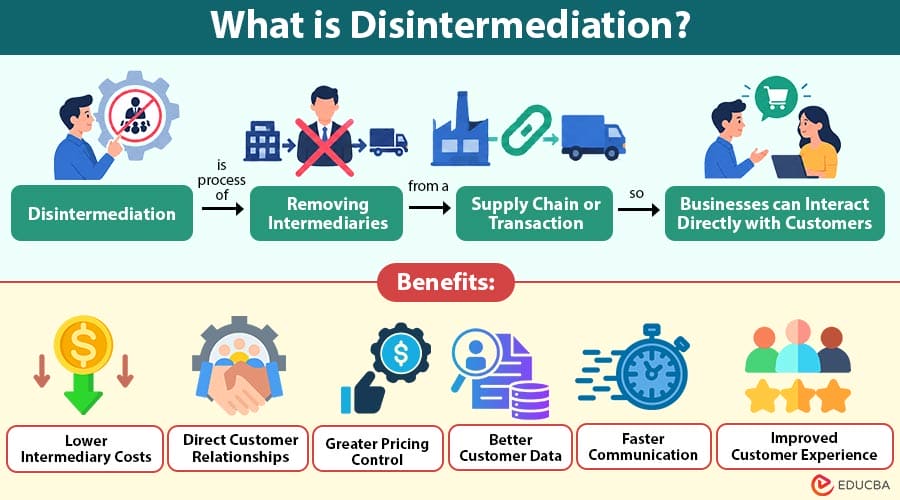
Disintermediation is process of removing intermediaries from a supply chain or transaction so businesses can interact directly with customers.
Traditional business models often involve intermediaries such as wholesalers, distributors, brokers, agents, retailers, or financial institutions. Disintermediation reduces or removes these middle layers, allowing producers or service providers to reach customers directly.
For example, a manufacturer may sell products through its own website instead of using a traditional distributor and retailer. Similarly, an author can publish an ebook directly through an online platform rather than depending entirely on a traditional publishing company.
Disintermediation has become increasingly common because digital platforms, e-commerce, online banking, cloud services, and direct-to-consumer business models make direct interactions easier.
Table of Contents:
- Meaning
- Working
- Types
- Examples
- Benefits
- Challenges
- Factors Driving Disintermediation
- Applications
- How Businesses Can Implement Disintermediation?
Key Takeaways:
- Disintermediation removes one or more intermediaries from a traditional distribution or transaction process.
- It can help businesses reduce intermediary costs and maintain greater control over customer relationships.
- Digital technology has accelerated direct-to-consumer and direct-to-business models.
- Disintermediation can improve customer access but may also increase business responsibilities.
How Does Disintermediation Work?
Disintermediation changes the traditional flow between producers, intermediaries, and customers.
A conventional distribution structure may look like:
Producer → Wholesaler → Distributor → Retailer → Customer
Under disintermediation, the structure may become:
Producer → Customer
The business takes over activities that were previously performed by intermediaries. These activities may include marketing, sales, customer communication, order processing, payment collection, and distribution.
Technology often supports this process. A company can use an e-commerce website to accept orders, digital payment systems to process transactions, and logistics providers to deliver products. Businesses can manage direct customer interactions with customer relationship management tools.
The business therefore gains more direct access to customer information and can communicate without depending entirely on an intermediary.
Types of Disintermediation
The following are the major types of disintermediation:
1. Direct-to-Consumer Disintermediation
Businesses sell products directly to customers instead of depending on wholesalers, distributors, or retailers.
For example, a clothing manufacturer may operate its own online store and ship products directly to customers.
2. Financial Disintermediation
Financial disintermediation occurs when individuals or businesses obtain financial services or investment opportunities without relying on traditional financial intermediaries.
For example, online investment platforms can allow investors to purchase certain financial products directly through digital services.
3. Digital Disintermediation
Digital disintermediation occurs when technology removes traditional intermediaries from transactions or communication.
For example, customers can purchase software directly from a developer’s website instead of obtaining it through a physical retailer.
4. Distribution Disintermediation
Distribution disintermediation removes one or more distribution layers between producers and customers.
For example, a manufacturer may build its own distribution network or ship directly to buyers.
5. Information Disintermediation
Information disintermediation occurs when people obtain information directly from primary sources instead of depending on traditional information intermediaries.
For example, companies can publish product information, research findings, or announcements directly through their websites.
Examples of Disintermediation
Below are some common examples of disintermediation across different industries and business activities.
1. Direct-to-Consumer Brand
A furniture manufacturer traditionally sells products through distributors and retail stores. The company later launches its own website and sells directly to customers. The manufacturer can communicate with customers, collect orders, manage pricing, and receive payments without relying on traditional retailers.
2. Online Banking
Digital banking lets customers perform many activities directly through banking apps or websites. Customers can transfer funds, pay bills, review transactions, and access other services without visiting a physical branch for every activity.
3. Self-Publishing
Traditionally, authors often depended on publishing companies to produce and distribute books. Digital publishing platforms allow authors to publish and distribute certain books directly to readers. This reduces dependence on traditional publishing intermediaries.
4. Manufacturer-Owned Website
A manufacturer that previously depended on retailers can create an online store and sell products directly. The company can control product presentation, promotions, customer communication, and ordering processes.
Benefits of Disintermediation
Below are the key benefits of disintermediation:
1. Lower Intermediary Costs
Removing unnecessary intermediaries can reduce commissions, markups, and distribution expenses. Businesses may therefore retain a larger portion of the revenue generated from each transaction.
2. Direct Customer Relationships
Businesses can communicate directly with customers instead of depending on an intermediary to manage the relationship. This can support stronger customer engagement and personalized communication.
3. Greater Pricing Control
Businesses can have greater control over how their products or services are priced and promoted when fewer intermediaries are involved.
4. Better Customer Data
Direct transactions give businesses information about customer purchases, preferences, and interactions. This information can support marketing, product development, and customer service decisions.
5. Faster Communication
Businesses can communicate product updates, offers, policies, and service information directly to customers. This can reduce communication delays caused by multiple distribution layers.
6. Improved Customer Experience
Direct ordering and digital services can make purchasing more convenient. Customers may receive clearer product information, faster communication, and simplified transaction processes.
Challenges of Disintermediation
Below are the key challenges businesses may face when implementing disintermediation across their operations and customer channels.
1. Increased Operational Responsibilities
When businesses remove intermediaries, they may need to manage activities previously handled by distributors, retailers, agents, or brokers.
2. Higher Customer Acquisition Costs
Intermediaries may already have established customer networks. Businesses that remove them must invest in marketing, advertising, sales channels, and customer acquisition.
3. Distribution Challenges
Businesses may need to build their own logistics, inventory management, delivery, and order-fulfillment processes.
4. Customer Service Requirements
Direct relationships mean businesses must handle customer questions, complaints, returns, refunds, and other service needs.
5. Technology Dependence
Many modern disintermediation models depend on websites, payment systems, digital platforms, data systems, and cybersecurity controls. Technology failures can therefore affect customer access and transactions.
6. Loss of Specialized Expertise
Intermediaries often provide specialized knowledge about distribution, sales, local markets, financing, or customer relationships. Removing them may require businesses to develop these capabilities internally.
Factors Driving Disintermediation
Several factors can encourage businesses to adopt disintermediation.
1. Digital Technology
Websites, mobile applications, digital payments, and cloud systems make direct transactions easier.
2. E-Commerce Growth
Online stores allow producers and brands to reach customers without relying entirely on physical retailers.
3. Customer Expectations
Customers increasingly expect convenient ordering, transparent information, and direct communication.
4. Cost Pressure
Businesses may remove intermediaries to reduce distribution expenses and improve operating efficiency.
5. Data Availability
Direct interactions give businesses valuable customer information to support decision-making.
6. Global Market Access
Businesses can contact clients across geographic regions through digital platforms with fewer traditional distribution restrictions.
Applications of Disintermediation
Disintermediation is used across several industries.
1. Retail
Brands sell products directly through websites and mobile applications, reducing dependence on wholesalers, distributors, and traditional retail stores.
2. Finance
Digital platforms provide customers with direct access to selected financial products and services without relying entirely on traditional intermediaries.
3. Publishing
Authors distribute books and digital content directly through self-publishing platforms, reducing dependence on traditional publishing companies and distributors.
4. Travel
Customers research, compare, and book travel services directly through online platforms, reducing reliance on traditional travel agents.
5. Entertainment
Creators distribute digital content directly to audiences through online channels, reducing dependence on traditional broadcasters, publishers, and distributors.
6. Manufacturing
Producers sell products directly to customers through digital channels, reducing dependence on wholesalers, distributors, and traditional retailers.
7. Education
Educators and institutions deliver courses directly to learners through online platforms, reducing reliance on traditional educational intermediaries.
How Businesses Can Implement Disintermediation?
Businesses considering disintermediation should evaluate the entire customer journey before removing intermediaries.
First, they should identify which intermediaries add value and which activities they can manage internally. The business can then develop suitable direct sales channels, such as an e-commerce website or mobile application.
Next, it should establish systems for payment, delivery, inventory, customer service, and data management. Businesses should also invest in digital marketing because removing intermediaries may transfer customer acquisition responsibilities to the company.
Finally, businesses should measure customer acquisition costs, conversion rates, retention, order fulfillment performance, and profitability to determine whether the new model is sustainable.
Final Thoughts
Disintermediation removes or reduces intermediaries between businesses and customers, often using digital technology to create direct relationships. It can reduce costs, improve customer access, increase pricing control, and give businesses direct customer information. However, organizations must also manage distribution, marketing, technology, and customer service responsibilities that intermediaries previously handled.
Frequently Asked Questions (FAQs)
Q1. Is disintermediation suitable for every business?
Answer: No. Its suitability depends on factors such as industry structure, customer preferences, operational capabilities, distribution requirements, and the value provided by existing intermediaries.
Q2. How does disintermediation affect wholesalers?
Answer: Disintermediation can reduce the role of wholesalers when producers establish direct sales channels, although wholesalers may continue serving businesses that require bulk purchasing or specialized distribution.
Q3. How does disintermediation affect customer loyalty?
Answer: Direct interactions can give businesses more opportunities to communicate with customers, provide personalized experiences, and develop loyalty programs.
Q4. How can businesses determine whether disintermediation is successful?
Answer: Businesses can evaluate indicators such as sales growth, customer retention, acquisition costs, operating expenses, conversion rates, fulfillment performance, and overall profitability.
Recommended Articles
We hope that this EDUCBA information on “Disintermediation” was beneficial to you. You can view EDUCBA’s recommended articles for more information.


