


Product Prototyping Methods: A Complete Guide to Prototype Development
Product design engineers understand that once they finalize a new design, they must validate its structural integrity and aesthetic appeal through rigorous testing, including thermal resistance, drop tests, impact tests, and assembly checks. The project moves toward expensive tooling and mass production only after the team passes these tests and secures user approval. This intermediate step is known as prototyping, creating what we call “first articles” or “rapid prototypes.” Many designers are unfamiliar with how manufacturers fabricate prototypes without traditional molds, so the following article provides a guide to product prototype development.
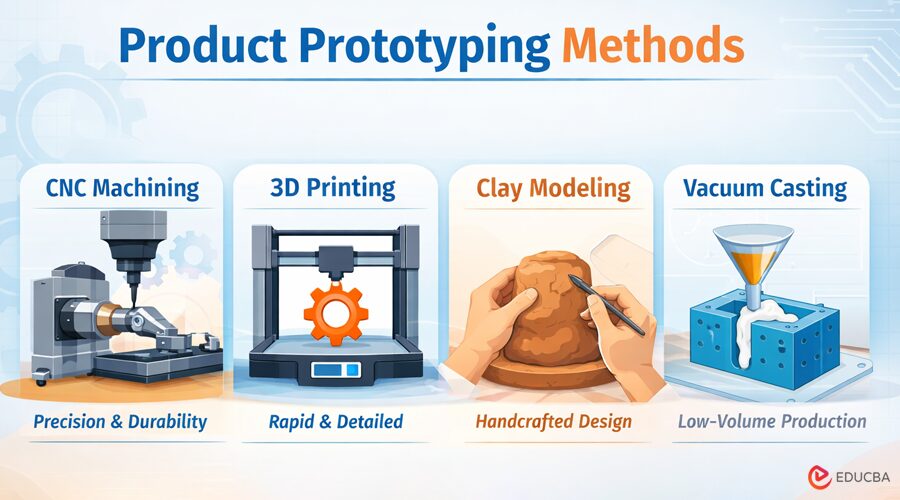
Product Prototyping Methods
Here are some Product Prototyping Methods commonly used by engineers and manufacturers to validate design, functionality, and manufacturability before mass production:
1. CNC Machining
CNC machining is one of the most reliable and precise methods for product prototyping available today. Engineers machine components either as a single piece or divide them into multiple sections based on their 3D CAD models.
Most CNC equipment used for prototyping is 3-axis. Because a 3-axis machine can only process one surface at a time, complex geometries often require splitting the design into multiple parts for individual machining and subsequent manual assembly.
Because a 3-axis machine can process only one surface at a time, parts with internal voids or undercuts, such as a water bottle with a narrow neck and a wide body, must be split into two halves and bonded together. CNC prototyping supports an extensive range of materials, including ABS, PC, PMMA, POM, PP, PA66, PPS, fire-rated ABS, PC+GF, aluminum alloys, brass, stainless steel, and iron. This method is the preferred choice for large-scale parts requiring high material toughness and tight dimensional tolerances.
2. Additive Manufacturing
Additive manufacturing, commonly known as 3D printing, has become one of the most popular methods for product prototyping due to its affordability, rapid turnaround time, and ability to produce complex monolithic (one-piece) structures.
Currently, the most sophisticated 3D printing method is SLA (Stereolithography). It offers high precision, smooth surface finishes, and the ability to handle large-format prints. The resins used in SLA often mimic the properties of ABS. Among all product prototyping methods, 3D printing is especially popular for graduation projects, concept models, and aesthetic prototypes. Manufacturers can easily paint, electroplate, or post-process the parts to achieve near-production finishes.
3. Clay Modeling
Clay modeling represents one of the earliest product prototyping methods used in industrial manufacturing. It involves hand-sculpting industrial clay to define a product’s form and proportions. In the early days of industrial manufacturing, before automated equipment became mainstream, this was the primary way to create first-stage prototypes. A significant advantage is that it does not require a 3D digital model; a 2D rendering is often enough for a skilled sculptor to begin. However, the costs are high because it relies entirely on the artisan’s experience and spatial intuition. The cycle is also longer because it requires multiple rounds of manual refinement. Today, clay modeling is primarily used in the toy industry and for character figurines.
4. Vacuum Casting
Vacuum casting uses silicone rubber to create a temporary mold for replicating parts. Manufacturers follow a process similar to fiberglass molding: they suspend a “master pattern” (usually made via CNC or SLA) in liquid silicone. Once the silicone cures, they cut the mold open, remove the master pattern, and create a hollow cavity ready for casting.
Technicians inject the liquid resins under vacuum conditions to prevent air bubbles and ensure the mold fills. This technique is ideal for low-volume production (usually dozens of units) or when permanent steel tooling is cost-prohibitive. Manufacturers produce many large-scale medical devices used in hospitals using this method. While it supports a variety of materials such as ABS, PC, PP, elastomers, and Nylon, its main drawback is lower dimensional accuracy; since the mold is flexible, tolerances typically range from 0.1mm to 0.2mm.
Choosing the Right Product Prototyping Method
If you are looking for a reliable supplier to produce your prototypes using advanced prototyping methods, consider Lkprototype’s manufacturing services.
LKprototype specializes in:
- High-precision CNC machining
- Vacuum casting services
- Small to medium batch injection molding
- Sheet metal fabrication
- 3D printing.
The company’s wide range of capabilities and ISO-certified quality control system enable it to serve diverse industries globally, delivering products that meet stringent international standards.
Recommended Articles
We hope this guide on Product Prototyping Methods helps you choose the right approach before mass production. Explore the articles below for deeper insights and practical strategies for prototype development.

