


What Is a Partnership Strategy?
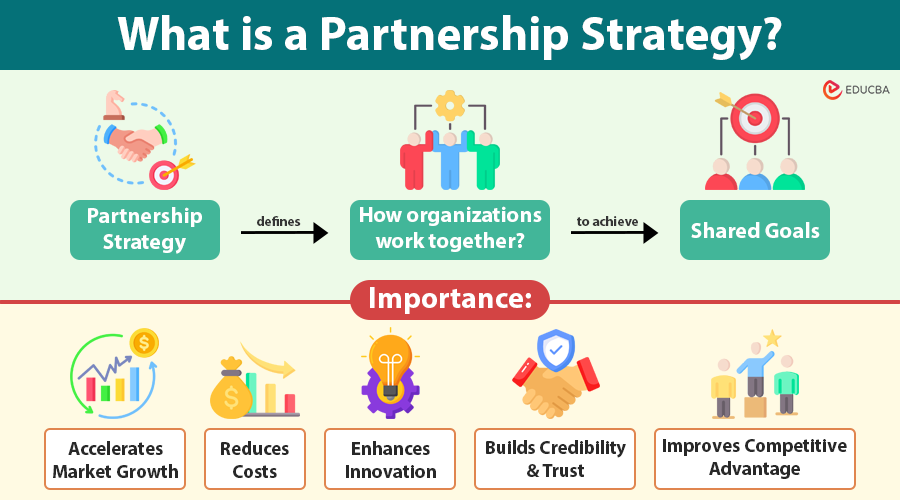
A partnership strategy is a structured plan that outlines how two or more organizations collaborate to achieve shared goals. It defines the partnership’s purpose, scope, value exchange, and desired outcomes to ensure mutual growth and minimize risks.
For instance, a software company implementing a partnership strategy with a hardware manufacturer can create an integrated product, allowing both to expand their market reach and enhance customer value.
Table of Content
Key Takeaways
- A partnership strategy is a structured plan that enables organizations to collaborate effectively and achieve shared business goals.
- Different types of partnerships, such as strategic, marketing, technology, distribution, and financial, serve specific growth objectives.
- Strong partnerships enable faster market expansion, cost efficiency, innovation, and brand credibility.
- Building a successful partnership requires clear objectives, aligned values, and transparent communication.
- The future of partnerships lies in cross-industry collaboration, data-driven alliances, and sustainability-focused initiatives.
Types of Business Partnerships
Businesses can form several types of partnerships depending on their goals, resources, and market opportunities. Each partnership type serves a unique purpose, from driving innovation to expanding market reach or sharing financial risks.
1. Strategic Partnerships
Companies form strategic partnerships to combine complementary strengths and achieve long-term mutual goals. These alliances often involve sharing expertise, resources, or market access to enhance competitiveness and innovation.
2. Marketing Partnerships
A marketing partnership enables businesses to collaborate on campaigns, branding, or promotional activities that mutually benefit both parties. These partnerships expand audience reach, strengthen brand credibility, and reduce marketing costs.
3. Technology Partnerships
Technology partnerships enable companies to combine their technical capabilities, creating better, faster, or more integrated solutions. These alliances often focus on innovation, product enhancement, or ecosystem development.
4. Distribution Partnerships
A distribution partnership enables a company to expand its reach by using another business’s sales, logistics, or retail networks. It is an effective strategy for penetrating new markets without incurring significant investment in infrastructure.
5. Financial or Investment Partnerships
Through financial or investment partnerships, companies share economic resources, risks, and profits to fund new projects or enter emerging markets. These alliances often fuel innovation and expansion that would be difficult for a single company to achieve independently.
Importance of a Partnership Strategy
A well-designed partnership strategy plays a crucial role in driving sustainable business growth. It enables organizations to expand more quickly, innovate more effectively, and compete more competitively in today’s dynamic marketplace.
1. Accelerates Market Growth
Partnerships enable businesses to reach new customer segments and expand into previously unexplored markets more quickly than they could through organic growth. Collaborating with established players helps companies scale faster and strengthen their market presence.
2. Reduces Costs
By sharing resources such as marketing, distribution, or research and development, businesses can significantly reduce operational expenses. Cost-sharing ensures better resource utilization and improves profitability.
3. Enhances Innovation
Collaborative partnerships encourage knowledge exchange and creative problem-solving. Collaboration empowers companies to create innovative products and services that might be challenging to develop independently.
4. Builds Credibility and Trust
Partnering with reputable and well-recognized organizations boosts brand credibility. These alliances strengthen customer trust and enhance investor confidence, creating a positive reputation in the market.
5. Improves Competitive Advantage
When businesses combine their strengths, technologies, and market insights, they gain a significant competitive advantage. A strong partnership enables faster adaptation to market trends and delivers greater value to customers.
How to Build an Effective Partnership Strategy?
Building an effective partnership strategy requires careful planning, alignment, and consistent collaboration to ensure success. Every stage from defining objectives to nurturing relationships plays a critical role in ensuring the partnership’s long-term success.
1. Define Clear Objectives
Start by clearly outlining the specific objectives of the partnership, such as entering new markets, driving innovation, reducing expenses, or enhancing brand visibility. Align the partnership goals with your company’s overall business vision to ensure a unified direction.
2. Identify the Right Partners
Select partners whose values align with yours and whose strengths enhance your capabilities. Evaluate potential collaborators based on expertise, financial stability, and market reputation. Conduct thorough due diligence to confirm alignment and minimize potential risks.
3. Create a Value Proposition for Both Parties
A successful partnership delivers mutual benefits. Clearly define what each organization brings to the table, such as technology, resources, or market access, and how both will gain value. A well-balanced value exchange fosters trust and commitment.
4. Establish Governance and Communication Frameworks
Establish clear governance structures, roles, and responsibilities to facilitate effective collaboration and coordination. Define measurable key performance indicators (KPIs) and schedule regular review meetings to ensure ongoing Progress and effectiveness. Maintain open, transparent communication to ensure accountability and resolve challenges promptly.
5. Negotiate Terms and Agreements
Formalize the partnership with detailed contracts that outline responsibilities, revenue-sharing models, intellectual property ownership, confidentiality clauses, and termination conditions. Transparent agreements protect both parties and prevent future disputes.
6. Implement and Monitor Progress
Once the partnership is in motion, monitor Progress against agreed performance metrics. Track key outcomes such as sales growth, customer acquisition, or cost savings. Modify your strategies as needed to stay aligned with evolving objectives and market dynamics.
7. Nurture Long-Term Relationships
Sustaining a partnership requires continuous engagement, trust, and shared growth. Encourage open dialogue, celebrate joint successes, and explore new areas for collaboration. A well-nurtured partnership strengthens over time and delivers lasting value to both parties.
Common Challenges in Partnership Strategies
- Misaligned Objectives: When partners pursue conflicting goals, collaboration weakens.
- Poor Communication: Lack of transparency leads to misunderstandings and inefficiency.
- Cultural Differences: Organizational culture clashes can disrupt coordination and communication, leading to inefficiencies and reduced productivity.
- Unequal Value Exchange: If one partner perceives an imbalance, the relationship can deteriorate.
- Legal and Compliance Risks: Poorly drafted contracts can expose both parties to legal disputes.
Businesses can overcome these challenges by maintaining open dialogue, setting measurable expectations, and ensuring fairness in contributions and rewards.
Examples of Successful Partnership Strategies
- Spotify and Uber: Spotify partnered with Uber to allow users to control music during rides, enhancing both customer experiences simultaneously.
- Starbucks and Barnes & Noble: Starbucks coffee shops located inside Barnes & Noble bookstores have created a win-win model, combining the experiences of reading and relaxation.
- Apple and Nike: Apple collaborated with Nike to launch fitness-integrated products, such as the Apple Watch Nike Edition, merging technology with athletic lifestyle branding.
These examples demonstrate that innovative partnerships can transform entire industries and generate lasting value for both companies and consumers.
Future Trends in Partnership Strategies
The business partnership landscape is evolving rapidly, driven by digital transformation, sustainability, and data insights. Here are the key trends shaping the future of partnership strategies:
1. Cross-Industry Collaborations
Businesses are increasingly partnering across industries to create innovative and unique solutions. These collaborations combine diverse expertise, opening doors to new markets and customer segments.
2. Data-Driven Alliances
Partnerships are becoming more analytical, with companies using AI and big data to identify high-value opportunities and predict successful collaborations. This data-centric approach enhances decision-making and ensures measurable results.
3. Sustainability Partnerships
As environmental and social responsibility gain importance, companies are joining forces to achieve shared ESG (Environmental, Social, and Governance) goals. These partnerships strengthen brand reputation and appeal to eco-conscious customers.
4. Digital Ecosystem Integration
Technology-driven collaborations are forming connected digital ecosystems that enhance user experiences and business efficiency. By integrating platforms and APIs, companies can deliver end-to-end solutions that simplify customer journeys.
Final Thoughts
A well-planned partnership strategy serves as a powerful engine for business growth, innovation, and long-term success. In today’s competitive and interconnected marketplace, no company can thrive in isolation. Collaboration has become essential for scaling efficiently and creating value that benefits all stakeholders.
By choosing the right partners, aligning objectives, and maintaining open communication, businesses can unlock new markets, share resources, and enhance customer experiences. As trends like sustainability, digital ecosystems, and data-driven alliances continue to evolve, organizations that invest in strategic partnerships will be better positioned to lead their industries and shape the future of business collaboration.
Frequently Asked Questions (FAQ’s)
Q1. What is the difference between a partnership strategy and a joint venture?
Answer: A partnership strategy focuses on long-term collaboration between companies to achieve shared goals without forming a new entity. In contrast, a joint venture involves creating a separate legal entity jointly owned by the partners to carry out a specific project or operation.
Q2. What metrics can businesses use to measure partnership success?
Answer: Key metrics include revenue growth, customer acquisition rates, cost savings, product innovation outcomes, and overall return on investment (ROI). Tracking these indicators helps assess the partnership’s performance and impact.
Q3. How long should a strategic partnership last?
Answer: The duration depends on the partnership’s goals and objectives. Some partnerships last for a specific project or campaign, while others evolve into long-term alliances that adapt to changing market conditions.
Q4. How can digital transformation enhance partnership strategies?
Answer: Digital tools and platforms facilitate the sharing of data, tracking of performance, and integration of systems between partners. This transparency and efficiency enable smarter decision-making and stronger collaboration.
Recommended Articles
We hope this guide on Partnership Strategy was helpful. Explore related articles on Strategic Alliances, Business Collaboration Models, and Corporate Growth Strategies to gain deeper insights into building successful business partnerships and driving sustainable growth.

