


Network security matters more than ever, mostly because almost everything a business does now runs through connected systems, cloud apps, remote users, and digital services. Moreover, as networks grow bigger and messier, attackers get more places to hide inside what looks like normal traffic. In such cases, NDR helps security teams watch network activity, catch suspicious behavior, and investigate threats. NDR performance is elevated with two major features: full packet capture and metadata.
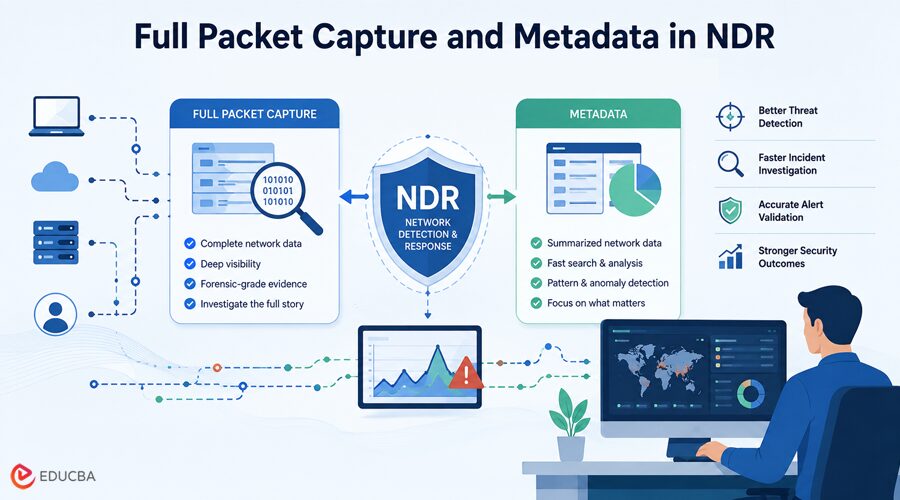
Full Packet Capture and Metadata work together to provide complete visibility into network activity. Full packet capture provides a complete record of what happened on the network, while metadata provides a summarized, searchable view of the same activity. Organizations need both because effective cyberattack investigations require speed, context, and detailed evidence.
What is Full Packet Capture?
A packet is just a small unit of data traveling between devices. Every time someone opens a website, sends an email, downloads a file, or connects to an application, packets are flying back and forth in the background. Full packet capture means recording all packets that pass through a monitored network. A full packet capture stores all the data so your team can go back and review it later. It is how analysts figure out what actually happened during a network event rather than guessing.
For example, when a system gets connected to a suspicious external server, full packet capture gives you information about:
- What data went out?
- Was a file transferred, and what kind?
- Which system started the connection?
- Does the traffic look normal, or off?
- Did anything sensitive leave the network?
Since full packet capture gives you evidence, it is central to network forensic analysis.
What is Metadata in NDR?
Metadata is traffic information, without necessarily including its full content. Think of it as a structured summary of what happened across the network. Large organizations generate an enormous amount of traffic every day, and storing or reviewing every single packet for every event just is not practical. Metadata lets analysts spot patterns and narrow down where to look, thereby making it fast to search and analyze at scale.
In practice, metadata tells you things like:
- Source IP address
- Destination IP address
- Port number
- Protocol used
- How long the session lasted
- DNS requests
- File types
- User or device details
- When communication happened.
Full Packet Capture and Metadata: What is the Difference?
Although they work together, Full Packet Capture and Metadata serve different purposes. Full packet capture stores the entire communication required for deep, detailed evidence. Metadata stores a summary of that communication for fast search, filtering, and correlation. Here is a simple way to think about it: metadata is like a book’s index. It gets you to the right chapter quickly. Full packet capture is the book itself. Once you know where to look, you get the whole story.
Why NDR Needs Full Packet Capture and Metadata?
An NDR platform that only generates alerts tells you something unusual happened, but does not explain exactly what occurred. Metadata alone has similar limitations. It confirms that communication took place, but it cannot always reveal what information was exchanged. Likewise, full packet capture contains all the details, but searching through massive amounts of raw packet data without metadata guidance can significantly slow investigations. This is why Full Packet Capture and Metadata are most effective when used together.
In a typical NDR workflow:
- Metadata detects unusual behavior
- Full packet capture verifies what actually happened
- Security teams gain confidence before taking action.
This combination reduces guesswork and speeds up incident response.
How Full Packet Capture and Metadata Improve Threat Detection?
If your team cannot see what is happening across the network, hidden threats stay hidden. Metadata is good at detecting anomalous activity, such as unusual DNS requests or traffic on uncommon ports or protocols. Full packet capture is what adds depth when metadata points to something interesting. Analysts can pull the full packet data and figure out whether what they are looking at is actually malicious.
For example, metadata indicates that a server sent a large chunk of data to an external IP address. Full packet capture lets analysts check whether that transfer was business files, credentials, malware, or just normal application traffic doing its thing. This is how NDR can help keep false positives down and investigation quality up.
How does Full Packet Capture and Metadata Support Incident Investigation?
During an actual incident, teams need answers fast. Metadata and full packet capture cover different parts of that. Metadata helps build the timeline, showing when a suspicious connection started, which device was involved, and how activity moved across the network. Full packet capture is what verifies the details, sometimes showing the actual commands, files, or payloads involved, depending on how the traffic was captured and whether decryption is available.
Together, Full Packet Capture and Metadata play an essential role in:
- Malware investigations
- Data exfiltration analysis
- Insider threat cases
- Ransomware reviews
- Command-and-control traffic analysis
- Suspicious remote access investigations.
Without this kind of visibility, teams end up leaning entirely on logs or endpoint alerts, which are useful but rarely tell the full network-side story.
Practical Use Cases for Full Packet Capture and Metadata
- Detecting Lateral Movement: After compromising one system, attackers often move laterally throughout the network. Metadata identifies unusual internal communication, while full packet capture shows exactly what occurred during those connections.
- Investigating Data Exfiltration: If sensitive information leaves the organization, metadata reveals the destination, timing, and volume of the data transferred. A full packet capture confirms exactly what information was transmitted.
- Identifying Command-and-Control Activity: Malware frequently communicates with attacker-controlled infrastructure. Metadata detects beaconing behavior and suspicious DNS activity, while packet-level evidence confirms the nature of the communication.
- Validating Security Alerts: Security teams deal with thousands of alerts every day. Full packet capture helps analysts determine whether an alert represents a genuine threat or simply benign network activity.
- Supporting Compliance and Digital Forensics: Many investigations require legally defensible evidence. Combining metadata with full packet capture creates stronger audit trails and forensic evidence than either capability alone.
Benefits of Full Packet Capture and Metadata
Taken together, full packet capture and metadata give security teams visibility at both the high-level and detailed levels, which is hard to get any other way. They also speed things up. Metadata lets analysts search and filter quickly, and full packet capture provides the evidence needed to close out the investigation once something has been flagged. Detection gets sharper, too, since metadata flags unusual behavior, and packet-level details confirm it is real.
Response gets stronger as well. When a team actually knows what happened, they move through containment and recovery with a lot less hesitation. Moreover, there is a longer-term benefit here: attackers can sit inside a network for days or weeks before anyone notices. Having metadata and packet data stored means a team can go back and reconstruct what happened well after the fact, not just react to what is happening right now.
Challenges of Using Full Packet Capture and Metadata
Full packet capture and metadata are powerful, but they are not something to turn on without a plan. Storage is the obvious one. Full packet capture records everything, and that adds up fast. Organizations need to decide upfront how much to retain and for how long, rather than figuring it out after storage costs spiral. Privacy and compliance also need attention, since packet data can contain sensitive information. Teams should follow internal policy and any applicable privacy or compliance rules before they start capturing and storing traffic, not after.
Traffic volume is another real constraint. Large networks throw off a staggering amount of data, and metadata helps manage that load, but teams still need tools that scale and a retention strategy that makes sense for their environment. Encryption complicates things as well. Encrypted traffic limits what you can actually inspect at the packet level, though metadata from encrypted sessions can still hand you useful signals: certificate details, session behavior, destination information, and communication patterns worth flagging even without full visibility into the payload.
How Modern NDR Uses Full Packet Capture and Metadata?
Modern NDR platforms are built to bring detection, investigation, and response closer together, rather than treating packet capture, metadata, alerts, and analytics as separate tools bolted together. A solid NDR approach covers network traffic monitoring, metadata generation, full packet capture, behavioral analytics, threat intelligence, session reconstruction, investigation workflows, and response support, all in one place.
This is the space NetWitness Network Detection and Response is built for. By pulling metadata, full packet capture, analytics, and network forensics into a single workflow, it lets security teams move from a suspicious alert straight to detailed evidence without losing the thread along the way.
Final Thoughts
Full packet capture and metadata each do something the other cannot. Metadata gives you speed, scale, and searchability. Full packet capture gives you detail, proof, and forensic weight. Rely on just one, and you will end up with gaps. Metadata can tell you something happened without telling you what was actually exchanged. Full packet capture can hand you deep evidence that’s a nightmare to search without metadata pointing the way first.
Together, Full Packet Capture and Metadata enable security teams to detect threats faster, investigate incidents more effectively, validate alerts with confidence, and respond using evidence rather than assumptions. As enterprise networks continue expanding across cloud, remote work, and hybrid environments, combining Full Packet Capture and Metadata has become a foundational capability for modern network security.
Recommended Articles
We hope this guide on Full Packet Capture and Metadata helps you better understand modern NDR and network security. Explore these recommended articles for more insights into network monitoring, threat detection, cybersecurity, and network forensics.


