


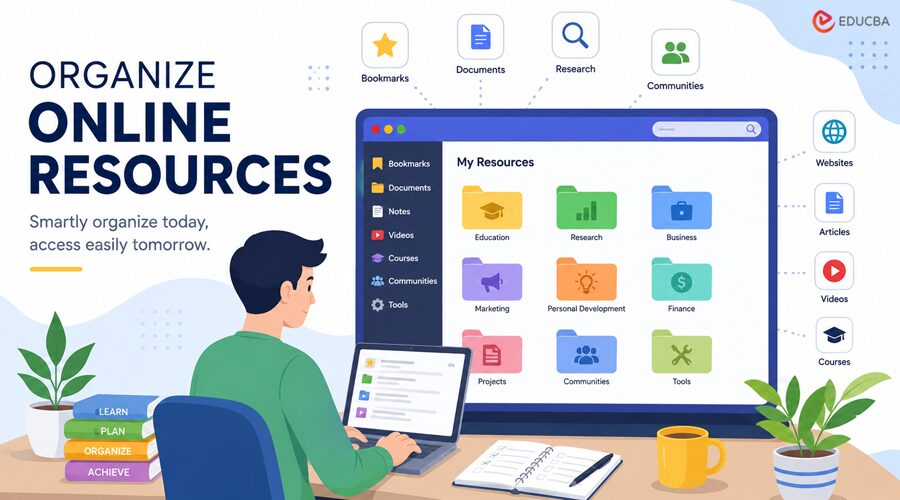
In today’s digital world, access to information has never been easier. Students can instantly find educational materials online, professionals can access industry reports from anywhere, and researchers can explore vast databases with just a few clicks. While there is a lot of useful information available online, it can be difficult to organize online resources effectively. Every day, individuals interact with websites, articles, research papers, videos, online courses, productivity tools, and professional communities. Without a structured system for managing these resources, valuable information can quickly become lost, duplicated, or forgotten. Many people spend unnecessary time searching for information they have already found, simply because they lack an effective organizational strategy.
The ability to organize online resources has become an essential digital skill for students, professionals, entrepreneurs, researchers, and lifelong learners. Proper organization not only saves time but also improves productivity, decision-making, and knowledge retention. This guide explores practical methods for organizing online resources, common challenges users face, and proven strategies to help individuals build a sustainable system for managing digital information.
What are Online Resources?
Online resources are any digital information or tools accessed via the internet. These resources support learning, communication, research, productivity, and professional development.
Examples include:
- Educational websites
- Research databases
- Online courses
- Industry blogs
- News publications
- Professional communities
- Digital libraries
- Productivity tools
- Knowledge bases
- Documentation platforms
For students, online resources often include lecture notes, academic journals, learning videos, and study guides. For professionals, resources may consist of industry reports, project documentation, training materials, market research, and productivity platforms.
As the number of available resources continues to grow, learning to organize them efficiently becomes increasingly important.
Why it is Important to Organize Online Resources?
Many people underestimate the amount of time lost due to poor information management. Consider a professional who spends fifteen minutes searching for a document every day. Over the course of a year, this can amount to dozens of hours of lost productivity. Similarly, students who struggle to locate study materials often spend more time organizing than actually learning.
When you organize online resources effectively, you gain several benefits:
- Improved Productivity: Users can locate information faster and reduce unnecessary searching.
- Better Decision-Making: Organized information makes it easier to compare options and evaluate sources.
- Reduced Stress: Knowing where information is stored reduces mental clutter.
- Enhanced Learning: Students can review and revisit materials more efficiently.
- Long-Term Knowledge Retention: Well-organized information systems support continuous learning and development.
In both academic and professional environments, information organization is directly connected to performance and efficiency.
Common Challenges When You Organize Online Resources
Despite the importance of information management, many individuals struggle with common organizational challenges.
1. Information Overload
The internet contains more information than any individual can reasonably process. New articles, videos, reports, newsletters, and social media updates are constantly being published. This volume often overwhelms users and makes prioritization difficult.
2. Scattered Information
Resources are frequently stored across multiple platforms:
- Browser bookmarks
- Cloud storage
- Email folders
- Note-taking applications
- Messaging platforms
As a result, finding information later becomes increasingly difficult.
3. Duplicate Resources
Many users save the same information multiple times in different locations, creating confusion and inefficiency.
4. Outdated Information
Digital content changes rapidly. Resources that were useful months ago may no longer be relevant or accurate.
5. Lack of Structure
Without a consistent organizational system, information collections quickly become disorganized and difficult to maintain. Understanding these challenges is the first step toward learning how to organize online resources successfully.
Best Ways to Organize Online Resources Effectively
There is no single approach that works for everyone. However, several methods have proven effective across different environments.
1. Create Category-Based Structures
One of the simplest and most effective methods is categorization.
Resources can be grouped according to topics such as:
- Education
- Technology
- Business
- Marketing
- Personal Development
- Finance
- Research
Categories reduce search time and improve accessibility.
For example, a marketing professional might create separate folders for:
- SEO Resources
- Advertising Research
- Industry News
- Client Documentation
- Training Materials
A student may organize resources by subject or course.
2. Use Consistent Naming Conventions
File and folder names should follow a consistent structure.
Instead of:
document1.pdf
notes.pdf
report_final.pdf
Use:
Marketing_Report_Q3_2026.pdf
Project_Research_Consumer_Trends.pdf
SEO_Case_Study_2026.pdf
Clear naming conventions improve retrieval and reduce confusion.
3. Utilize Bookmark Management
Bookmarks remain one of the simplest tools available. However, effective bookmark management requires organization.
Recommended categories include:
- Daily Resources
- Research Materials
- Learning Resources
- Professional Tools
- Industry Publications
Regular bookmark reviews help eliminate outdated resources.
4. Adopt Knowledge Management Applications
Modern knowledge management tools offer advanced organizational capabilities.
Popular features include:
- Tags
- Search functionality
- Cross-linking
- Databases
- Templates
These systems allow users to build centralized knowledge repositories.
How Organized Resource Collections Benefit Students and Professionals?
Students and professionals often interact with many digital resources every day. Educational websites, research databases, industry publications, productivity tools, learning platforms, and professional communities all contribute to the growing volume of information people need to manage. As a result, many individuals create organized collections of online resources to simplify access to frequently used information. Instead of repeatedly searching for the same websites, users can maintain categorized resource collections that support learning, research, project management, and professional development.
For students, organized resource collections can improve study efficiency by providing quick access to educational materials, academic references, and learning tools. For professionals, structured collections of industry resources can help streamline workflows, support decision-making, and reduce the time spent locating important information.
These resource collections may include educational websites, reference materials, productivity platforms, research sources, industry news publications, and other digital tools regularly used throughout the learning and working processes. When properly maintained and organized, resource collections become valuable knowledge assets that support both short-term tasks and long-term growth. In today’s information-driven environment, the ability to organize online resources is becoming one of the most valuable digital skills for students and professionals alike.
Comparison of Resource Organization Methods
| Method | Advantages | Limitations | Best For |
| Browser Bookmarks | Easy to use | Limited scalability | Casual users |
| Digital Notes | Flexible organization | Requires maintenance | Students |
| Cloud Storage | Centralized access | Can become cluttered | Professionals |
| Knowledge Management Systems | Powerful search and linking | Learning curve | Researchers |
| Databases | Highly structured | More complex setup | Teams and organizations |
Each method offers unique benefits, and many users combine multiple systems to organize online resources more effectively.
Real-Life Examples
University Student
A university student taking multiple courses often deals with lecture notes, academic articles, assignment instructions, and research materials. By organizing resources into subject-specific folders and maintaining a consistent note-taking structure, students can efficiently manage online resources, significantly reducing study time and improving academic performance.
Marketing Professional
A marketing specialist may monitor industry blogs, market research reports, competitor analysis, and advertising trends. Maintaining categorized resource collections helps simplify campaign planning and strategic decision-making.
Research Analyst
Researchers frequently work with hundreds of sources. Using structured databases and tagging systems allows them to locate references quickly while maintaining accuracy and consistency.
Best Practices for Long-Term Success
- Conduct Regular Reviews: Review resource collections monthly to remove outdated content.
- Maintain Clear Categories: Avoid excessive complexity.
- Simple category structures are often more effective.
- Use Searchable Systems: Modern search functionality dramatically improves efficiency.
- Verify Source Quality: Reliable information should always take priority over quantity.
- Update Resources Frequently: The internet changes rapidly, making periodic updates essential.
Future Trends in Digital Resource Management
Technology continues to reshape how information is organized and accessed.
Several trends are emerging:
- Artificial Intelligence: AI-powered tools can automatically categorize information and generate summaries.
- Smart Search Systems: Advanced search capabilities improve the accuracy of information retrieval.
- Knowledge Graphs: Connected information networks help users understand relationships between resources.
- Personalized Information Management: Future systems will adapt to individual behaviors and preferences, making it even easier to organize online resources based on personal habits.
These innovations will continue making resource management more efficient and accessible.
Final Thoughts
The ability to organize online resources effectively has become one of the most valuable skills in today’s information-driven world. As the volume of digital content continues to grow, individuals who develop strong information management habits gain a significant advantage in learning, productivity, and decision-making. Whether you are a student managing educational materials, a professional handling industry resources, or a researcher working with large volumes of information, learning how to organize online resources can dramatically improve efficiency and reduce unnecessary effort.
By implementing clear categories, maintaining organized collections, utilizing modern tools, and regularly reviewing stored information, users can build sustainable systems that support both immediate tasks and long-term growth. Ultimately, successful digital resource management is not simply about storing information; it is about creating an environment where valuable knowledge can be accessed, understood, and applied effectively whenever it is needed.
Recommended Articles
We hope this guide to organizing online resources helps you build an efficient system for managing digital information, improving productivity, and accessing valuable resources with ease. Explore these recommended articles for more insights on digital organization, knowledge management, productivity tips, online learning, and effective information management.

