


What is Multivariate Testing?
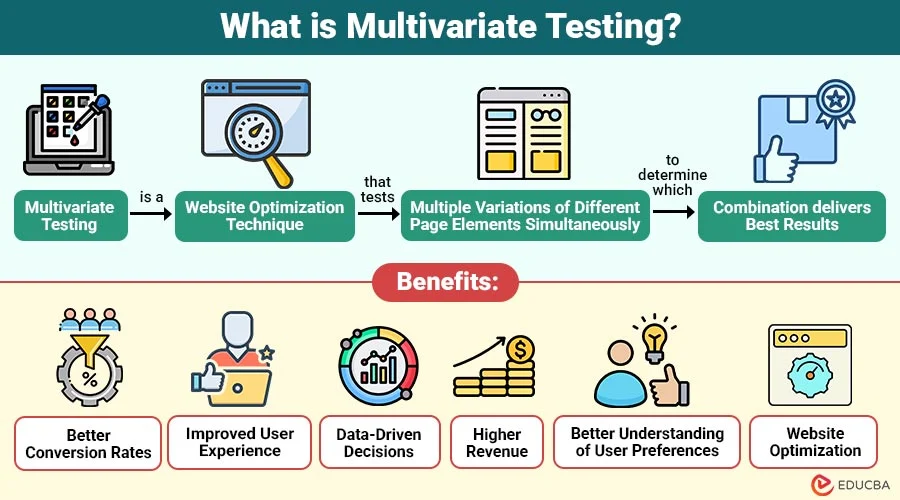
Multivariate testing (MVT) is a website optimization technique that tests multiple variations of different page elements simultaneously to determine which combination delivers best results. Instead of changing just one element, multivariate testing evaluates how headlines, images, buttons, layouts, colors, and other components interact.
For example, an e-commerce website may test two headlines, three product images, and two call-to-action (CTA) buttons simultaneously. The test identifies which combination generates the highest conversion rate.
Unlike A/B testing, which compaxres two complete versions of a webpage, multivariate testing examines several elements simultaneously to understand how each one influences user behavior.
Table of Contents:
- Meaning
- Importance
- Working
- Types
- Benefits
- Common Metrics
- Real-World Example
- Challenges
- Industries that Use Multivariate Testing
- Popular Tools
Key Takeaways:
- Multivariate testing evaluates multiple webpage elements simultaneously to identify the highest-performing combinations for improved conversions.
- Data-driven insights reduce guesswork, helping businesses optimize user experience and website performance through experimentation.
- Reliable results require sufficient website traffic, careful planning, and statistically significant data before implementation decisions.
- Continuous multivariate testing effectively supports long-term conversion optimization, increased engagement, and sustainable digital business growth.
Importance of Multivariate Testing
Multivariate testing plays an important role in conversion rate optimization (CRO) by helping businesses make data-driven decisions instead of relying on assumptions. Its importance includes the following:
1. Identifies Effective Element Combinations
Identifies the most effective combinations of webpage elements, improving overall performance through data-backed optimization and informed decision-making processes.
2. Improves Website Conversion Rates
Improves website conversion rates by identifying which design variations most consistently and successfully encourage visitors to complete desired actions.
3. Enhances User Experience
Enhances user experience through better design decisions, creating intuitive interfaces that satisfy visitors and encourage longer engagement on the website.
4. Reduces Guesswork
Reduces guesswork in digital marketing by replacing assumptions with measurable insights from real user behavior.
5. Optimizes Landing Pages and Sales Funnels
Helps optimize landing pages and sales funnels, ensuring every element contributes effectively toward higher conversions and improved performance.
6. Increases Customer Engagement
Increases customer engagement by identifying layouts, content, and design combinations that encourage meaningful interactions with website visitors consistently.
How Does Multivariate Testing Work?
Multivariate testing follows a structured process to analyze multiple webpage elements.
1. Define the Objective
Identify the goal of the experiment, such as increasing:
- Sales
- Newsletter sign-ups
- Downloads
- Form submissions
- Click-through rates
2. Select Page Elements
Choose elements that may influence user behavior, including:
- Headlines
- Images
- CTA buttons
- Product descriptions
- Forms
- Colors
- Navigation menus
3. Create Variations
Develop multiple versions of each selected element.
Example:
Headline:
- Version A
- Version B
Button:
- Green
- Blue
Image:
- Product image
- Lifestyle image
4. Generate Combinations
Testing software automatically creates every possible combination.
Example:
| Headline | Button | Image |
| A | Green | Product |
| A | Green | Lifestyle |
| A | Blue | Product |
| A | Blue | Lifestyle |
| B | Green | Product |
| B | Green | Lifestyle |
| B | Blue | Product |
| B | Blue | Lifestyle |
5. Split Website Traffic
Visitors are randomly shown different combinations.
6. Collect Performance Data
Metrics commonly measured include:
- Conversion rate
- Bounce rate
- Revenue
- Click-through rate
- Average session duration
- Form completion rate
7. Analyze Results
The winning combination becomes the preferred webpage version for future visitors.
Types of Multivariate Testing
Below are the main types of multivariate testing, each designed to optimize webpage performance based on testing goals and traffic availability:
1. Full Factorial Testing
Full factorial testing evaluates every possible combination of webpage variables to identify the highest-performing version and accurately measure interaction effects.
Best For: High-traffic websites
2. Fractional Factorial Testing
Fractional factorial testing analyzes selected combinations of variables rather than all possibilities, reducing traffic requirements while delivering reliable optimization insights efficiently.
Best For: Medium-sized businesses
3. Taguchi Method
The Taguchi method applies statistical techniques to identify impactful combinations of variables, minimizing experiments while maximizing optimization efficiency and test accuracy.
Best For: Large optimization projects
Benefits of Multivariate Testing
Organizations use multivariate testing because it offers numerous benefits.
1. Better Conversion Rates
Optimized webpage combinations increase visitor engagement, encouraging more users to complete purchases, registrations, downloads, or other desired actions.
2. Improved User Experience
Well-tested layouts improve usability, making webpages easier to navigate, understand, and interact with consistently across devices.
3. Data-Driven Decisions
Instead of relying solely on presumptions, beliefs, or personal preferences, businesses base their marketing strategies on actual consumer behavior.
4. Higher Revenue
Small improvements across multiple webpage elements increase conversions, generating greater sales, customer value, and overall business revenue.
5. Better Understanding of User Preferences
Testing reveals which content, layouts, and design combinations consistently attract audiences and drive stronger customer engagement.
6. Website Optimization
Multiple webpage elements are optimized simultaneously, effectively improving performance, usability, conversions, and overall visitor satisfaction across websites.
Common Metrics Used in Multivariate Testing
Several performance indicators help evaluate test success.
1. Conversion Rate
Measures percentage of visitors completing desired actions, indicating how effectively webpage variations achieve business objectives and conversions.
2. Click-Through Rate
Measures the percentage of users clicking links, buttons, or advertisements after viewing them, reflecting content effectiveness and engagement.
3. Bounce Rate
Indicates the quality of the user experience and the relevance of the information by calculating the percentage of visitors who depart a webpage without doing anything more.
4. Revenue Per Visitor
Calculates average revenue generated from each website visitor, helping evaluate the financial impact of webpage improvements.
5. Average Order Value
Measures average amount customers spend per transaction, showing how testing influences purchasing behavior and overall sales.
6. Time on Page
Tracks how long visitors remain on a webpage, indicating engagement levels and content effectiveness during their browsing experience.
7. Form Completion Rate
Measures the percentage of users successfully submitting forms, reflecting usability, clarity, and effectiveness of form design elements.
Real-World Example
The following scenario shows how multivariate testing compares multiple variations to find the best-performing webpage design.
An online clothing retailer wants to improve product page conversions.
They decide to test:
- Two headlines
- Two product images
- Two CTA button colors
This creates eight possible combinations.
After three weeks, the results show the following:
- Headline B
- Lifestyle product image
- Green CTA button
generate the highest conversion rate.
The retailer updates all product pages using this winning combination, resulting in higher sales and better customer engagement.
Challenges of Multivariate Testing
Despite its advantages, multivariate testing also has certain limitations.
1. Requires High Website Traffic
Testing multiple variable combinations requires substantial website traffic to achieve statistically reliable, meaningful optimization results.
2. Longer Testing Duration
More variations require additional time to collect sufficient data, delaying analysis and implementation of optimized webpage versions.
3. Complex Analysis
Interpreting relationships among multiple variables requires advanced analytical skills to accurately identify meaningful interactions and performance improvements.
4. Resource Intensive
Designing, implementing, and managing numerous webpage variations requires considerable time, effort, budget, and skilled team resources to be managed effectively.
5. Technical Implementation
Successful multivariate testing often requires advanced testing platforms, tracking systems, technical expertise, and proper website integration capabilities.
6. Risk of Inconclusive Results
Limited website traffic or insufficient data may produce inconclusive findings, reducing confidence in optimization decisions and outcomes.
Industries that Use Multivariate Testing
Many industries use multivariate testing to improve digital experiences.
1. E-Commerce
Optimizes product pages, checkout flows, pricing displays, and promotional banners to increase conversions and revenue.
2. Software as a Service (SaaS)
Tests landing pages, pricing tables, free trial forms, and onboarding experiences to generate qualified leads.
3. Banking and Financial Services
Improves online application forms, account opening pages, loan calculators, and customer engagement through optimized interfaces.
4. Healthcare
Enhances appointment-booking systems, patient portals, healthcare information pages, and service inquiries to improve usability.
5. Education
Optimizes course pages, enrollment forms, webinar registrations, and educational content to improve student conversions.
6. Travel and Hospitality
Test hotel listings, booking pages, travel packages, destination images, and promotional offers to maximize reservations.
Popular Multivariate Testing Tools
Some widely used tools include:
1. Optimizely
A platform for digital experimentation that helps companies optimize customer experiences across websites and do multivariate testing.
2. Visual Website Optimizer
A conversion optimization platform offering multivariate testing, A/B testing, visitor insights, and personalization to improve website performance.
3. Adobe Target
An advanced personalization and testing solution that delivers multivariate experiments to optimize digital customer experiences and conversions.
4. AB Tasty
A digital experience optimization platform providing multivariate testing, personalization, and feature experimentation for improved user engagement.
5. Convert Experiences
A privacy-focused experimentation platform supporting multivariate testing, A/B testing, and personalization to enhance website conversion rates.
Final Thoughts
Multivariate testing is a powerful conversion rate optimization technique that evaluates multiple webpage elements simultaneously to discover the most effective combinations. By analyzing how headlines, images, buttons, layouts, and other components work together, businesses can make informed decisions that improve user experience, increase engagement, and boost conversions. Although it requires sufficient website traffic and careful analysis, multivariate testing provides deeper insights than simple page comparisons, making it an essential strategy for organizations seeking continuous digital optimization and long-term business growth.
Frequently Asked Questions (FAQs)
Q1. When should you choose multivariate testing instead of A/B testing?
Answer: Choose multivariate testing when you want to evaluate how multiple webpage elements interact simultaneously. If you only need to compare one major change, A/B testing is usually the better option.
Q2. How much website traffic is typically needed for multivariate testing?
Answer: There is no fixed requirement, but websites with thousands of visitors per month generally achieve more reliable results because each variation needs enough data for statistical significance.
Q3. Can multivariate testing be performed on mobile websites?
Answer: Yes. Businesses frequently run multivariate tests on mobile websites and responsive pages to optimize layouts, navigation, buttons, and user interactions across different devices.
Q4. How long should a multivariate test run?
Answer: The ideal duration depends on website traffic, the number of variations, and conversion volume. Most tests continue until sufficient data is collected to produce statistically reliable results.
Recommended Articles
We hope that this EDUCBA information on “Multivariate Testing” was beneficial to you. You can view EDUCBA’s recommended articles for more information.


