


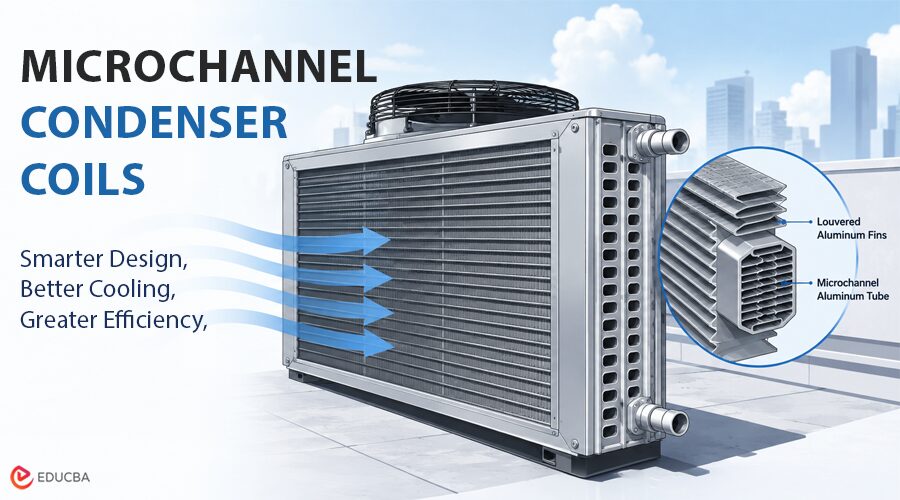
Heat exchangers do not get much love in engineering classrooms, but they sit at the center of nearly every cooling system you will touch in industry. If you are studying HVAC-R, mechanical engineering, or thermal systems, understanding microchannel condenser coils is essential, as small improvements in condenser design can yield significant gains in system efficiency. Today, microchannel technology has quietly become the standard worth knowing. It shows up in chillers, rooftop units, transport refrigeration, and data center cooling. This guide explains how they work, why they matter, and the technical skills engineers should develop to work with them effectively.
What Are Microchannel Condenser Coils?
In any vapor-compression cycle, the condenser is the component that rejects heat. Refrigerant enters as a high-pressure, high-temperature vapor and, as it passes through the coil, gives up heat to the surrounding air or water, condensing into a liquid. That liquid then heads to the expansion valve and on through the rest of the loop. The condenser’s job sounds simple, but the geometry of how refrigerant and air meet inside the coil decides how efficient the whole system will be.
Why Microchannel Condenser Coils Are Becoming the Industry Standard?
Traditional condenser coils use round copper tubes mechanically bonded to aluminum fins. They work, and they have worked for decades. But they carry a lot of refrigerant, are heavy, and lose efficiency at the tube-to-fin junction. Microchannel coils flip the design. Flat aluminum tubes contain dozens of tiny parallel ports, brazed directly to louvered aluminum fins. The result is a single-metal, all-aluminum slab that exchanges heat more efficiently per unit of volume. A few practical advantages stand out:
- Smaller refrigerant charge. The narrow ports hold far less refrigerant than round copper tubing, which matters for cost, leak risk, and environmental regulations on high-GWP refrigerants.
- Lower air-side pressure drop. Louvered fins and a thinner profile allow fans to move air with less resistance, reducing fan energy use.
- Reduced weight. An all-aluminum coil is lighter than copper-aluminum equivalents, which helps with rooftop units and other transport applications.
- Better corrosion behavior. Single-metal construction avoids the galvanic corrosion that can attack copper-aluminum joints in coastal or industrial atmospheres.
For applications where every watt of compressor and fan power costs money, those four points add up to real operating savings.
Where You Will See Them in the Field?
Microchannel condensers appear in a wide range of equipment. Water-cooled and air-cooled chillers are used in commercial buildings. So do industrial process cooling systems, refrigerated warehouses, truck and trailer transport refrigeration, and the dry coolers that reject heat from data center loops.
Domestic manufacturers like CS Coil supply OEMs and replacement markets across these segments, giving engineering students a sense of the scale at which this technology operates. Knowing how to spec, install, or troubleshoot one is a transferable skill.
Skills Every HVAC-R Engineer Should Develop
If condenser technology interests you, a few areas of capability will pay off over the course of a career. None of them is taught fully in any single course, which is why self-directed learning matters:
- Thermodynamics fluency. Get comfortable reading pressure-enthalpy diagrams and calculating subcooling, superheat, and approach temperature without hesitation.
- Heat transfer modeling. Learn how to estimate UA values, log mean temperature difference, and the trade-offs between fin density and air-side fouling.
- CFD basics. Even a working knowledge of how engineers simulate airflow through louvered fins helps you read manufacturer data sheets critically.
- Refrigerant regulation literacy. Phase-downs of high-GWP refrigerants are reshaping equipment design. The U.S. EPA provides a useful overview of the AIM Act worth bookmarking.
- Corrosion engineering. Coatings, alloys, and environmental exposure decide how long a coil lasts. Industry groups publish guidance on coil protection in harsh atmospheres that is worth reading early in your career.
Career Opportunities in HVAC-R
HVAC-R is not a glamorous specialization, but it is a durable one. Buildings need cooling, supply chains need refrigeration, and data centers need heat rejection at a scale that continues to grow. Labor market data shows steady demand for HVAC technicians and related roles, and the engineering side of the field follows similar trends as efficiency standards tighten. If you are picking electives or short courses, weight your choices toward thermal systems, controls, and materials. Pair that with hands-on exposure to real equipment whenever you can. The engineers who understand both the math and the metal are the ones who end up specifying the systems everyone else installs.
Final Thoughts
As HVAC systems continue evolving toward higher efficiency and lower environmental impact, microchannel condenser coils have become one of the most important advancements in heat exchanger technology. Their lightweight construction, improved heat transfer, reduced refrigerant charge, and excellent corrosion resistance make them an ideal solution across a wide range of cooling applications. For students and early-career HVAC-R engineers, understanding microchannel condenser coils is more than an academic exercise—it is a practical skill that supports better system design, improved troubleshooting, and stronger career prospects in the rapidly growing HVAC industry.
Recommended Articles
We hope this article has enhanced your understanding of microchannel condenser coils and their growing importance in modern cooling systems. Continue exploring the recommended articles below for more tips and industry insights.

