


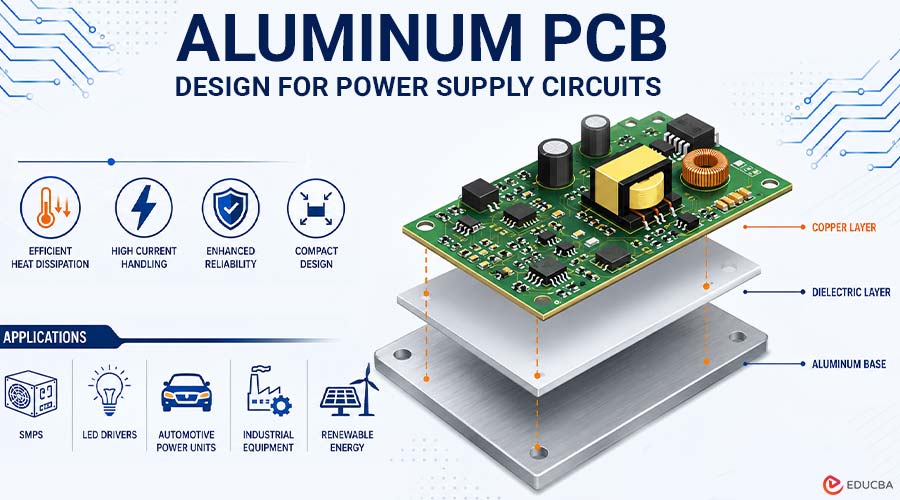
Power supply circuits form the foundation for all electronic systems, including consumer electronics, industrial hardware, and automotive systems. The design process now requires designers to address two main challenges: modern electronics demand products that use less energy and take up less space while producing more energy. FR4-based PCBs, which rely on traditional methods, fail because they cannot withstand the thermal stress of operating at maximum load. Aluminum PCB board design has become necessary because it uses a metal core to improve heat dissipation, enhance durability, and deliver reliable performance under extreme power conditions.
The growing need for aluminum core PCB applications has made this technology a common choice for use in LED drivers and switch-mode power supplies, automotive power modules, and industrial converters. The article provides an overview of aluminum PCB design, covering power supply circuit design, material selection, structural design, thermal performance, design techniques, and practical applications across various scenarios.
What is an Aluminum PCB in Power Supply Circuits?
An aluminum PCB used in a power supply circuit is a metal-core PCB that can effectively carry large currents and dissipate heat. The system is comprised of three major components:
- The copper circuit layer acts as the electrical pathway that carries current through the system.
- The dielectric insulating layer functions as a barrier that separates electrical components while enabling heat transfer.
- The aluminum base layer serves two purposes: it functions as a heat sink and provides structural stability to the system.
The design enables effective heat removal from the system, thereby protecting its electrical components and making it suitable for power-supply applications.
Importance of Aluminum PCBs in Power Supply Design
Power supply circuits produce heat as a result of their constant process of voltage transformation and current transmission. Improper heat management results in three major issues:
- Reduced efficiency
- Component failure
- Voltage instability
- Shortened product lifespan
Aluminum PCBs solve these issues by:
- Enhancing thermal transfer performance
- Doosting the ability to transmit electric power
- Decreasing the requirement for additional thermal management equipment
- Boosting the complete system dependability
Structure of Aluminum PCB for Power Supply Circuits:
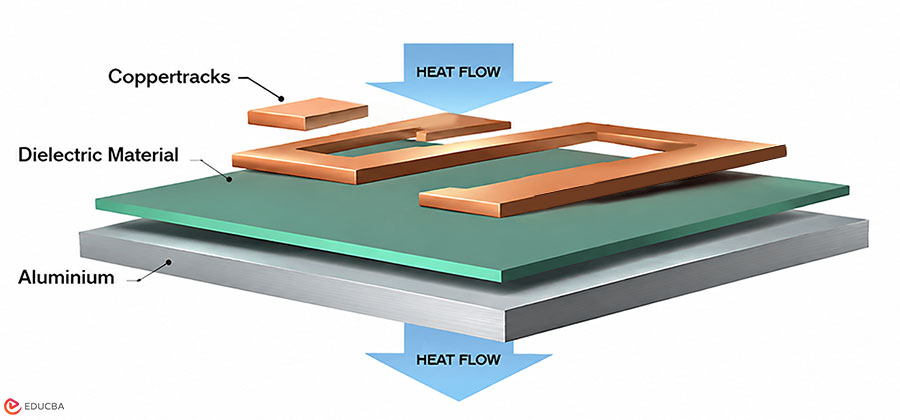
| Layer | Material | Function |
| Top Layer | Copper | Electrical conduction |
| Middle Layer | Dielectric material | Electrical insulation + heat transfer |
| Bottom Layer | Aluminum base | Heat dissipation + mechanical support |
Design Considerations for Power Supply Aluminum PCBs
Proper Aluminum PCB design is critical for achieving optimal performance in power supply systems.
1. Thermal Management Design
Power supply circuits require their thermal performance to reach optimal levels. Designers achieve effective heat transfer from circuits by selecting dielectric materials that provide high thermal conductivity between circuit components and the aluminum backing. Thermal resistance paths need to be minimized through proper component placement, which should include all heat-generating elements, to prevent overheating.
2. High Current Handling Design
Engineers use wide copper traces and thicker copper to create circuits that can handle high-current loads. Engineers create short direct-current paths, which reduce both resistance and voltage drop, thereby enhancing system efficiency and stability.
3. Layout Optimization
The efficient layout design creates distinct sections for high-power and control functions, which helps to minimize system interference. The system maintains stable operation through compact routing and balanced current distribution, thereby reducing energy waste.
4. Component Placement Strategy
The design team positions heat-generating components close to thermal zones, which improves heat dissipation. The design uses equal spacing between elements to prevent hotspot formation while achieving consistent operational results.
Materials Used in Aluminum PCB Power Supply Design
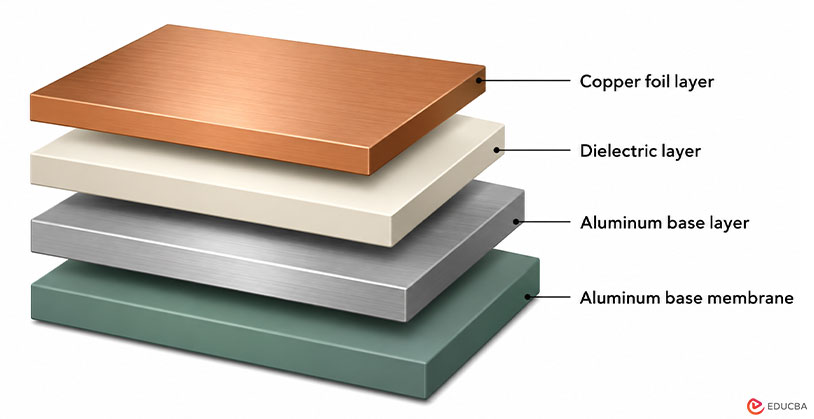
1. Copper Layer
Copper serves as the main conductive material, which allows for effective current flow and signal propagation, and it also dissipates heat throughout the PCB.
2. Dielectric Layer
The dielectric layer plays a important role in thermal management by insulating electrical components, transferring heat to the aluminum base, and ensuring secure layer connections.
3. Aluminum Base
As a heat sink, the aluminum base efficiently dissipates heat from high-power components to improve thermal efficiency and reliability.
4. Thermal Conductivity Comparison
| Material | Thermal Conductivity | Application Role |
| Epoxy Dielectric | Low | Basic insulation |
| Ceramic-Filled Dielectric | Medium to high | High-power circuits |
| Copper Layer | Very high | Electrical + thermal spread |
| Aluminum Base | High | Heat dissipation core |
Manufacturing Process of Aluminum PCBs
1. Material Selection
The first step in the process requires selecting a PCB material that meets power rating, thermal load, and environmental conditions. Designers select high-quality aluminum cores, dielectric layers, and copper foils to create a product that remains durable while achieving effective heat dissipation.
2. Circuit Patterning
Photolithography transfers the circuit design to the copper layer with high precision. Chemical etching removes excess copper to create the conductive pathways that power-supply circuits require.
3. Lamination Process
The copper layer, dielectric material, and aluminum base bond together through a process that applies controlled heat and pressure. This procedure establishes a solid, unified structure that maintains both mechanical strength and effective thermal transfer.
4. Drilling and Finishing
The team drills holes that allow for both component mounting and electrical connections. The team applies surface finishing to the product, which results in improved solderability, copper protection, and enhanced durability.
5. Quality Control and Testing
Each PCB undergoes a testing process that includes thermal cycling, electrical continuity testing, high-voltage insulation testing, and full-load performance testing, ensuring reliability and safety for high-power applications.
Advantages of Aluminum PCB in Power Supply Circuits
1. Superior Heat Dissipation
Aluminum PCBs conduct heat very well, allowing power components to dissipate heat generated by the aluminum base. This mechanism helps provide continuous operation without overheating and provides stable circuit functions.
2. High Efficiency
Aluminum PCBs reduce thermal resistance, thereby lowering energy consumption across power supply circuits. Proper heat control keeps the system performing at its most efficient, and therefore, the system as a whole is more efficient.
3. Compact Design
The inbuilt heat dissipation feature minimizes or even eliminates the necessity for large heat sinks and cooling systems. This capability allows designers to make power supply units with lower space requirements.
4. Enhanced Reliability
Reducing operating temperature reduces thermal stress on electronic components, resulting in longer equipment life and fewer failures. This makes aluminum PCBs an excellent choice for applications where reliability is a concern.
5. Better Load Handling
Aluminum PCBs handle high-current and high-voltage applications because their robust design and effective thermal management system support demanding power system requirements.
Applications in Power Supply Systems
1. Switch-Mode Power Supplies (SMPS)
The SMPS circuits that power adapters, chargers, and industrial converters use aluminum PCBs as their standard material. The system achieves effective energy conversion by processing both high switching frequencies and thermal loads while maintaining dependable system performance.
2. LED Driver Circuits
The use of aluminum PCBs in LED drivers enables constant-current control and efficient heat management, resulting in stable light output and prolonged system operation time.
3. Automotive Power Units
The automotive sector uses aluminum PCBs in electric vehicle EV chargers and control modules, and battery systems because of their ability to withstand vibrations and provide thermal management and durability across different operating conditions.
4. Industrial Power Systems
Aluminum PCBs are used in industrial equipment such as motor drives and heavy-duty control systems, where they handle high power loads and maintain operational stability and long-lasting performance in challenging environments.
5. Renewable Energy System
Aluminum PCBs are used in solar inverters and wind power controllers to enable continuous energy conversion while managing heat, thereby maintaining system operational efficiency and dependable performance.
Future Trends in Aluminum PCB Power Supply Design
1. AI-Based Thermal Simulation and Optimization
Power supply circuits use AI tools to predict heat distribution and optimize layouts, thereby improving thermal performance.
2. Ultra-Thin High-Power PCB Structures
Thinner board development enables designers to create compact products while maintaining power-handling capacity.
3. Graphene-Enhanced Dielectric Materials
Graphene and other advanced materials enable higher thermal conductivity, resulting in faster heat dissipation.
4. Hybrid Metal-Core PCB Systems
The practice of combining various metal cores improves thermal and mechanical properties.
5. Smart Power Monitoring Integration
Sensor installation allows users to track temperature, voltage, and current levels without interruption. The upcoming design innovations will achieve better efficiency and reliability while decreasing system dimensions.
Final Thoughts
The aluminum PCB board design is a critical component in today’s power supply circuits, providing outstanding thermal management, high current-carrying capability, and system reliability. It has a metal core structure that effectively dissipates heat from the heat-sensitive part, so it will not overheat under continuous high-power use and can operate under normal power conditions. This renders the aluminum PCBs extremely well-suited for applications requiring efficiency, safety, and long service life.
The ongoing development of aluminum PCBs, with improved efficiency, smaller size, and higher power density, will make them an essential element of future technological advancements. The materials can be utilized across different industrial sectors because they serve various applications in automotive systems, renewable energy systems, industrial equipment, and consumer electronics. Advanced power supply designs should use aluminum PCB technology because it improves thermal efficiency and reliability, and yields better results when combined with experienced PCB manufacturers.
Recommended Articles
We hope this guide on Aluminum PCB design helps you understand its role in improving thermal performance and power supply efficiency. Check out these recommended articles for more such topics.

