


What is a Management Consultant?
A management consultant is a professional who advises organizations on improving performance, solving business problems, and implementing strategies for growth. They help businesses of all sizes, from small startups to big multinational companies, across industries such as finance, healthcare, IT, manufacturing, and retail.
Management consultants bring an external, objective perspective to an organization, allowing them to identify inefficiencies, uncover opportunities, and recommend solutions that internal teams may overlook. Their role is not limited to providing advice; they often play a critical part in executing strategies, guiding change management, and ensuring measurable results.
Table of Contents
- Meaning
- Roles and Responsibilities
- Types
- Skills Required
- Benefits of Hiring
- Career Path
- Education & Certification
Roles and Responsibilities of a Management Consultant
Management consultants perform multiple responsibilities that vary based on client needs. Some of the key roles include:
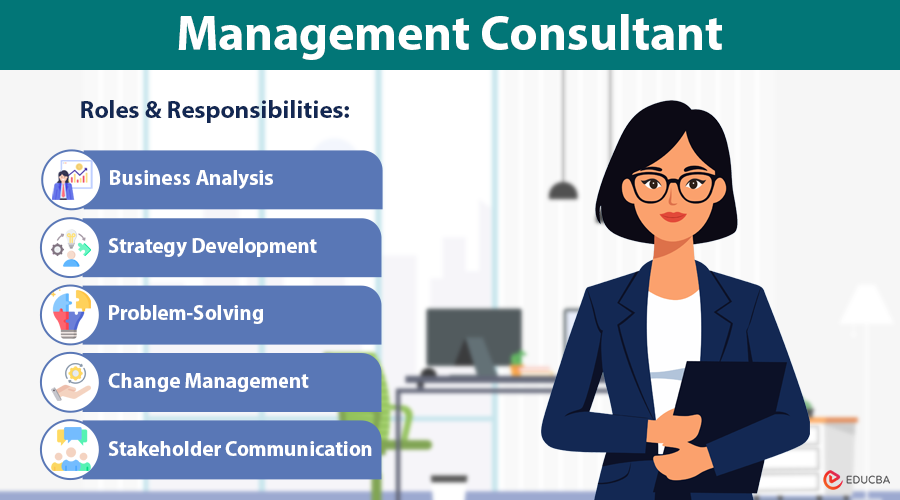
- Business analysis: Consultants examine a company’s operations, processes, and structure to understand its strengths and weaknesses. They analyze data to find ways to improve.
- Strategy development: They help organizations develop growth strategies, market entry plans, cost-reduction programs, and competitive strategies.
- Problem-solving: Consultants provide innovative solutions to complex business problems, helping companies navigate challenges efficiently.
- Change management: Management consultants support organizations in implementing changes, ensuring minimal disruption and maximum adoption.
- Stakeholder communication: They act as a bridge between leadership and employees, ensuring smooth communication of strategies, goals, and updates.
- Market and industry research: Consultants conduct in-depth research on industry trends, customer behavior, and competitor performance to provide actionable insights.
- Performance monitoring: They help organizations track the success of implemented strategies using KPIs and performance metrics, ensuring continuous improvement.
Types of Management Consultants
Management consulting is a broad field, and consultants often specialize in specific domains:
- Strategy Consultants: Focus on long-term planning, business growth, mergers and acquisitions, and entering new markets. They help organizations identify opportunities to gain a competitive edge.
- Operations Consultants: Aim to improve operational efficiency, reduce costs, streamline workflows, and optimize supply chains.
- Financial Consultants: Provide financial planning, risk management, budgeting, cost analysis, and investment strategies to enhance profitability.
- Human Resources Consultants: Advise on workforce planning, talent management, employee engagement, HR policies, and organizational culture.
- IT and Technology Consultants: Offer solutions related to digital transformation, IT systems implementation, cybersecurity, and emerging technologies.
- Marketing Consultants: Help businesses develop marketing strategies, branding, customer acquisition, and retention programs.
- Sustainability and ESG Consultants: Assist companies in implementing environmentally responsible practices and meeting sustainability goals.
Skills Required to Become a Management Consultant
A successful management consultant must have a combination of analytical, technical, and interpersonal skills:
- Analytical thinking: Ability to process complex data, identify patterns, and make informed recommendations.
- Problem-solving skills: Creativity and logic to devise innovative and practical solutions for business challenges.
- Communication skills: Good speaking and writing skills are important for sharing results and convincing others.
- Project management: Ability to manage multiple projects, resources, deadlines, and teams efficiently.
- Industry knowledge: Deep understanding of the client’s sector and awareness of emerging market trends.
- Adaptability: Quick adjustment to evolving business environments and client expectations.
- Leadership and collaboration: Capability to guide teams, mentor junior consultants, and foster a collaborative work environment.
- Technical proficiency: Knowledge of analytics tools, software, and emerging technologies is increasingly important in consulting today.
Benefits of Hiring a Management Consultant
Organizations hire management consultants for their expertise, experience, and unbiased perspective. Key benefits include:
- Expert advice: Consultants provide knowledge and best practices accumulated from multiple industries and projects.
- Objective perspective: They offer unbiased evaluations of organizational problems without internal politics influencing recommendations.
- Efficiency improvement: By streamlining processes, consultants reduce operational costs, optimize resources, and improve productivity.
- Enhanced decision-making: They provide data-backed insights to help executives make informed decisions.
- Innovation: Consultants bring fresh ideas and approaches that foster creativity and innovation.
- Risk mitigation: They identify potential risks, anticipate challenges, and propose strategies to minimize impact.
- Accelerated growth: With expert guidance, organizations can implement changes faster and achieve their business goals more effectively.
Career Path of a Management Consultant
A career in management consulting is rewarding, offering exposure to diverse industries and business challenges. Typical career progression includes:
1. Analyst / Associate (Entry-Level)
Entry-level professionals focus on research, data collection, and basic analysis. They support senior consultants by preparing reports, conducting interviews, and assisting in problem-solving tasks.
2. Consultant / Senior Consultant
With a few years of experience, consultants take on more responsibility, leading client projects, conducting in-depth analyses, and developing strategic recommendations. They begin to manage client relationships and mentor junior team members.
3. Manager / Project Leader
Managers oversee multiple projects, ensuring timely delivery and quality. They manage client expectations, coordinate teams, and ensure the financial performance of their projects.
4. Associate Principal / Junior Partner
At this level, professionals take on leadership roles, developing new business opportunities, managing large client accounts, and contributing to the firm’s strategic direction.
5. Senior Partner / Director
Senior partners are responsible for the overall success of the firm, including strategic planning, client acquisition, and organizational growth. They play a key role in shaping the firm’s culture and direction.
Education & Certification
- A bachelor’s degree in business, finance, economics, or related fields is essential.
- An MBA or professional certifications like PMP, CMC, Lean Six Sigma, or CFA enhance career prospects and credibility.
- Continuous learning and specialization in emerging areas like digital transformation, AI consulting, and sustainability can open advanced opportunities.
Final Thoughts
Management consultants help businesses grow, fix problems, and work more efficiently. They bring external expertise, unbiased insights, and strategic thinking to organizations, enabling them to achieve goals faster and more effectively.
Whether you are looking to hire a management consultant to drive business transformation or pursue a career in this dynamic field, understanding the roles, types, skills, and benefits of management consulting is essential for long-term success.
Frequently Asked Questions (FAQs)
Q1. How do management consultants differ from business analysts?
Answer: While both focus on improving business performance, management consultants provide strategic, organization-wide advice, whereas business analysts typically focus on specific processes, systems, or operational improvements within departments.
Q2. What industries hire management consultants the most?
Answer: Management consultants are in demand across multiple sectors, including financial services, healthcare, information technology, manufacturing, energy, government, and consumer goods. Consulting firms often have industry-specific teams to serve specialized clients.
Q3. How do management consultants maintain confidentiality?
Answer: Consultants adhere to strict confidentiality agreements and professional ethics, ensuring sensitive company information, trade secrets, and data are not disclosed or misused.
Q4. What tools and software do management consultants use?
Answer: Consultants commonly use tools like Microsoft Excel, Power BI, Tableau, Google Analytics, Asana, Trello, and CRM systems. Advanced consultants also use AI-driven analytics, visualization, and automation tools.
Q5. Is management consulting a good career for fresh graduates?
Answer: Yes. It offers exposure to diverse industries, continuous learning, and accelerated professional growth. However, it demands strong analytical skills, adaptability, and a willingness to handle high-pressure environments.
Recommended Articles
We hope this comprehensive guide on management consulting has helped you understand what management consultants do, their roles, skills, and career paths. Explore our other detailed articles on related business and career topics to enhance your professional knowledge and growth.

