

Updated May 5, 2023
Difference Between Machine Learning vs Neural Network
Machine Learning is an application or the subfield of artificial intelligence (AI). Machine Learning enables a system to learn and progress from experience without being explicitly programmed automatically. Machine Learning is a continuously developing practice. Machine learning aims to understand the structure of data and fit that data into models; these models can be understood and used by people. In Machine Learning, generally, the tasks are classified into broad categories. These categories explain how learning is received; two of the most widely used machine learning methods are supervised and unsupervised.
The structure of the brain inspires the neural network. The neural network contains highly interconnected entities called units or nodes. Neural networks are deep learning technologies. It generally focuses on solving complex processes. A typical neural network is a group of algorithms that model the data using neurons for machine learning.
Head-to-Head Comparison Between Machine Learning vs Neural Network (Infographics)
Below are the top 5 comparisons between Machine Learning vs Neural Network:
Key Differences Between Machine Learning vs Neural Network
Below are the lists of points that describe the key Differences Between Machine Learning vs Neural Network:
- As discussed above, machine learning is a set of algorithms that parse data and learn from the data to make informed decisions, whereas neural network is one such group of algorithms for machine learning.
- Neural networks are deep learning models; deep learning models are designed to analyze data with a logical structure like humans frequently would conclude. It is a subset of machine learning.
- Machine learning models follow the function learned from the data, but it still needs some guidance. For example, suppose a machine learning algorithm gives an inaccurate outcome or prediction. In that case, an engineer will step in and make some adjustments, whereas, in the artificial neural network models, the algorithms are capable enough to determine on their own whether the predictions/outcomes are accurate.
- Neural network structures/arrange algorithms in layers of fashion that can learn and make intelligent decisions on its own. In Machine learning, the decisions are based only on what it has learned.
- Machine learning models/methods or learnings can be of two types supervised and unsupervised learning. In the neural network, we have a feedforward neural network, Radial basis, Kohonen, Recurrent, Convolutional, and Modular neural networks.
- Supervised learning and Unsupervised learning are machine learning tasks.
- Supervised learning is simply a process of learning algorithms from the training dataset. Supervised learning is where you have input variables and an output variable, and you use an algorithm to learn the mapping function from the input to the output. The aim is to approximate the mapping function so that when we have new input data, we can predict the output variables for that data.
- Unsupervised learning is modeling the underlying or hidden structure or distribution of the data to learn more about the data. Unsupervised learning is where you only have input data and no corresponding output variables.
- The neural network passes data through interconnected layers of nodes, classifies characteristics and information of a layer, and then passes the results on to other nodes in subsequent layers. The difference between neural networks and deep learning lies only in the number of network layers. A typical neural network may have two to three layers; a deep learning network might have dozens or hundreds.
- In machine learning, one can apply several algorithms to any data problem. These techniques include regression, k-means clustering, logistic regression, decision trees, etc.
- Architecturally, an artificial neural network is exhibited with layers of artificial neurons, also called computational units, able to take input and apply an activation function along with a threshold to determine if messages are passed.
- The simple model of a neural network contains: The first layer is the input layer, followed by one hidden layer, and lastly by an output layer. Each of these layers can have one or more neurons. Models can become more complex, with increased problem-solving and abstraction capabilities, by increasing the number of hidden layers and the number of neurons in a given layer.
- There are supervised and unsupervised models using neural networks; the most generally known is the feedforward neural network, which architecture is a connected and directed graph of neurons with no cycles trained using the backpropagation algorithm.
- Machine learning, learning systems are adaptive and constantly evolving from new examples to determine the patterns in the data. For both, data is the input layer. Both acquire knowledge through analysis of previous behaviors or/and experimental data, whereas in a neural network, the learning is deeper than machine learning.
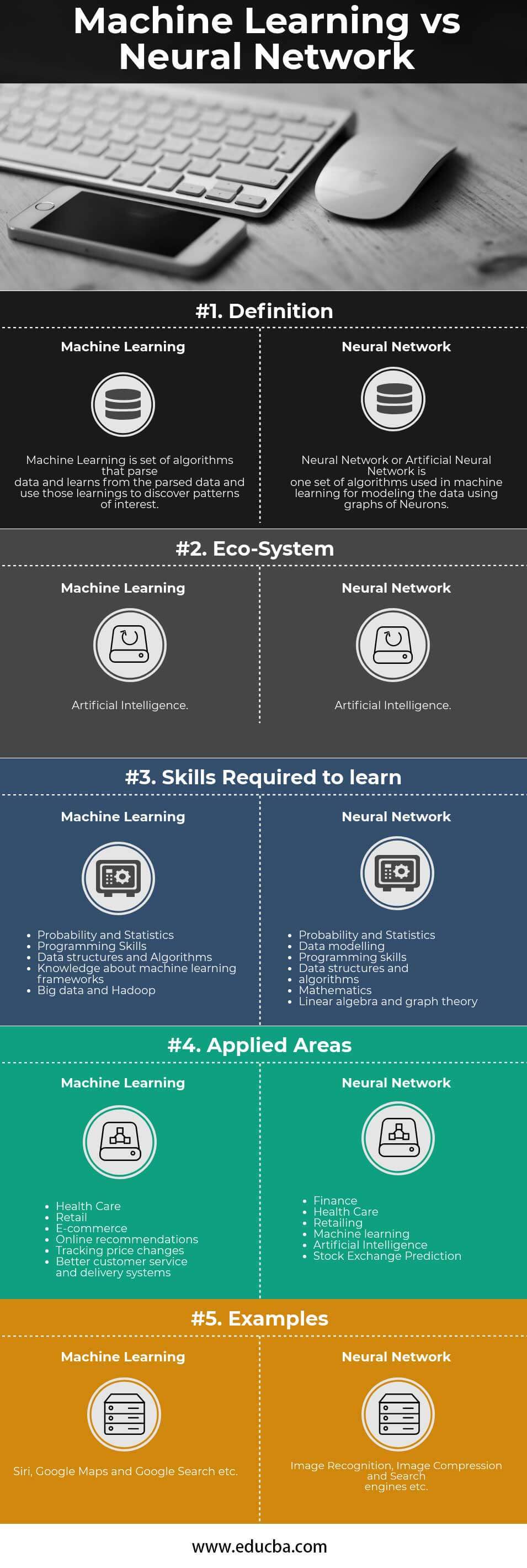
Machine Learning vs Neural Network Comparison Table
Below is the 5 topmost comparison between Machine Learning vs Neural Network.
| Basis of Comparison | Machine Learning | Neural Network |
| Definition | Machine Learning is a set of algorithms that parse data, learn from the parsed data, and use those learnings to discover patterns of interest. | Machine learning uses neural networks or artificial neural networks as one set of algorithms for modeling data by creating graphs of neurons. |
| Eco-System | Artificial Intelligence. | Artificial Intelligence. |
|
Skills Required to Learn
|
|
|
| Applied Areas
|
|
|
| Examples | Siri, Google Maps and Google Search, etc. | Image Recognition, Image Compression, Search Engines, etc. |
Conclusion
It falls under the same field of Artificial Intelligence, wherein Neural Network is a subfield of Machine Learning; Machine learning serves mainly from what it has learned, wherein neural networks are deep learning that artificially powers the most human-like intelligence. We can conclude by saying that neural networks or deep learnings are the next evolution of machine learning. It explains how a machine can make its own decision accurately without the programmer telling them so.
Recommended Articles
This has been a guide to the top difference between Machine Learning vs Neural Network. Here we have discussed Machine Learning vs Neural Network head-to-head comparison, key differences, infographics, and comparison table. You may also have a look at the following articles to learn more –

