


How to Structure Articles for LLM Content Structuring?
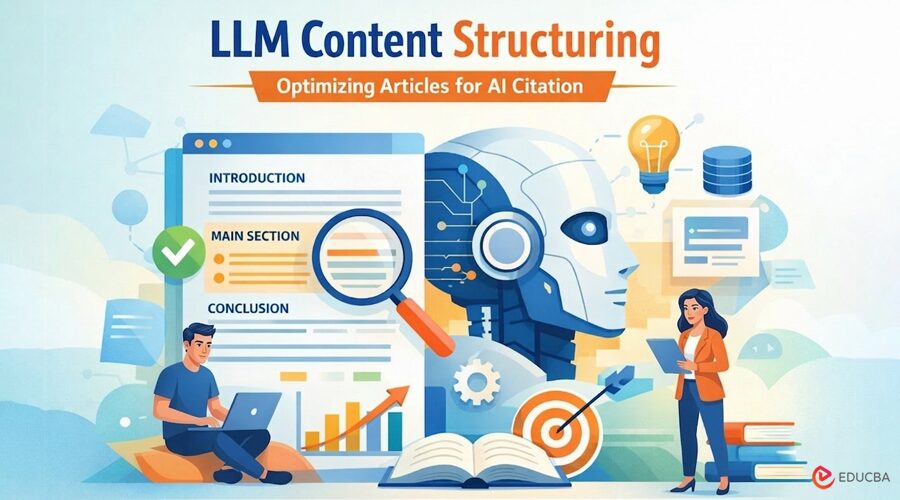
The structure of articles has always played a role in determining how they are discovered, read, and distributed throughout the web. Historically, writers directed digital content primarily toward human readers and search engine crawlers. Nowadays, there is an additional layer of interpretation when large language models (LLMs) are used to analyze web content to produce answers, summaries, and references. These systems are based on trends in written content to identify what information can be trusted and used. Proper LLM Content Structuring determines whether an AI system includes an article as a source.
Writers and publishers must ensure clarity, organization, and consistency to have their content cited in AI-generated responses. LLMs do not simply scan keywords; they assess the connections between topics, statements, and supporting context in a piece of content. Articles with ideas presented in a clear, logical sequence are easier for AI systems to interpret and cite. Using LLM Content Structuring makes your articles more likely to be cited by AI.
Clear Topic Definition
The articles frequently cited by language models start with a well-developed topic. Human readers and automated systems can recognize the article’s primary aim regarding its subject, which is clear from the start. The article’s foundation is a straightforward introduction that clarifies the topic and its significance. This helps eliminate uncertainty and enables AI systems to correctly classify information.
The specific subject matter will also avoid confusion in the article. In case a writing piece transfers to irrelevant concepts, language models might not be able to define what information is the focus of the paper. The focus is well maintained, thus enabling the article to serve as a credible reference. When language models respond to content, they search through passages that closely match a given query. A clear topic is more likely to find part of the article relevant to a user query.
Logical Section Organization
How writers arrange sections in an article greatly influences how readers interpret the information. Logical progression helps big language models understand the relationship between different sections of the content. The outline is easier for readers and artificial intelligence to follow because it has a logical progression: the explanation comes first, followed by the application or general ideas to particular details.
Clearly defined headings are also indicators that help language models more clearly define the intention of each section. A clear heading that represents the paragraph’s content provides a brief outline of its thoughts. This helps AI systems quickly identify the locations of major explanations or definitions in the article. Properly structuring sections helps AI systems choose paragraphs as references in their responses.
Consistent Information Hierarchy
Language models identify which sections of an article contain primary information and which provide supporting context by analyzing patterns. It is possible to create a regular hierarchy of an article that explains this difference. The main ideas are supposed to be used at the beginning of the sections, with their elaboration provided in the form of supporting explanations. This form of presentation enables the models to quickly detect the main message.
The consistency of the sections also enhances the article’s interpretability. The language models will find it easier to extract structured knowledge from information presented in a similar format across sections. Modern LLM SEO trends favor articles that present information clearly and logically rather than merely targeting keywords. A clear order highlights the most crucial statements, making them easy to reference.
Use of Clear Explanatory Language
Language models do not just match the number of keywords; they also capture the meaning of the sentence. These systems readily understand articles written in simple, straightforward language. In the absence of unimportant complexity in the explanations, the connection between ideas becomes more visible. This is clear enough to enable models to detect factual statements, definitions, and conclusions that come in handy when formulating responses.
Excessively complicated wording can confuse, reducing the chances of being referenced. In case the meaning of sentences is hard to understand or they include a vague reference, language models might fail to define it. Keep wording simple and make important information stand out in the text. Consequently, Proper LLM Content Structuring emphasizes clarity in language to maximize AI discoverability.
Inclusion of Contextual Information
Context provides language models with an overview of how individual statements relate to overall topics. Articles that include short explanations of the main aspects are also useful background material, making them credible sources. Efficient articles relate every statement to a larger idea or argument rather than stating isolated facts.
Another way AI systems can identify when a piece of information is important to a specific question is through context. For example, when a paragraph describes a concept and its relevance, language models can more accurately match user requests. When an artificial intelligence system produces an elaborate answer, it is more likely to select passages that are well-supported by information and context.
Maintaining Credible and Informative Content
The issues of accuracy and reliability are critical to the content that language models can mention. Language models more commonly refer to articles that provide well-established knowledge. Explanations are clear, thoughtful, and balanced, which contribute to an article’s credibility.
Stability in tone and the quality of information in the article are also significant. As long as all the parts have the same degree of clarity and depth, the whole article will be a reliable source. Large language models prefer sources that present information in a consistent, coherent manner. With a combination of clarity and trust in content, authors are more likely to have their articles quoted in AI-generated responses.
Recommended Articles
We hope this guide on LLM Content Structuring helps you create articles that are clear, organized, and more likely to be cited by AI systems. Explore the recommended articles below for more tips on writing AI-ready content, improving article structure, and enhancing online visibility.

