



Start Coding with Learning Python
Learning to code was something only engineers or computer science students attempted. Today, coding has become a practical skill for anyone: students, working professionals, career-switchers, analysts, teachers, entrepreneurs, and even hobby learners. The first question every new learner asks is: “Where do I start?” With so many programming languages Java, C++, JavaScript, Ruby it is easy to feel overwhelmed. According to the PYPL Index and TIOBE Index, Python is the leading programming language in 2025. Whether your goal is understanding basic coding principles or building practical projects, learning Python is often the recommended first step and for good reason.
Table of Contents
- Introduction
- Why Python is the Best Language for Beginners
- What Makes Python Easy to Learn?
- How Learning Python Applies to Real-World Use Cases?
- Benefits of Learning Python Early in Your Coding Journey
- Python vs. Other Beginner Languages
- Learning Pathways for Complete Beginners
Why Python is the Best Language for Beginners?
If you have never written a line of code, learning Python gives you a key advantage: you can understand what you are writing. Many other languages have complex syntax, strict rules, and technical jargon. Python keeps things simple.
For Example:
#A simple Python program to filter even numbers from a list
numbers = [3, 8, 12, 5, 7, 20]
#Using a list comprehension to filter even numbers
even_numbers = [num for num in numbers if num % 2 == 0]
print("Original list:", numbers)
print("Even numbers:", even_numbers)
This tiny snippet shows how quickly you can write something useful and actually understand every part of it. For a new learner, these small wins matter; they create momentum. Python helps you stay curious rather than frustrated.
What Makes Python Easy to Learn?
Python specifically lowers cognitive load for beginners. Its strengths include:
- A Natural, English-like Syntax: Python code looks like instructions written in plain language.
- Minimal Technical Barriers: You do not need prior knowledge of math, engineering, or programming.
- Easy-to-Read Code: You spend more time understanding logic, not memorizing rules.
- Strong Beginner Ecosystem: Millions of learners, guides, tutorials, and communities support beginners.
- Quick Setup & Simple Tools: Python runs on any device with minimal installation steps.
Its simplicity lets you focus on understanding why something works rather than struggling with the language.
How Learning Python Applies to Real-World Use Cases?
When someone new to coding asks, “Where is Python used?”, the honest answer is: almost everywhere. Here is how different professionals use it:
- Students: Build small programs and academic projects
- Office Professionals: Automate Excel tasks, emails, and reports
- Analysts: Clean and transform data
- Researchers: Process datasets and run simulations
- Creators: Make small apps, bots, and scripts
- Tech Teams: Work on websites, AI models, and backend systems
Python’s versatility makes learning Python practical, not abstract. Its rich ecosystem of libraries supports almost any application:
- Pandas & NumPy: Data professionals widely use Pandas and NumPy for data cleaning, analysis, and numerical computation.
- TensorFlow and PyTorch: Essential tools in machine learning and deep learning, helping developers build models for prediction, classification, and AI applications.
- Django and Flask: Support web development, enabling the creation of dynamic websites, APIs, and backend systems with minimal complexity.
These libraries allow beginners to progress from simple scripts to more sophisticated real-world projects as their skills deepen.
Benefits of Learning Python Early in Your Coding Journey
Let us explore the key benefits you will gain as you begin learning Python:
- A Gentle Introduction to Programming Concepts: You learn fundamentals (variables, loops, functions) in a clear, approachable way.
- Early, Visible Outcomes: You can build something meaningful in your first week- a calculator, a chatbot, an automation script.
- Improves Logical Thinking: Python trains your brain to systematically break down problems.
- Transferable Skills: Once you understand Python logic, learning other languages becomes easier.
- Suitable for All Learning Styles: Videos, exercises, projects, and text-based lessons all work well with Python’s simplicity.
Over the last decade, demand for Python has surged globally, as detailed in a 2025 industry report. Python now leads in popularity and usage, with over 1.19 million job postings requiring Python skills and widespread enterprise adoption across sectors.
Quick Comparison: Python vs. Other Beginner Languages
| Language | Ease of Learning | Readability | Beginner Support | Use Cases |
| Python | Very Easy | Very High | Excellent | Web, AI, Automation, Data, DevOps scripting |
| Java | Moderate | Medium | High | Enterprise apps, Android |
| C++ | Hard | Low | Low | System programming, gaming |
| JavaScript | Moderate | Medium | Excellent | Web development, Backend, Mobile & Desktop apps |
| Ruby | Easy | High | Good | Web development |
The below image is a simple visual comparison that highlights how much more beginner-friendly Python’s syntax is than that of other popular programming languages.
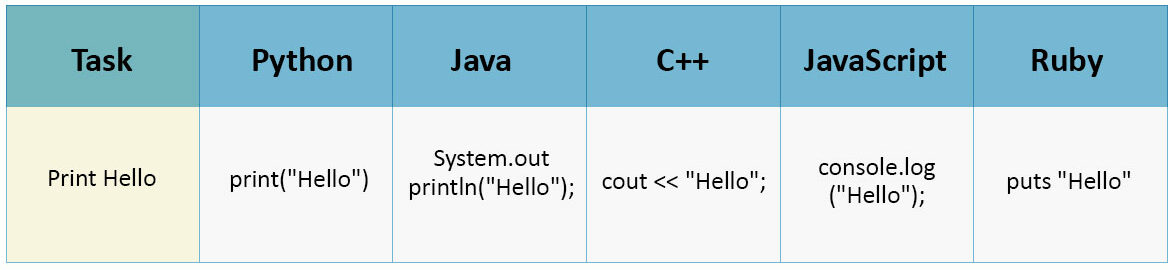
This makes it easy to see why so many newcomers gravitate towards Python as their first step.
Learning Pathways for Complete Beginners
Many first-time learners prefer a structured introduction before diving into bigger projects. Short foundational programs help with this because they break Python into small, manageable topics like:
- Variables
- Data types
- Loops
- Functions
- Lists and dictionaries
One such example is the Basics of Python short course offered by UniAthena. It provides an introductory overview of these core concepts in a beginner-friendly, step-by-step format. This structured resource can be especially useful for learners who want clarity and guidance as they explore Python for the first time.
Final Thoughts
Python is a highly regarded programming language that is very popular; according to various online resources, it is one of the top programming languages. This is primarily due to its simplicity, versatility, and the support provided by a large number of developers in the Python community. For beginners, it has been suggested that learning Python is a good way to begin their coding journey.
You will develop confidence as you learn how to solve problems with code, and start building your career, as well as build a future for yourself as an automated developer, web developer, and/or data scientist. There are many subfields in the programming arena, and learning about them through Python will help you develop your skills that may be used in the workforce or for personal growth.
Recommended Articles
We hope this guide on learning Python helps you start your coding journey with confidence. Check out these recommended articles for more insights and strategies to enhance your programming skills and career growth.


