


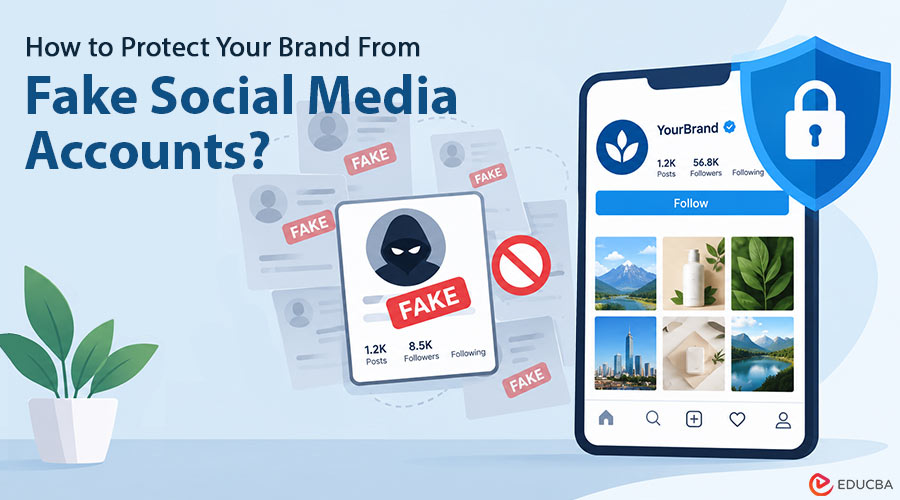
Fake social media accounts can lead to phishing, payment fraud, identity theft, fake promotions, and reputational damage. The danger comes from trust: customers recognize a company’s name or logo and may assume an account is genuine. Attackers exploit that trust to request money, passwords, verification codes, or personal information.
The FTC reported $2.1 billion in consumer losses from scams that started on social media in 2025, with nearly 30% of reported scam losses originating on social media. For businesses, brand protection means safeguarding digital identity and the trust between a company and its customers.
Why Fake Social Media Accounts Are More Dangerous Than They Look?
A fake account does not need millions of followers to cause serious damage. Even a few hundred can be enough if they include existing customers. An impersonator may use a company’s logo to contact a customer about an order problem and send a link requesting payment details. The attacker may never breach the company’s systems. Instead, they borrow the company’s identity and target customers externally. That is why effective brand protection must include social-media monitoring.
What Are the Most Common Warning Signs of a Fake Brand Account?
Attackers often make small username changes by replacing letters, adding underscores or numbers, or using words like “support,” “official,” “customer-care,” or “deals.” Examples include @Example_Brand, @ExampleBrandSupport, @ExampleBrand_Official, and @ExampleBrandDeals. The username alone is not enough. Businesses should examine its history, followers, posts, links, and claims.
Look for a Combination of Signals
Warning signs may include:
- Exact company logo
- Slightly altered username
- Very few followers
- Copied company posts
- Unrelated domain
- Unusually large discounts
- Direct messages to customers
- Payment requests outside the normal process
Any one signal may have an innocent explanation. Together, they create a stronger reason for investigation. Businesses should build a risk picture from multiple signals rather than relying on a simple “fake or real” checklist.
Watch What the Account is Asking Customers to Do
Behavior can be a stronger warning sign than appearance. A fake account may claim that a customer won a prize, received a discount, or has an order problem, then ask for money, passwords, one-time codes, payment details, unfamiliar links, downloads, identification documents, or personal information. Businesses should monitor both behavior and branding. A copied logo means little if the account directs customers to a suspicious payment page.
How Should Businesses Monitor Facebook, Instagram, LinkedIn, and TikTok?
A strong monitoring program should include the exact brand name and misspellings; the brand name with “official,” “support,” or “customer service”; country or city names; product names; CEO and executive names; campaigns; and branded hashtags. This creates a brand-monitoring dictionary.
How Often Should Businesses Search for Fake Accounts?
Frequency should match risk. A small company might check once or twice a week. A larger consumer brand may need daily monitoring, while an active impersonation campaign may require continuous automated monitoring.
A practical routine is to search weekly, review known incidents monthly, and monitor automated alerts continuously. Consistency matters. A 15-minute weekly search can be more valuable than a three-hour investigation.
Expert Insight: Inigo Rivero on Building a Simple Monitoring Routine
Inigo Rivero, Managing Director of House of Marketers, recommends making brand monitoring a regular habit rather than waiting for customers to report an impersonator. Rivero recommends spending around 15 minutes each week searching for the company’s name, common misspellings, CEO’s name, and terms such as “support,” “official,” and “customer service.” Businesses should also check account suggestions and tags. Treat customer feedback as a security signal. Multiple reports about the same account, website, username, or payment request should trigger an investigation.
What Should a Company Do Immediately After Finding a Fake Account?
Preserve evidence before doing anything else. Take screenshots; save the account URL and username; capture the profile image; save suspicious posts or advertisements; preserve customer messages where lawful; and document external websites or payment instructions.
How Can Businesses Get Fake Social Media Accounts Removed?
Instead of simply saying “This account is fake,” explain what the account is doing and why it is unauthorized. Useful evidence includes the official website, official social profiles, trademark information, business registration, copyright ownership, screenshots, links, and evidence of customer interactions. Meta provides trademark and policy reporting mechanisms, while LinkedIn and TikTok provide impersonation-reporting processes.
Trademark Ownership Can Strengthen Brand Protection
A registered trademark does not automatically guarantee removal, but trademark rights can provide stronger documentation when dealing with unauthorized use of protected brand identity. Rivero recommends registering trademarks because it strengthens a company’s position when asking platforms to act. Trademark protection should complement, not replace monitoring.
AI Should Prioritize Threats, Not Automatically Declare Every Similar Account Fake
Legitimate resellers, regional offices, affiliates, and fan communities can resemble a brand. Automatically labeling every similar account as fraudulent creates false positives.
The better model is:
AI detects → AI prioritizes → human verifies → company reports → platform reviews.
Automation provides breadth. Human review provides context.
Expert Insight: Cyrus Kennedy on Platform-Focused Brand Protection
Cyrus Kennedy, CEO of The Ad Firm, recommends combining platform monitoring with formal evidence collection and intellectual-property processes. Kennedy identifies altered usernames, low-follower accounts with unusual activity, recycled brand imagery, poor-quality writing, and requests for payments or sensitive information as warning signs. He recommends monitoring Facebook, Instagram, LinkedIn, and TikTok through saved searches, brand-name variations, Google Alerts, and regular manual reviews.
What Should Businesses Tell Customers Who Interacted With a Fake Account?
A warning should explain that the company does not operate the account and tell customers not to send money, passwords, verification codes, or personal information. Direct them to a trusted contact channel.
Speed Matters
Rivero recommends announcing the legitimate account within 24 hours of identifying an impersonation incident. If customers entered passwords on a fake website, advise them to change those passwords and any reused passwords. If payment information was provided, direct them to their bank or card provider.
Expert Insight: Jean-Christophe Thery on Fast Response and Customer Communication
Jean-Christophe Thery, Founder of MusaArtGallery, recommends searching brand names, misspellings, products, executives, and logo variations across major platforms every day or two. Thery says fake accounts often reveal themselves through lookalike handles, copied profile images, reused brand language, unusual urgency, private-message requests, and attempts to move customers off-platform.
He recommends taking screenshots, recording the URL, and reporting the account. Removal is not the end: the company should warn customers, identify genuine accounts, and explain what information it will never request. Account removal addresses the attacker. Customer communication addresses the trust problem.
Secure the Real Accounts Before Fighting the Fake Ones
Businesses should protect official profiles with MFA, unique passwords, limited administrator access, regular access reviews, removal of former employees, current recovery information, and login monitoring. Brand impersonation and account compromise are separate risks, so legitimate accounts also need strong protection.
Build a Brand-Impersonation Incident Response Plan
The playbook should define who monitors, verifies accounts, preserves evidence, submits reports, handles trademark or legal matters, communicates with customers, investigates suspicious domains, and confirms account removal. Everyone should understand their responsibilities before an incident happens.
Expert Insight: Rafay Baloch on Brand Impersonation as a Trust Attack
Rafay Baloch, CEO and Founder of REDSECLABS, approaches brand impersonation from a cybersecurity perspective, including security consulting, training, and white-hat hacking.
Baloch describes impersonation as a “trust attack.” The attacker is trying to make the customer believe:
“This is the company I already trust.”
He identifies subtle username changes, copied logos, low-follower accounts, unusual URLs, poor-quality posts, urgent requests, and requests for passwords, payments, or personal information as important warning signs. Baloch recommends monitoring Facebook, Instagram, LinkedIn, and TikTok for brand variations, copied visual assets, and suspicious behavior, while preserving screenshots and URLs before reporting an account.
AI can scan large numbers of accounts, identify brand-name variations, compare visual assets, and surface suspicious profiles faster. However, human verification remains essential because legitimate partners, regional operations, resellers, or communities may resemble the brand.
His central message is:
“When someone steals your identity online, they are not just copying your brand—they are borrowing your customers’ trust.”
What Businesses Should Do in the First 24 Hours?
When an active campaign is discovered:
- Preserve evidence before the account changes or disappears.
- Confirm the threat and rule out authorized partners or resellers.
- Identify customer exposure and whether money or sensitive information was requested.
- Report the account through the official platform process.
- Investigate related assets, including similar accounts and domains.
- Warn customers through verified channels.
- Continue monitoring because another account may appear.
Final Thoughts
Fake social media accounts are ultimately a trust problem, not just a technology problem. Businesses should monitor brand and executive accounts, detect suspicious behavior, preserve evidence, use AI with human verification, and respond quickly when impersonation occurs. Most importantly, customers should have an easy way to verify official accounts. Social-media trust takes years to build, but a convincing fake account can exploit it within hours.
Recommended Articles
We hope this guide to detecting and stopping fake social media accounts helps you protect your brand identity and maintain customer trust. Check out these recommended articles for more insights and strategies to strengthen your online security.


