


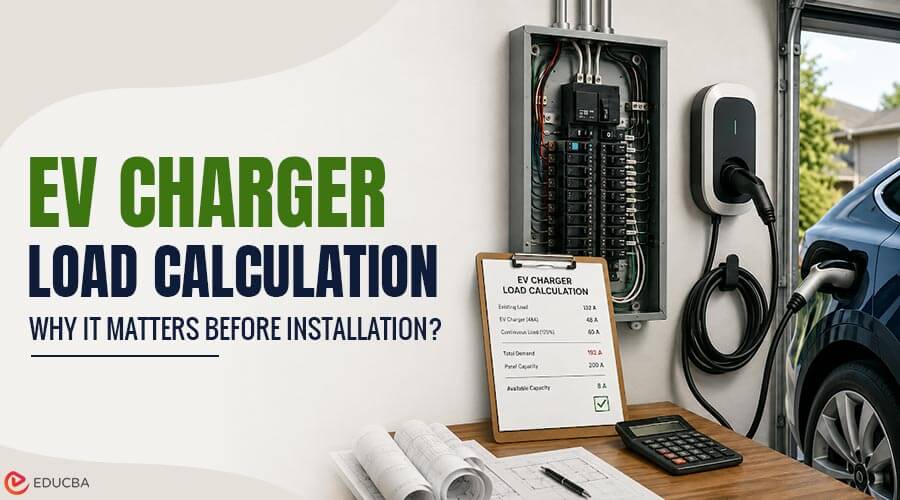
“Can my house actually handle a Level 2 EV charger, or am I about to melt something?” The honest answer starts with a number many homeowners have never calculated: how much of their electrical panel’s capacity is already being used. That number is at the heart of an EV charger load calculation. Consider a home with a 200-amp panel and a new 48-amp Level 2 charger. The homeowner assumes there is plenty of capacity.
But once the home’s existing electrical loads are added up, the available headroom may be much smaller than expected. This example shows how proper load calculation can prevent unnecessary expenses and electrical problems during planning, installation, and long-term use.
The Decision Looks Simple Until You Look at the Panel
On paper, adding a home charger sounds like buying an appliance. Pick a unit, mount it in the garage, run a cable, done. In practice, a Level 2 charger is one of the largest continuous loads a house will ever carry, and it runs for hours at a stretch, most nights, for years.
The Alternative Fuels Data Center notes that residential Level 2 equipment uses 240-volt service, similar to an electric dryer, and most home units operate up to 30 amps and deliver about 7.2 kW. That is not a small addition. It is closer to running a second dryer, all night, every night, on top of everything else already plugged in. So the real question is not “which charger should I buy?” It is “what is my panel already doing?” That is where the case starts.
The 200-Amp Panel is Not as Roomy as it Sounds
Take the household in the intro. A midsize home with 200-amp service, central AC, electric range, electric dryer, a heat pump water heater added two years ago, and now a 48-amp charger going in the garage. The owner assumes 200 amps is plenty. On a summer evening, it is not. A load calculation estimates household demand and adds the charger as a continuous load.
Because continuous loads require higher sizing than their nameplate rating, a 48-amp charger requires more dedicated capacity than its listed amperage suggests. Stack it onto a house that already leans on the panel in July, and the arithmetic gets tight fast.
Three things usually surface once the numbers are on paper:
- Available headroom: The panel has less free capacity than the homeowner assumed, often because a prior remodel added loads nobody re-documented.
- Breaker slot shortage: Even when the amperage works, there is no physical room for a new 60-amp double-pole breaker without reworking the panel.
- Service-entry limits: The panel is fine, but the meter, main lugs, or utility feeder is the real bottleneck.
Where Homeowners Lose Money Without an EV Charger Load Calculation?
Now watch the same job play out two ways. Homeowner A skips the calculation, buys the biggest charger on the shelf, and hires whoever can come Thursday. The breaker holds for a month, then starts nuisance-tripping on hot nights when the AC and the car overlap. The homeowner calls a second electrician, receives a service upgrade quote, and has to redo part of the original installation. Homeowner B pays for the load calculation first.
The math shows the panel can carry a 40-amp charger comfortably, or a 48-amp unit with load management that throttles the car when the AC kicks on. No service upgrade. No second truck roll. The charger runs without incident for years. Same house, same car, very different bill. This is where an experienced local shop earns its fee. A licensed electrical team will run the calculation, pull the permit, size the conductors, and tell you honestly whether a panel upgrade is justified or whether smarter equipment gets you there for less.
This Decision is About to Repeat Itself in Millions of Homes
Zoom out from the one house. The Department of Energy projects that by 2030, roughly 25.7 million of the 28 million charging ports the country will need, about 92%, will be private Level 1 and Level 2 chargers at single-family homes. That is a lot of panels about to be asked a question many were not sized to answer. Most of those homes were built when a clothes dryer and central AC were the largest loads homeowners expected.
Today, they may need to support a heat pump, induction range, battery backup, and EV, sometimes all at once. The panel is the shared resource. It gets rationed whether the owner plans for it or not. As more homeowners install EV chargers, EV Charger Load Calculation becomes an important part of determining whether existing electrical systems can safely and efficiently handle the new demand.
Recommended Articles
We hope this comprehensive guide to EV charger load calculation helps you make informed decisions about your home EV charging setup. Check out these recommended articles for more insights and practical tips on EV charging and electrical systems.

