


India’s electric vehicle (EV) industry has entered a new phase of growth. What was once a niche segment is now becoming one of the fastest-growing sectors in the Indian automobile market. Government incentives, expanding charging infrastructure, technological advancements, and rising consumer awareness are accelerating EV adoption across passenger, commercial, two-wheel, and public vehicles. As the EV ecosystem grows, several listed companies are benefiting from this transformation. These companies manufacture electric vehicles, batteries, charging infrastructure, power equipment, or supply critical components for the industry. This article explores the best EV Stocks in India in 2026, their role in the electric mobility ecosystem, and the factors investors should evaluate before investing.
Disclaimer: This article is for educational purposes only. The companies mentioned are not stock recommendations. Investors should conduct their own research and consult a financial advisor before making investment decisions.
Major EV Stocks in India (2026)
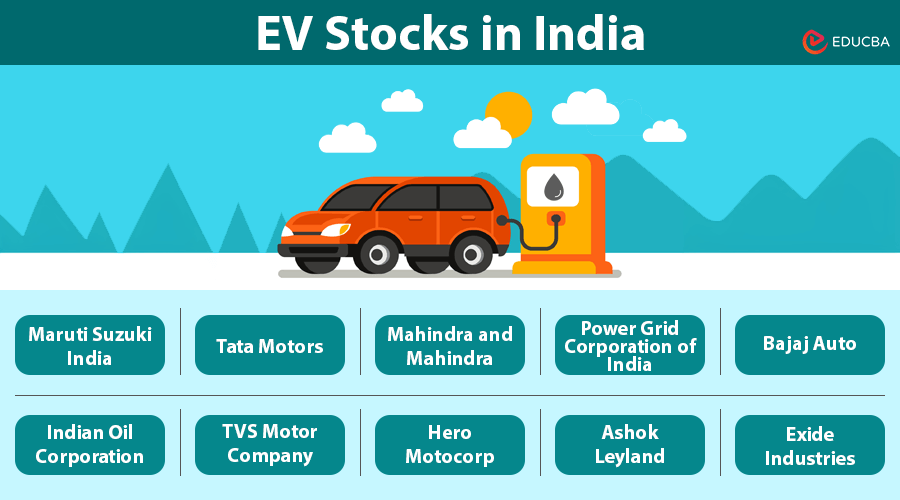
The following companies are among the major listed players participating in India’s electric vehicle ecosystem through EV manufacturing, batteries, charging infrastructure, or related technologies.
| Stock | Market Cap (Rs. Crores) |
| Maruti Suzuki India Ltd | 451,624 |
| Bajaj Auto Ltd | 273,438 |
| Power Grid Corporation of India Ltd | 267,811 |
| Indian Oil Corporation Ltd | 199,957 |
| TVS Motor Company Ltd | 172,267 |
| Mahindra & Mahindra Ltd | 138,227 |
| Tata Motors Ltd | 126,736 |
| Hero MotoCorp Ltd | 97,136 |
| Ashok Leyland Ltd | 96,507 |
| Exide Industries Ltd | 35,411 |
Note:
The market capitalization figures are as of June 4, 2026, and are subject to change based on market movements. Rankings may vary over time as stock prices fluctuate. Investors should refer to the latest data from NSE or BSE before making investment decisions.
#1. Maruti Suzuki India Ltd
Maruti Suzuki, India’s largest passenger vehicle manufacturer, has officially entered the electric vehicle market with its first all-electric SUV and has announced a broader EV roadmap over the coming years.
The company is investing heavily in:
- Electric SUVs
- Battery manufacturing partnerships
- Dedicated EV production facilities
- Export-focused EV manufacturing
- Charging ecosystem collaborations
Leveraging its extensive dealership network and strong brand presence, Maruti Suzuki aims to become a significant player in India’s mass-market EV segment.
#2. Bajaj Auto Ltd
Bajaj Auto has strengthened its position in India’s electric two-wheeler market through the Chetak Electric brand.
Key focus areas include:
- Premium electric scooters
- Electric three-wheelers
- Export opportunities
- Dedicated EV manufacturing facilities
The company continues expanding production capacity to meet increasing domestic and international demand.
#3. Power Grid Corporation of India Ltd
Power Grid plays a vital role in enabling India’s EV infrastructure.
Its contributions include:
- EV charging stations
- Grid modernization
- Fast charging infrastructure
- Renewable energy integration
- Smart power management
As charging demand grows nationwide, grid infrastructure becomes increasingly important.
#4. Indian Oil Corporation Ltd
Indian Oil is transforming its traditional fuel station network into multi-energy service stations.
Its EV initiatives include:
- Public fast charging stations
- Battery swapping facilities
- Renewable energy integration
- Green hydrogen projects
- EV charging expansion across highways and cities
The company continues expanding its charging network to support India’s growing EV fleet.
#5. TVS Motor Company Ltd
TVS Motor has emerged as one of India’s fastest-growing electric two-wheeler manufacturers.
Its EV initiatives include:
- TVS iQube electric scooter
- Future electric motorcycles
- Electric three-wheelers
- Connected mobility platforms
The company continues investing in:
- Battery technology
- Smart vehicle software
- Charging partnerships
- International EV expansion
#6. Mahindra & Mahindra Ltd
Mahindra has significantly expanded its electric SUV lineup under its INGLO platform.
Its EV strategy includes:
- BE series electric SUVs
- XEV lineup
- Electric commercial vehicles
- Electric three-wheelers through Mahindra Last Mile Mobility
The company is investing in:
- Dedicated EV manufacturing
- Battery technologies
- Software-defined vehicles
- Connected mobility solutions
Mahindra also remains India’s leading manufacturer of electric three-wheelers.
#7. Tata Motors Ltd
Tata Motors continues to remain one of the leaders in India’s electric passenger vehicle market.
Its EV portfolio includes:
- Nexon EV
- Punch EV
- Tiago EV
- Tigor EV
- Curvv EV
- Harrier EV (new generation)
The company benefits from strong ecosystem integration through the Tata Group, including:
- Tata Power (charging infrastructure)
- Tata AutoComp
- Tata Technologies
- Tata Elxsi
Its subsidiary Jaguar Land Rover is also investing significantly in premium electric vehicles globally.
#8. Hero MotoCorp Ltd
Hero MotoCorp is steadily expanding its EV presence through its VIDA electric scooter brand.
The company is focusing on:
- Affordable electric scooters
- Premium electric models
- Charging infrastructure
- Battery ecosystem partnerships
- Global electric mobility opportunities
Hero also maintains strategic investments in advanced EV startups and battery technologies.
#9. Ashok Leyland Ltd
Ashok Leyland is focusing on sustainable commercial mobility through multiple technologies.
Its strategy includes:
- Electric buses
- Electric light commercial vehicles
- Hydrogen-powered trucks
- Fuel-cell technologies
- Fleet electrification
Rather than relying solely on battery EVs, the company is also investing heavily in hydrogen mobility solutions for long-haul transportation.
#10. Exide Industries Ltd
Exide Industries is one of India’s leading battery manufacturers and an important participant in the EV supply chain.
Its EV-related initiatives include:
- Lithium-ion battery manufacturing
- Battery management systems
- Energy storage solutions
- Strategic battery technology partnerships
- Battery recycling initiatives
As EV adoption increases, battery manufacturers like Exide are expected to benefit from long-term industry growth.
Other Important EV-Related Stocks in India
Apart from vehicle manufacturers, several companies support India’s EV ecosystem.
Some notable names include:
- Olectra Greentech Ltd: Electric buses
- JBM Auto Ltd: Electric buses and charging infrastructure
- Uno Minda Ltd: EV components
- Amara Raja Energy & Mobility Ltd: Advanced batteries
- Tata Power Company Ltd: EV charging infrastructure
- Servotech Renewable Power System Ltd: EV chargers
- KPIT Technologies Ltd: Automotive software and EV engineering
- Tata Elxsi Ltd: EV design and embedded software
Factors to Consider Before Investing in EV Stocks
Before investing in electric vehicle companies, investors should evaluate several important factors.
1. Market Position: Companies with established brands and growing EV market share generally have stronger long-term prospects.
2. Product Pipeline: Look for businesses that regularly launch new electric vehicles and upgrade existing models.
3. Battery Technology: Battery innovation directly affects Driving range, charging time, Vehicle cost, and profit margins. Companies investing in advanced battery technologies may have a competitive advantage.
4. Charging Infrastructure: The availability of charging stations significantly influences EV adoption. Companies that contribute to charging infrastructure may benefit alongside vehicle manufacturers.
5. Government Policies:
India continues to support EV adoption through initiatives such as:
- Production-linked incentives (PLI)
- State EV policies
- FAME scheme benefits (where applicable)
- Manufacturing incentives
- Charging infrastructure development
Policy changes can significantly impact industry growth.
6. Financial Performance:
Review key financial metrics, including:
- Revenue growth
- Profitability
- Debt levels
- Return on equity (ROE)
- Cash flows
- Valuation ratios
7. Research & Development: Companies investing consistently in innovation are generally better positioned for long-term growth in the rapidly evolving EV industry.
Benefits of Investing in EV Stocks
Some potential advantages include:
- Exposure to a rapidly growing industry
- Long-term structural growth opportunities
- Government support for electrification
- Rising consumer demand
- Expansion of charging infrastructure
- Global export opportunities
- Technological innovation
Risks of Investing in EV Stocks
Like any investment, EV stocks carry risks.
These include:
- High competition
- Rapid technological changes
- Battery raw material price volatility
- Regulatory changes
- Valuation risks
- Supply chain disruptions
- Slower-than-expected EV adoption
Diversification and thorough research remain important before investing.
Future Outlook of India’s EV Industry
India aims to become a global hub for electric mobility and battery manufacturing over the coming decade.
Several factors support the industry’s long-term growth:
- Rising fuel prices
- Increasing environmental awareness
- Government incentives
- Battery manufacturing expansion
- Better charging infrastructure
- Growing demand for electric two-wheelers and commercial vehicles
- Advancements in battery technology.
While the industry still faces challenges, the long-term outlook remains positive as electrification continues across multiple vehicle segments.
Frequently Asked Questions (FAQs)
Q1. Which are the top EV stocks in India in 2026?
Answer: Some of the leading EV-related stocks include Tata Motors, Mahindra & Mahindra, Maruti Suzuki, TVS Motor, Bajaj Auto, Hero MotoCorp, Exide Industries, Power Grid Corporation, Indian Oil Corporation, and Ashok Leyland.
Q2. Are EV stocks a good long-term investment?
Answer: EV stocks may offer long-term growth potential due to increasing electric vehicle adoption, supportive government policies, and technological advancements. However, investors should assess company fundamentals, valuations, and risks before investing.
Q3. Which sectors benefit from EV growth besides automobile companies?
Answer: Several industries benefit from EV adoption, including battery manufacturing, charging infrastructure, auto components, software, renewable energy, power transmission, and energy storage.
Q4. What risks should investors consider before investing in EV stocks?
Answer: Key risks include intense competition, shifting government policies, rapid technological advances, supply chain disruptions, rising costs of battery raw materials, and elevated stock valuations.
Q5. How can beginners choose EV stocks?
Answer: Beginners should evaluate a company’s financial performance, market share, product pipeline, competitive advantages, research and development, management quality, and long-term growth strategy, rather than relying solely on market trends.
Recommended Articles
We hope this guide to EV Stocks in India helps you understand India’s growing electric mobility ecosystem and the companies driving this transformation. Explore these related articles to learn more about stock investing, market analysis, and building a diversified investment portfolio.


