
Cassandra Tutorial
Basic
Cassandra Tutorial
Cassandra is an extremely scalable, high-performance distributed NoSQL database that is structured to manage great amounts of data across many service servers. Apache Cassandra provides high availability with not a single point of failure. Here, let us first understand the term NoSQL Database.
Actually, a NoSQL Database, also called Not Only SQL, is a database that has the machinery to store and retrieve data with simple queries other than the tabular relations used in the RDBMS. This type of database supports easy replication and is schema-free with simple API, consistent, and can control huge data. Thus, Apache Cassandra is a distributed, open-source, decentralized storage management system.
Why do we need to learn Cassandra?
Cassandra was initially invented on Facebook for an inbox search. After that, it was made open-sourced by Facebook in July 2008. Later, Apache Incubator accepted it in March 2009, and it made Apache a top-level project in February 2010.
Cassandra manages a large amount of structured data spread out across the world with no chance of failure. It is really faulted tolerant and consistent. A column-based database implements a Dynamo-style replication model but enhances a more dominant “column family” data model.
Today, Cassandra is used by a few biggest companies such as Facebook, Twitter, Cisco, eBay, Netflix, Rackspace, Twitter, etc.
Applications of Cassandra
- Cassandra is popular in the present context due to its better technical features.
- Cassandra allows increasing hardware to accommodate more clients and more data if needed.
- Since it has no failure option, it supports businesses and its critical applications that cannot afford failure.
- It has a fast quick response time that increases linear scale performance.
- Cassandra dynamically accommodates all data formats like structured, semi-structured, and unstructured.
- It is able to distribute data with flexibility wherever we need it by replicating data across multiple centers.
- It also supports Transactions with ACID properties like atomicity, consistency, isolation, and durability.
- It is designed to execute low-product hardware, achieve fast writes, and able to store hundreds of terabytes of data without losing the efficiency of reading.
Example
Cassandra query language is used to access Cassandra through its nodes. In CQL, a Keyspace is a namespace describing nodes' data replication. Coders use cqlsh quick to work with CQL or other application language drivers.
Creating a Keyspace using Cqlsh with Syntax
CREATE KEYSPACE <identifier> WITH <properties>For example,
cqlsh.> CREATE KEYSPACE learnCQl.com WITH
replication = {'class':'Simpleplan', 'replication_factor' : 3};
Also, let’s create a table using CQL syntax:
CREATE (TABLE | COLUMNFAMILY) <tablename>
('<column-definition>' , '<column-definition>')
(WITH <option> AND <option>)
We can define a Column like this:
column name1 data type,
column name2 data type,
Like:
age int,
name text
For example,
cqlsh> USE learnCQl;
cqlsh: learnCQl>; CREATE TABLE studs(
studs_id int PRIMARY KEY,
studs_name text,
studs_city text,
studs_phone varint
);
It created a table with columns studs_id, studs_name, studs_city, and studs_phone.
Prerequisites
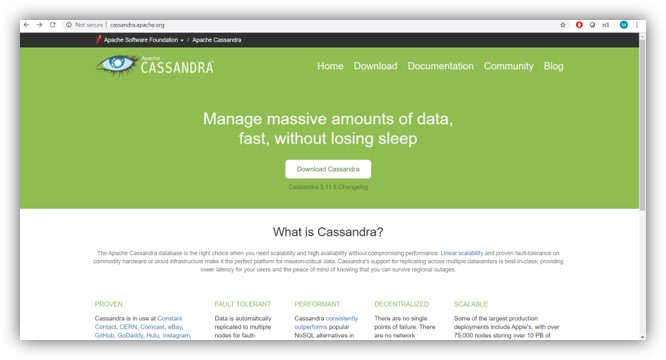
You can learn the Cassandra tutorial if you have an interest in Database management, and you can visit the official website for more details cassandra.apache.org
In terms of prerequisites, if you have basic knowledge of JAVA programming, then it is a simple tutorial, and we can easily understand all the concepts. In addition, it would be great if you have any prior knowledge of database queries and any Linux ideas.
Target Audience
Apache Cassandra is an exceptionally useful topic for software specialists, especially those who are aimed to learn the wires of Cassandra and also deal with practice.

Valuation, Hadoop, Excel, Web Development & many more.