

Updated June 15, 2023
Difference Between Data Mining vs Text Mining
Data Mining vs Text Mining is a comparative concept that is related to data analysis. Data mining refers to the process of analyzing large data sets to identify a meaningful pattern. In contrast, text mining is analyzing the text data, which is in an unstructured format, and mapping it into a structured format to derive meaningful insights. Data mining majorly depends upon Statistical techniques and algorithms, whereas text mining is dependent upon statistical techniques and linguistic analysis. Data mining highly depends upon numerical business data, whereas the text mining process depends upon the lexical and syntax structure of the text data.
Data Mining
Data Mining provides an excellent opportunity for exploring the interesting relationship between retrieval and inference/reasoning, a fundamental issue concerning the nature of data mining.
The data mining process breaks down into the below steps:
- Collect, extract, transform, and load data into a data warehouse.
- Store and manage the data, multidimensional database i.e. either on in-house servers or the cloud.
- Provide data access to business analysts, management teams, and information technology professionals and determine how they want to organize it using application software.
- And finally, present the data in an easy-to-share format, such as a table or graph.
Text Mining
Text mining requires both sophisticated linguistic and statistical techniques able to analyze unstructured text formats and techniques that combine each document with actionable metadata, which can be considered a sort of anchor in structuring this type of data.
Text mining consists of a wide variety of methods and technologies, such as:
- Keyword-based technologies: The input is based on a selection of keywords in the text filtered as a series of character strings, not words or “concepts.”
- Statistics technologies: Refers to systems based on machine learning. Statistics technologies leverage a training set of documents used as a model to manage and categorize text.
- Linguistic-based technologies: This method may leverage language processing systems. The output of text analysis allows a shallow understanding of the structure of the text, the grammar, and the logic employed. (For a better understanding of how this works, this post on text mining and NLP is helpful.)
All these approaches have a common feature that they are all concerned with processing text in an approximate way, whereas they are not capable of understanding them.
Head to Head Comparison between Data Mining and Text Mining (Infographics)
Below are the top 3 comparisons between Data Mining and Text Mining:
Key Differences Between Data Mining and Text Mining
The difference between Data mining and Text mining is explained in the points presented below:
- Data mining systems essentially analyze figures that may be described as homogeneous and universal. It extracts, transforms, and loads data into a data warehouse. Business analysts use data mining software applications to present analyzed data in easily understandable forms, such as tables or graphs. Currencies, dates, and names, might have to be managed, but they are easy to link to data and do not require any deep understanding of their context. Text mining tools have to face major technical challenges such as heterogeneous document formats (text documents, emails, social media posts, verbatim text, etc.), as well as multilingual texts and abbreviations and slang typical of SMS language.
- The required data is easy to access and homogeneous. Once algorithms are defined, the solution can be quickly deployed. The complexity of the data processed makes text mining projects longer to deploy. Text mining counts several intermediary linguistic stages of analysis before enriching content (language guessing, tokenization, segmentation, morpho-syntactic analysis, disambiguation, cross-references, etc). Next, relevant terms extraction and metadata association steps tackle structuring the unstructured content to nurture domain-specific applications. Moreover, projects may involve some heterogeneous languages, formats, or domains. Finally, few companies have their own taxonomy. However, this is mandatory for starting a text mining project, and it can take a few months to be developed.
- In other words, text mining was poorly understood enough to have management support and, therefore, was never valued as a ‘must-have.’ However, with the advent of digitalization, the rise of social networks, and increased connectivity, companies are now more concerned about their online reputation. They are looking for ways to increase customer loyalty in a world of increasing choice. As a result, sentiment analysis is the new focus of text mining.
Data Mining and Text Mining Comparison Table
Below is the list of points describing the comparisons between Data Mining and Text Mining.
| BASE FOR COMPARISON | Data Mining | Text Mining |
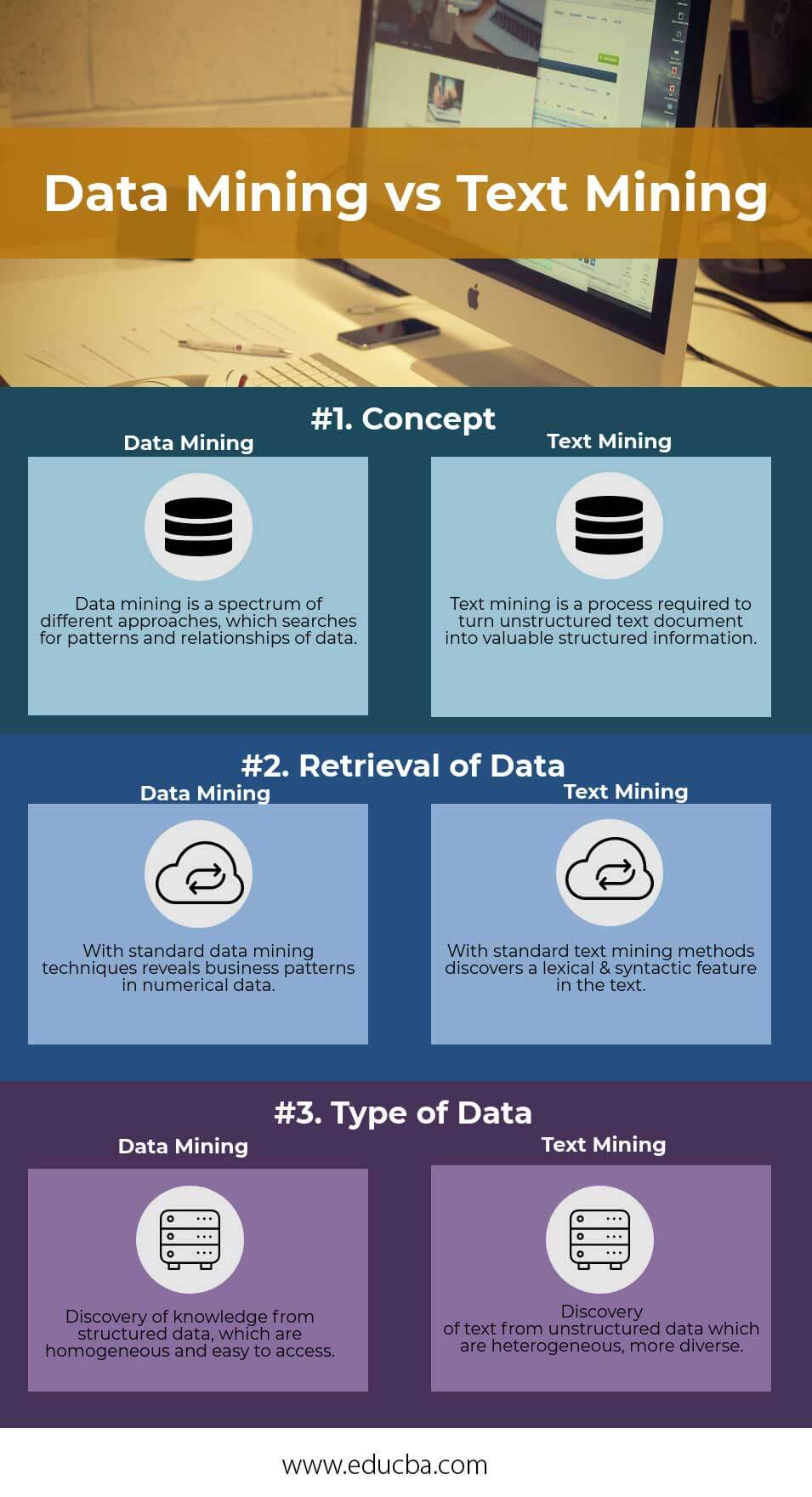
| Concept | Data mining is a spectrum of different approaches which searches for patterns and relationships of data. | Text mining is a process required to turn unstructured text documents into valuable structured information. |
| Retrieval of Data | Standard data mining techniques reveal business patterns in numerical data. | Standard text mining methods discover lexical & syntactic features in the text. |
| Type of Data | Discovery of knowledge from structured data, which is homogeneous and easy to access. | Discovery of text from unstructured data, which is heterogeneous and more diverse. |
Conclusion
Text and data mining are now considered complementary techniques required for effective business management; text mining tools are becoming even more significant. This helps information extraction and metadata association become easier and more efficient. Natural language will never be as easy to handle as figures, but text mining is now more mature, and its association with data mining makes more sense.
Recommended Articles
This has been a guide to Data Mining vs Text Mining. Here we discuss the head-to-head comparison, key differences, infographics, and a comparison table. You may also look at the following articles to learn more –

