
What is a Carve-Out?
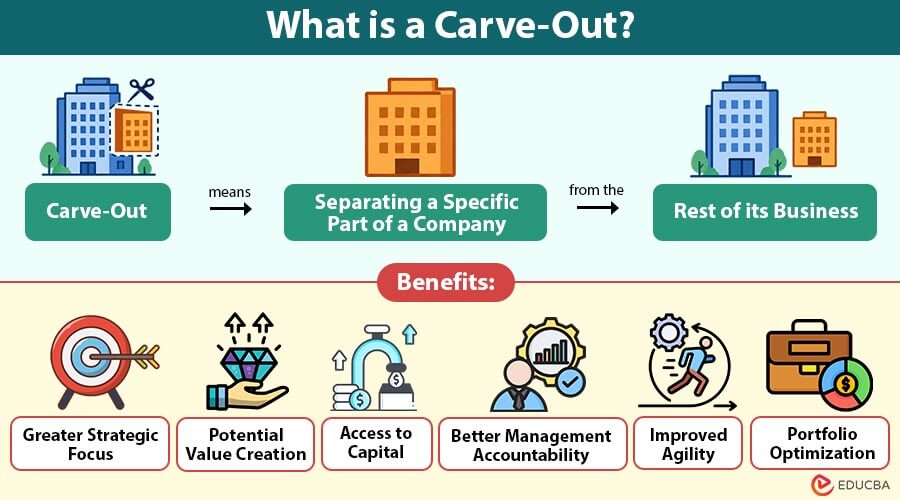
A carve-out means separating a specific part of a company from the rest of its business. The separated business may continue operating as part of the parent company, become an independent company, or be sold to another organization.
The separated business is commonly called the carve-out business, while the original organization is known as the parent company.
For example, suppose a technology company operates three divisions: cloud services, cybersecurity, and software development. If management decides that the cybersecurity division no longer fits its long-term strategy, it may separate that division through a carve-out.
A carve-out does not always mean selling the entire business. Depending on the transaction structure, the parent company may continue to own part or all of the separated business.
Table of Contents:
- Meaning
- Working
- Types
- Why do Companies Use Carve Outs?
- Benefits
- Challenges
- Example
- How to Evaluate a Carve-Out?
Key Takeaways:
- Carve-outs separate specific business units, assets, or subsidiaries from a larger parent organization.
- Companies use carve-outs to improve focus, unlock value, raise capital, and optimize business portfolios.
- Successful carve-outs require careful planning across financial, operational, legal, tax, technology, and employee considerations.
- Businesses should evaluate strategic rationale, standalone costs, dependencies, valuation, and transition requirements before pursuing carve-outs.
How Does a Carve-Out Work?
A carve-out usually involves several stages. The exact process depends on whether the business will be sold, spun off, or established independently.
1. Identify the Business
The parent company first decides which business unit or assets to separate. Management evaluates strategic importance, financial performance, growth prospects, and operational relationships with the rest of the organization.
2. Define the Scope
The company determines exactly what belongs to the carve-out. This may include employees, contracts, intellectual property, equipment, inventory, customers, technology, offices, and other assets.
3. Separate Financial Information
The parent company prepares financial information specifically for the business being separated. This can be difficult when the unit previously shared accounting systems, employees, facilities, or other resources with the parent.
4. Establish Standalone Operations
The carve-out business may need its own finance, human resources, IT, legal, procurement, and other functions. Temporary agreements called Transition Service Agreements (TSAs) may allow the parent company to continue providing certain services after separation.
5. Choose the Transaction Structure
The company decides how to complete the carve-out. Common options include a sale to another company, a public offering, or a spin-off.
6. Complete the Separation
Once the company addresses regulatory, financial, operational, and legal requirements, it completes the transaction. The business then operates under its new ownership or structure.
Types of Carve-Out
A carve-out can be structured in several ways.
1. Equity Carve-Out
An equity carve-out sells part of a subsidiary’s shares publicly, allowing the parent to raise capital while retaining significant ownership.
2. Divestiture
A divestiture involves selling a business unit or subsidiary to another company, providing immediate cash and enabling greater strategic focus.
3. Spin-Off
A spin-off creates an independent company by distributing its shares to existing shareholders, separating operations without generating direct cash proceeds.
4. Asset Carve-Out
An asset carve-out separates specific assets, such as intellectual property, real estate, technology, equipment, or product lines, from the business.
Why do Companies Use Carve-Outs?
Companies may pursue carve-outs for several strategic and financial reasons.
1. Focus on Core Operations
Separating non-core divisions lets management focus resources, talent, and investment on businesses aligned with long-term strategic objectives.
2. Unlock Shareholder Value
A carve-out can reveal hidden value by allowing a business unit to operate independently and receive a separate market valuation.
3. Raise Capital
Companies can generate funds through carve-outs to reduce debt, finance growth initiatives, improve liquidity, or strengthen their overall balance sheet.
4. Improve Operational Performance
Independent management can make faster decisions, allocate resources efficiently, and develop strategies specifically suited to the separated business.
5. Attract Investors
Focused businesses may attract investors seeking clearer strategies, specialized operations, transparent financial performance, and stronger growth opportunities than diversified companies.
6. Strategic Restructuring
Carve-outs help companies reorganize their business portfolios, eliminate strategically unimportant operations, and redirect resources toward higher-priority growth opportunities.
Benefits of a Carve-Out
Carve-outs can create value for both the parent company and the separated business.
1. Greater Strategic Focus
The parent can concentrate on businesses that align with its long-term objectives. Meanwhile, the separated company can develop a strategy specifically suited to its market.
2. Potential Value Creation
A business hidden within a larger organization may receive a different valuation when operated independently. Investors may better understand its growth potential and financial performance.
3. Access to Capital
Depending on the structure, the separated business may gain access to external financing or public equity markets.
4. Better Management Accountability
Independent operations can make it easier to evaluate management performance because revenues, costs, investments, and results are no longer combined with those of the parent.
5. Improved Agility
A standalone company can potentially make decisions faster because it does not need to follow the broader organization’s priorities and approval processes.
6. Portfolio Optimization
The parent company can use a carve-out to create a more focused portfolio and allocate capital toward businesses with stronger growth opportunities.
Challenges of Carve-Out
Although carve-outs can generate significant benefits, they also create substantial challenges.
1. Operational Complexity
The business may depend heavily on the parent for IT, accounting, procurement, legal services, human resources, or facilities. Separating these functions can take considerable time and resources.
2. High Separation Costs
Creating standalone systems and processes can require significant investment. Technology migration, employee transfers, legal restructuring, and new infrastructure can increase costs.
3. Loss of Synergies
The parent and separated business may previously have benefited from shared resources. Separation can eliminate some of these economies of scale.
4. Employee Uncertainty
Employees may be uncertain about their future roles, compensation, reporting structures, and employment arrangements. Poor communication can lead to employee turnover.
5. Customer Disruption
Customers may be concerned about changes in ownership, contracts, product support, or service quality. Maintaining customer relationships during the transition is essential.
6. Financial Complexity
Preparing standalone financial statements can be challenging when historical expenses and revenues were not separately tracked.
7. Regulatory Issues
Certain transactions may require regulatory approvals, tax planning, antitrust analysis, or compliance with securities regulations.
Carve-Out Example
Suppose ABC Corporation operates three business segments: industrial equipment, software, and consumer electronics.
The consumer electronics division has strong revenue but limited strategic overlap with ABC’s industrial equipment business. Management believes the consumer division could grow faster with an independent strategy.
ABC decides to carve out the consumer electronics division.
First, it identifies the employees, intellectual property, contracts, inventory, technology, and facilities associated with the division. It then prepares separate financial statements and establishes standalone systems.
ABC could subsequently sell the division to another company. Alternatively, it could conduct an equity carve-out by selling a portion of the division to public investors while retaining ownership.
The transaction allows ABC to focus more closely on industrial equipment while giving the consumer electronics business greater independence.
How to Evaluate a Carve-Out?
Before pursuing a carve-out, companies should evaluate several important factors.
1. Strategic Rationale
Management should determine why the business should be separated and whether the carve-out supports the company’s long-term strategic objectives.
2. Financial Performance
Companies should independently assess revenue growth, profit margins, cash flow, debt requirements, profitability, and financial stability before proceeding.
3. Standalone Costs
Management should estimate the costs required to establish independent operations and replace services previously provided by the parent company.
4. Operational Dependencies
Companies should identify dependencies involving technology, employees, suppliers, customers, contracts, facilities, systems, and other shared resources.
5. Tax Implications
Management should evaluate the transaction structure’s potential tax consequences, including taxes affecting both the parent and the separated business.
6. Valuation
Companies should compare potential valuations from selling, spinning off, or independently operating the business to determine which option maximizes shareholder value.
7. Employee and Customer Impact
Management should protect critical employees, maintain customer relationships, communicate changes effectively, and minimize disruptions throughout the separation and transition process.
8. Transition Planning
A detailed separation plan should define responsibilities, timelines, systems, resources, milestones, performance targets, and accountability to execute the carve-out successfully.
Final Thoughts
A carve-out is a strategic corporate transaction that separates a business unit, subsidiary, product line, or assets from a larger organization. Companies use carve-outs to raise capital, unlock value, improve focus, simplify operations, or prepare businesses for sale. Successful execution requires careful planning across financial, operational, legal, tax, employee, and technology considerations.
Frequently Asked Questions (FAQs)
Q1. Who typically manages a carve-out transaction?
Answer: A carve-out is usually managed by senior executives, finance teams, legal advisors, tax specialists, investment bankers, and operational leaders.
Q2. How long does a carve-out process take?
Answer: The timeline varies based on transaction complexity, business size, regulatory requirements, and operational dependencies. Large separations may take several months or longer.
Q3. Can a private company carry out a carve-out?
Answer: Yes. Carve-outs are not limited to public companies. Private companies can separate subsidiaries, business units, product lines, or assets for strategic or financial purposes.
Q4. What happens to contracts during a carve-out?
Answer: Contracts must be reviewed to determine whether they can be transferred, assigned, renegotiated, or replaced. Some agreements may require approval from customers, suppliers, or other parties.
Recommended Articles
We hope that this EDUCBA information on “Carve-Out” was beneficial to you. You can view EDUCBA’s recommended articles for more information.


