


What is Bilateral Netting?
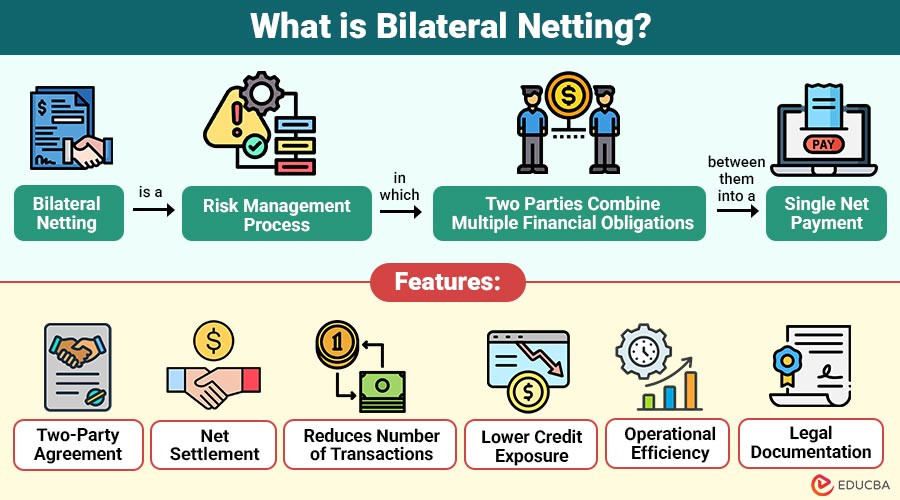
Bilateral netting is a risk management process in which two parties combine multiple financial obligations between them into a single net payment. Instead of settling every transaction separately, each party calculates the total amount it owes and the total amount it is owed. Only the difference (net amount) is paid by one party to the other.
In simple words, bilateral netting reduces the number of payments by offsetting mutual obligations between two parties. This helps lower settlement risk, credit exposure, operational costs, and transaction complexity.
For example, if Company A owes Company B $700,000 under one contract and Company B owes Company A $500,000 under another, instead of making two separate payments, bilateral netting allows Company A to pay only the net difference of $200,000.
Table of Contents:
Key Takeaways:
- Bilateral netting offsets mutual obligations between two parties, requiring settlement of only the net payment.
- It reduces credit exposure, settlement risk, operational costs, and payment processing complexity for counterparties.
- Financial institutions widely use bilateral netting across derivatives, foreign exchange, securities, and banking transactions.
- Legal agreements ensure enforceability, enabling efficient settlements while supporting stronger financial risk management practices.
Importance of Bilateral Netting
Bilateral netting plays an important role in financial markets.
1. Reduces Credit Risk
Only the net outstanding obligation remains, reducing potential financial losses if either counterparty defaults on payments.
2. Improves Liquidity
Settling only net balances reduces cash requirements, allowing businesses to use funds more efficiently for operations.
3. Simplifies Settlements
Combining multiple obligations into one payment streamlines settlement processes and reduces administrative complexity for counterparties.
4. Supports Financial Stability
Lower interconnected exposures between counterparties help reduce systemic risk and strengthen overall financial market stability.
5. Reduces Operational Costs
Fewer payment transactions decrease processing efforts, administrative expenses, and settlement costs for both participating counterparties.
How Does Bilateral Netting Work?
Bilateral netting follows a straightforward settlement process:
Step 1: Multiple Transactions Occur
Two parties enter into several financial transactions, such as loans, derivatives, currency trades, or securities contracts.
Step 2: Calculate Payables and Receivables
Each party totals:
- Amounts it owes
- Amounts it is entitled to receive
Step 3: Offset Mutual Obligations
Receivables are deducted from payables to determine the net amount.
Step 4: Single Settlement
Instead of several payments, a single net payment is made by the party with the larger obligation.
Step 5: Transaction Completion
Once the net payment is settled, all covered obligations are considered fulfilled.
Types of Bilateral Netting
There are several forms of bilateral netting depending on the purpose and timing.
1. Payment Netting
Multiple payment obligations due on the same settlement date are combined into one single net payment between counterparties.
2. Close-Out Netting
Upon counterparty default, all outstanding contracts are terminated, valued, and consolidated into a single final net settlement obligation.
3. Settlement Netting
Transactions scheduled for settlement on the same date are offset, significantly reducing payment transfers and settlement risk.
4. Novation Netting
Existing obligations are replaced by a single new obligation representing the net amount owed between the two counterparties only.
Features of Bilateral Netting
Some important features include:
1. Two-Party Agreement
Bilateral netting involves only two counterparties who mutually agree to offset their financial obligations together.
2. Net Settlement
Only the net payable amount is exchanged, rather than settling each transaction separately between counterparties.
3. Reduces Number of Transactions
Multiple payment obligations are consolidated into a single settlement, significantly reducing transaction volume and administrative complexity.
4. Lower Credit Exposure
Each counterparty remains exposed only to the net outstanding amount, reducing overall credit risk considerably.
5. Operational Efficiency
Fewer settlements simplify processing, reduce administrative costs, and improve overall operational efficiency for both counterparties.
6. Legal Documentation
Bilateral netting relies on legally enforceable agreements defining rights, obligations, and settlement procedures between counterparties.
Advantages of Bilateral Netting
Below are the key advantages of bilateral netting:
1. Lower Credit Exposure
The total credit exposure decreases because only the net payable amount remains outstanding, rather than each individual obligation.
2. Fewer Payments
Multiple financial obligations between two parties are combined into a single net payment, significantly reducing transaction volume and complexity.
3. Improved Cash Flow
Organizations retain more working capital because they settle only the net balance rather than multiple gross amounts.
4. Lower Settlement Risk
Consolidating payments into a single transaction significantly reduces settlement errors, delays, and the likelihood of payment failures.
5. Operational Efficiency
Netting simplifies accounting, reconciliation, documentation, and payment processing, reducing administrative workload and improving overall operational productivity.
6. Cost Savings
Fewer payment transactions reduce banking fees, processing expenses, administrative costs, and overall settlement-related operational expenditures for businesses.
Disadvantages of Bilateral Netting
Despite its benefits, bilateral netting has certain limitations.
1. Legal Risk
Netting agreements may not be legally enforceable in every jurisdiction, creating uncertainty during disputes or default situations.
2. Counterparty Risk
If netting becomes unenforceable during insolvency, parties may face unexpected financial losses and increased credit exposure.
3. Limited Scope
Bilateral netting offsets obligations between only two parties and cannot reduce exposures involving multiple counterparties simultaneously.
4. Documentation Requirements
Comprehensive legal agreements, standardized contracts, and proper documentation are essential before bilateral netting arrangements become legally effective.
5. Complex Valuation
Certain derivative contracts require accurate market valuations before calculating net obligations, making the netting process more complex.
6. Regulatory Compliance
Financial institutions must comply with accounting standards, regulatory rules, and reporting requirements before successfully applying bilateral netting arrangements.
Applications of Bilateral Netting
Bilateral netting is widely used across the financial industry.
1. Derivatives Markets
Banks use bilateral netting to efficiently offset obligations arising from swaps, options, forwards, and other derivative contracts.
2. Foreign Exchange Transactions
Financial institutions’ net reciprocal currency payment obligations before settlement, reducing transaction volumes and overall settlement risks significantly.
3. Securities Trading
Brokerages offset receivables and payables arising from securities trades, thereby simplifying settlements and effectively lowering counterparty credit exposure.
4. Repurchase Agreements (Repos)
Financial institutions’ net payment obligations under repo agreements are reduced through liquidity management across transactions.
5. Banking
Commercial and investment banks use bilateral netting to manage counterparty exposures, minimize risk, and streamline payment settlements.
Difference Between Bilateral Netting and Multilateral Netting
Below is the comparison table highlighting the key differences between bilateral netting and multilateral netting.
| Basis | Bilateral Netting | Multilateral Netting |
| Number of Parties | Two | Three or more |
| Settlement | Between two counterparties | Across multiple participants |
| Complexity | Lower | Higher |
| Payment Reduction | Moderate | Greater |
| Administration | Easier | More complex |
| Credit Exposure | Reduced between the two parties | Reduced across the entire network |
| Common Users | Banks, corporations | Clearing houses, multinational companies |
| Efficiency | Suitable for direct counterparties | Best for organizations with many trading partners |
Example of Bilateral Netting
Below is a simple example illustrating how bilateral netting works between two parties.
Company A owes Company B $1,000 for goods purchased. At the same time, Company B owes Company A $700 for consulting services.
Instead of making two separate payments, the companies offset their obligations.
- Amount owed by Company A: $1,000
- Amount owed by Company B: $700
- Net amount payable: $300
Final Settlement: Company A pays $300 to Company B, and both obligations are fully settled.
Final Thoughts
Bilateral netting enables two parties to offset mutual obligations and settle only the net amount owed, reducing credit exposure, settlement risk, and transaction costs. Widely used in banking and financial markets, it improves liquidity and operational efficiency. Despite legal and regulatory challenges, it remains an essential financial risk management tool.
Frequently Asked Questions (FAQs)
Q1. Is bilateral netting legally recognized worldwide?
Answer: No. The enforceability of bilateral netting depends on the laws and insolvency regulations of each country. Financial institutions typically use standardized legal agreements to improve enforceability.
Q2. Can bilateral netting be used for both domestic and international transactions?
Answer: Yes. Bilateral netting is commonly used for both domestic and cross-border transactions, especially when counterparties have recurring financial obligations under enforceable agreements.
Q3. Does bilateral netting eliminate the need for collateral?
Answer: Not always. While netting reduces overall exposure between counterparties, collateral may still be required due to regulatory requirements, contract terms, or the creditworthiness of the parties involved.
Q4. How often is bilateral netting performed?
Answer: The frequency depends on the agreement between the counterparties. Netting may occur daily, weekly, monthly, or on predefined settlement dates, depending on the volume and nature of the transactions.
Recommended Articles
We hope that this EDUCBA information on “Bilateral Netting” was beneficial to you. You can view EDUCBA’s recommended articles for more information.


