


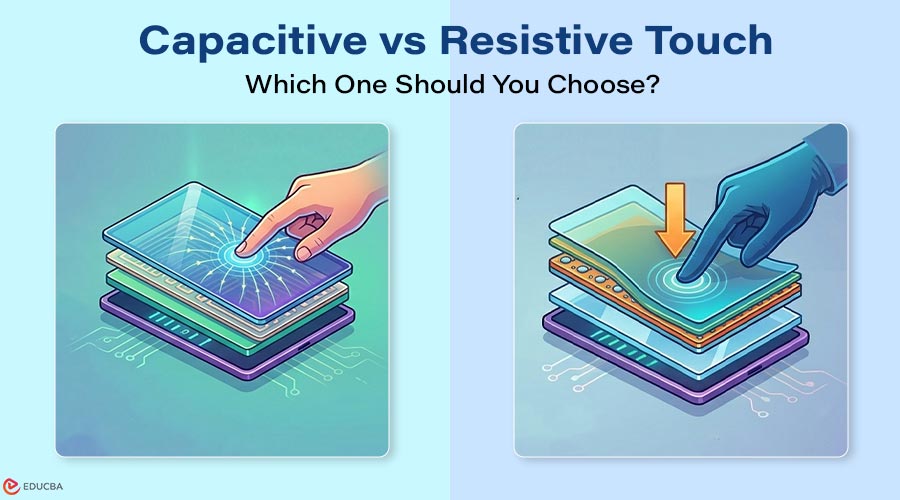
Capacitive vs Resistive Touch? How to Choose the Right Industrial Monitor
When selecting an industrial monitor, the touch technology is always a critical factor. The two mainstream options on the market are capacitive vs resistive touch. Choosing the appropriate touch type according to your working environment ensures smooth operation and improves overall productivity.
Capacitive Touch: Light Operation & High Durability
Capacitive touchscreens rely on human body electrical induction. They deliver fast response, support multi-touch, and provide a fluent user experience. Capacitive touch is ideal for frequently operated equipment, such as automated production lines, intelligent terminals, and self-service devices. Featuring a glass surface, capacitive screens are wear-resistant and long-lasting, with minimal touch drift even after extended use.
Industrial-grade capacitive touchscreens also offer strong anti-interference performance, suitable for environments with heavy electronic noise. However, capacitive screens have limitations. They do not support glove operation or input from non-conductive objects. Therefore, they are not suitable for scenarios that require gloves, such as food processing plants, laboratories, and medical settings.
Resistive Touch: Harsh Environment Ready & Precise Control
Resistive touchscreens operate based on pressure sensing. They can be activated by fingers, gloves, styluses, or any physical object, working reliably even under severe conditions. This makes resistive screens perfect for outdoor devices, construction sites, manufacturing workshops, and areas with heavy oil or dust.
Another advantage of resistive touch is its high accuracy, making it well-suited for precision-critical applications such as industrial control terminals, medical instruments, and precision equipment. On the downside, resistive screens have relatively lower durability and may become less sensitive over time. They only support single-point touch, resulting in a simpler interaction experience.
Capacitive vs Resistive Touch: How to Choose?
Choose a Capacitive Industrial Monitor If:
- Your working environment is clean
- You demand smooth, responsive interaction
- Applications include industrial automation, intelligent control, and self-service terminals
Choose a Resistive Industrial Monitor If:
- The site environment is complex and harsh
- Glove operation is required
- High positioning accuracy is needed
- Applications include manufacturing workshops, outdoor operations, and medical equipment
With numerous industrial monitor manufacturers available, selecting a professional supplier is essential. RCOMPT Technology has extensive expertise in industrial panel PC with touchscreen solutions, offering both capacitive and resistive industrial monitors to meet diverse environmental requirements and deliver stable, reliable performance. Choosing the correct touch method directly boosts efficiency and reduces maintenance issues. Selecting an industrial monitor is not only about cost it is about environmental compatibility and long-term durability. Match the product closely to your actual needs to make the best decision.
The ‘Counterattack’ of Resistive Touch Screens
In recent years, resistive touchscreens have seemed somewhat underrated, seemingly overshadowed by capacitive touchscreens with their fast response and smooth operation. Many people believe resistive displays are becoming obsolete, especially in consumer electronics such as smartphones and tablets, where capacitive screens dominate. However, if you label resistive touchscreens simply as “outdated,” you are mistaken. In fact, resistive touchscreens remain widely used across industrial applications and are still the most suitable choice in many scenarios.
Why Resistive Touchscreens Remain Popular?
First, resistive touchscreens offer irreplaceable advantages in specific environments. Their greatest feature is compatibility with any pressing object, such as gloves, styluses, or other tools. This is extremely important in industrial settings. In factories, warehouses, and outdoor sites, operators rarely work with bare hands. Gloves are essential in complex or high-temperature environments. Since capacitive screens rely on human conductivity, they fail with gloves, while resistive screens work reliably under physical pressure.
Second, resistive touchscreens are cost-effective. They are ideal for applications requiring stability and durability rather than premium touch performance. Although capacitive screens deliver faster response and multi-touch functionality, resistive screens excel in precise control and long service life, better matching real industrial demands.
Industrial Applications of Resistive Touchscreens
1. Factory Floors and Manufacturing Lines
Resistive touchscreens are widely deployed on production lines to adjust machine parameters, monitor progress, and operate equipment. Factory environments are dusty, oily, and hot, requiring operators to wear gloves. Capacitive screens cannot recognize gloved touches, while resistive screens respond accurately to pressure, even with thick work gloves.
2. Warehousing and Logistics Management
In logistics and warehousing, staff frequently use touchscreens to scan, enter data, and check inventory. Warehouses often have dust, moisture, and oily or dirty hands, which degrade capacitive touch sensitivity. Resistive touchscreens maintain stable performance under harsh conditions, avoiding slow or failed operations.
3. Outdoor Equipment
Resistive touchscreens feature prominently in outdoor control panels and public display terminals. Outdoor environments are subject to high temperatures, strong sunlight, rain, and exposure. Resistive screens support excellent dust and water resistance for continuous operation. Additionally, outdoor workers usually wear protective gloves, limiting capacitive screen usage, whereas resistive screens accept input from any object without restriction.
4. Medical Devices
Resistive touchscreens are still common in medical equipment, especially in applications that require frequent cleaning. Medical environments such as operating rooms and emergency rooms demand high stability. Resistive screens are simple, durable, and easy to sanitize, making them preferred for patient monitors, diagnostic instruments, and surgical consoles.
Additional Advantages of Resistive Touchscreens
- High Precision: Resistive touchscreens deliver far higher accuracy than capacitive alternatives. For industrial control and precise positioning tasks, they provide finer operation. Since they rely on pressure rather than conductivity, input accuracy remains excellent.
- Outstanding Durability: Constructed from two transparent conductive layers, resistive touchscreens offer strong wear and scratch resistance. They withstand frequent operation and mechanical impact. Even surface scratches rarely affect functionality.
- High Cost Efficiency: For mass production and bulk deployment, resistive touchscreens offer better cost-performance. While capacitive screens excel in sensitivity and visual quality, resistive screens meet practical needs at a lower cost with higher reliability when advanced multi-touch is unnecessary.
Resistive Touchscreens: Tough, Reliable Veterans
Resistive touchscreens have served industrial applications for years, mainly thanks to outstanding stability. They accept any input method: gloves, styluses, or even screwdrivers, to deliver a precise response. This makes them ideal for harsh environments such as mechanical processing and chemical factories. Manufacturers frequently recommend resistive screens to heavy-industry customers due to their excellent dust/water resistance, strong anti-interference performance, and cost advantages.
However, resistive screens have clear drawbacks. Their light transmittance is lower, their display quality is less delicate than that of capacitive screens, and long-term heavy pressing may wear the film layers. Even so, for devices that require only simple tapping, they remain the best cost-effective choice.
Capacitive Touchscreens: High-Sensitivity Smart Solution
If smooth, responsive interaction is your priority, capacitive touchscreens are the clear choice. They support multi-touch, deliver fast reaction speeds, feature high light transmittance, and produce sharper visuals. Manufacturers usually recommend capacitive screens for applications that require precise operation, such as medical equipment, smart warehousing, and high-end automated production lines.
Still, capacitive screens have a critical weakness: they do not work with ordinary gloves and are prone to false triggering under wet or oily conditions. They also cost more than resistive screens and offer weaker anti-interference capability. Therefore, capacitive screens are not ideal for extremely harsh operating environments.
Infrared Touchscreens: The Best Choice for Large Displays
Do you need an extra-large touchscreen? Infrared technology is almost your only option. It has no size limitations and easily supports screens from 55 inches up to 100 inches. With ultra-narrow bezels, infrared touchscreens excel in large-scale interaction scenarios, such as digital signage and command-and-control centers. Notably, when providing customized solutions, RCOMPT prioritizes infrared touch for large-screen projects.
That said, infrared touchscreens also have weaknesses. They are sensitive to strong ambient light; dust or stains can reduce accuracy, and installation and calibration are more complex than resistive or capacitive types. They perform best only under stable lighting and clean conditions.
Selection Rule: Application Scenario Determines Everything
When manufacturers recommend products, the actual working scenario always comes first.
- Hot, humid workshops → resistive touch is safe and reliable.
- Precision-driven medical devices → capacitive touch is preferred.
- Extra-large interactive displays → infrared touch is nearly irreplaceable.
Price is naturally an important factor, but never focus solely on low cost. Choosing the wrong touch type leads to high maintenance costs and unexpected downtime losses far beyond your budget. Next time you purchase industrial touchscreens, simply ask one question: What interaction experience does my equipment truly require?
About Guangdong Computer Intelligence Display Company
Guangdong Computer Intelligence Display Co., Ltd. is an innovative technology enterprise specializing in industrial-grade touch display solutions, integrating in-house R&D, manufacturing, and sales. Its main product portfolio includes industrial all-in-one panel PCs, industrial monitors, industrial tablets, compact industrial hosts, and smart digital signage displays. The detailed product series is as follows:
- RCOMPT CPT080 Industrial All-in-One Panel PC: Features an all-aluminum unibody frame with excellent dustproof and waterproof performance, suitable for harsh working environments, and supports customized hardware configurations.
- RCOMPT CPT180 Embedded Industrial Touch Panel PC: Equipped with dust/water resistance and multi-touch functionality.
- RCOMPT CPT100 Wall-Mounted Industrial All-in-One PC: Designed for space-saving wall installation in industrial control scenarios.
- RCOMPT CPT120 Multi-Function Kiosk PC: Supports IC/ID card reading, QR code scanning, and facial recognition modules.
- RCOMPT CPT150 Embedded Android Industrial Host with Dual Ethernet Ports: Optimized for stable network transmission and embedded deployment.
- RCOMPT CPT160 Floor-Standing High-Definition Smart Digital Signage: Delivers a clear visual display for commercial and public applications.
Core Product Advantages:
- All-aluminum unibody construction with front-panel IP65 protection rating.
- Optimized EMC electromagnetic compatibility design for strong anti-interference capability.
- Deep customization available for hardware specifications, I/O interfaces, and functional modules.
Industries apply RCOMPT products across industrial control, intelligent automation, smart healthcare, rail transit, smart manufacturing, transportation, logistics and warehousing, catering and retail, education, and medical services.
Final Thoughts
Although capacitive screens dominate consumer devices, the capacitive vs resistive touch comparison clearly shows that resistive technology remains vital in industrial settings. Their stability, cost efficiency, durability, and adaptability to harsh environments ensure extensive practical use. Whether in manufacturing workshops, logistics warehouses, outdoor facilities, or medical systems, resistive touch technology delivers unique and irreplaceable benefits. Resistive industrial displays are not obsolete; they continue to shine in countless industrial scenarios worldwide.
Recommended Articles
We hope this guide on capacitive vs resistive touch helps you choose the right industrial monitor. Explore these recommended articles for more insights.


