


What is Blue Ocean Strategy?
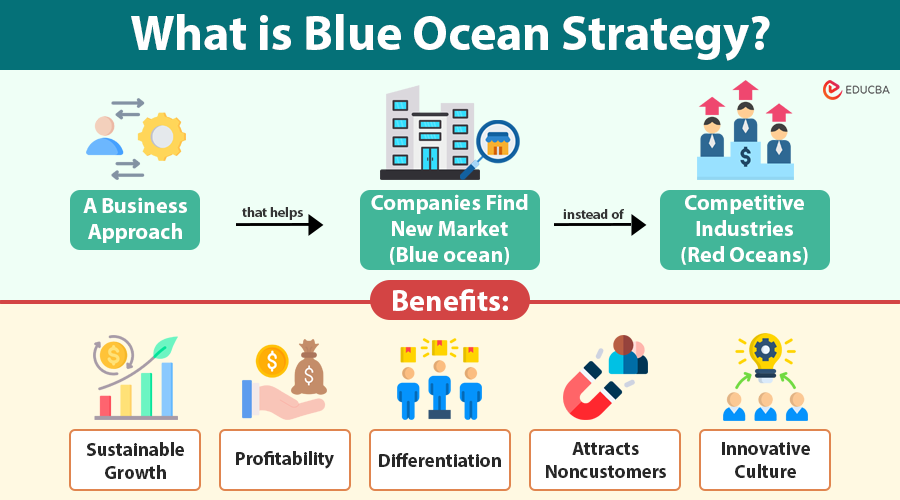
Blue ocean strategy is a business approach by W. Chan Kim and Renée Mauborgne that encourages companies to create new, untapped markets (“blue oceans”) instead of fighting for space in crowded, competitive industries (“red oceans”). The core idea is value innovation, delivering higher value to customers while simultaneously reducing costs, making competition irrelevant.
A classic example is Cirque du Soleil. Instead of battling traditional circuses that relied heavily on animal acts and low-cost family entertainment, Cirque du Soleil reimagined the circus experience. By blending elements of theater, live music, and acrobatics, it created a new form of premium entertainment tailored to adults and corporate clients. This innovative repositioning opened a blue ocean market with little direct competition and significantly higher profitability.
Table of Contents
- What is Blue Ocean Strategy?
- Core Principles of Blue Ocean Strategy
- Tools and Frameworks in Blue Ocean Strategy
- Examples of Blue Ocean Strategy in Action
- Benefits of Blue Ocean Strategy
- Challenges and Risks
- Blue Ocean vs. Red Ocean
- Implementing Blue Ocean Strategy in Business
Core Principles of Blue Ocean Strategy
Blue ocean strategy rests on six principles that help businesses systematically move from competition-driven thinking to innovation-driven growth:
1. Create Uncontested Market Space
Instead of competing within existing boundaries, companies look for ways to redefine industries. For example, Uber did not compete with taxis by offering cheaper fares; it created a new market space in ride-hailing powered by mobile apps.
2. Make the Competition Irrelevant
When companies create unique value, they differentiate themselves so strongly that competitors lose significance. Think of Spotify, instead of battling CD sales or piracy, it offered unlimited music streaming on demand.
3. Break the Value-Cost Trade-off
Traditionally, businesses believe they must choose between low cost and high differentiation. Blue ocean strategy challenges this by combining both. IKEA, for instance, delivers stylish furniture at affordable prices by innovating in self-service assembly and flat packaging.
4. Focus on Vision, Not Only on Figures
Businesses often chase incremental improvements, focusing on benchmarks, KPIs, and rivals. Blue ocean strategy encourages drawing a strategy canvas to see where the industry competes and where opportunities lie for innovation.
5. Reach Beyond Existing Demand
Instead of focusing solely on existing customers, companies must tap into non-customers, people who are aware of the industry but avoid it, or those who have never engaged with it. For example, Southwest Airlines tapped into people who avoided air travel due to high costs by offering affordable short-haul flights.
6. Get the Strategic Sequence Right
The strategy follows a clear sequence: utility → price → cost → adoption. A product must first deliver exceptional utility, then be priced attractively, developed at sustainable costs, and finally, adopted by customers.
Tools and Frameworks in Blue Ocean Strategy
Blue ocean strategy is not just a concept but a structured methodology supported by practical tools and frameworks. These tools guide businesses in analyzing existing markets, identifying hidden opportunities, and systematically creating new demand. Below are the key tools and frameworks that organizations use to successfully implement the blue ocean strategy.
1. Strategy Canvas
The Strategy Canvas is a key tool in blue ocean strategy. It visually illustrates how companies compete by highlighting the key factors in the industry and comparing the performance of different players on those factors. By analyzing this canvas, companies can clearly identify areas where competition is fierce and pinpoint those that are either over-served or under-served. The ultimate goal is to shift focus from competing head-to-head to creating a new value curve that stands apart from industry norms. For instance, Cirque du Soleil redefined the circus industry by focusing less on animal acts and more on theatrical storytelling and artistry.
2. Four Actions Framework
This framework encourages organizations to rethink industry standards by asking four critical questions: What should be eliminated, reduced, raised, and created? These questions help companies rethink old assumptions and reshape the value they offer. Instead of incremental improvements, firms can use this tool to unlock entirely new ways of delivering value. For example, Southwest Airlines eliminated unnecessary services, such as in-flight meals, reduced costs by using secondary airports, increased flight frequency, and created a fun, low-cost air travel experience.
3. Eliminate–Reduce–Raise–Create (ERRC) Grid
The ERRC Grid builds on the Four Actions Framework by providing a structured way to record decisions in a single-page matrix. This grid ensures that companies do not focus solely on cost reduction or differentiation but balance both simultaneously. It helps businesses articulate their strategic moves in a clear and actionable manner. By mapping out what to eliminate, reduce, raise, and create, organizations can systematically develop a unique value curve that appeals to a broader audience while maintaining efficiency.
4. Buyer Utility Map
The Buyer Utility Map enables businesses to look beyond product features and analyze how customers experience value throughout the entire purchase and usage cycle. It looks at six stages of the buyer’s journey: purchase, delivery, use, supplements, maintenance, and disposal, and matches them with six ways to add value, such as making things simpler, more convenient, more enjoyable, or reducing risks. By cross-referencing these dimensions, companies can pinpoint overlooked pain points or opportunities to delight customers. This tool is particularly useful in industries where customers encounter hidden problems or minor inconveniences.
5. Pioneer–Migrator–Settler (PMS) Map
The PMS Map is a portfolio management tool that categorizes products and services into pioneers, migrators, and settlers. Pioneers are offerings that create entirely new markets or industries, migrators represent incremental improvements over existing solutions, and settlers are traditional products competing in red oceans. By analyzing their portfolio, companies can ensure that they are not overly reliant on settlers and instead allocate resources toward pioneer projects that will drive future growth. This tool helps firms balance short-term stability with long-term innovation.
6. Three Tiers of Noncustomers
This framework encourages businesses to look beyond their current customers and tap into new demand by understanding non-customers. The first tier includes “soon-to-be” noncustomers who are on the verge of leaving the market. The second tier consists of “refusing” non-customers who consciously reject the industry’s offerings. The third tier represents “unexplored” non-customers whom the industry has never targeted. By identifying why these groups are not currently engaged, companies can discover new market opportunities and expand their reach. For example, Nintendo’s Wii appealed to non-gamer families and older adults whom the gaming industry had traditionally ignored.
Examples of Blue Ocean Strategy in Action
1. Southwest Airlines – Low-Cost, Fun Air Travel
Instead of competing with full-service airlines on luxury and amenities, Southwest Airlines targeted price-sensitive travelers. They eliminated costly frills like meals and seat classes, reduced turnaround times, increased efficiency through a single aircraft model (the Boeing 737), and created a low-cost, enjoyable flying experience. By blending affordability with reliability, Southwest tapped into new customer segments, including people who previously traveled by car or bus. This approach redefined air travel in the U.S. and inspired budget carriers worldwide.
2. Nintendo Wii – Expanding the Gaming Market
Before the Wii, gaming consoles competed on processing power, graphics, and complex gameplay, appealing mainly to hardcore gamers. Nintendo took a different approach by eliminating the industry’s obsession with technical superiority, reducing the complexity of gameplay, raising accessibility, and creating motion-sensor gaming that appealed to families, casual players, and older adults. The Wii became a global success, selling over 100 million units and bringing millions of non-gamers into the gaming market.
3. Apple iTunes – Transforming Music Consumption
When music piracy and illegal downloads were rampant, the music industry struggled to adapt. Apple applied the blue ocean strategy by eliminating the need for physical CDs, reducing piracy concerns through legal access, raising convenience, and creating iTunes as a platform where users could buy single tracks at affordable prices. This not only solved customer frustrations but also reshaped the entire music distribution industry.
4. Uber – Redefining Urban Transportation
Instead of competing with traditional taxi companies, Uber created a new market space by leveraging mobile technology. They eliminated the hassle of hailing cabs, reduced waiting times, raised transparency through GPS tracking and digital payments, and created a convenient ride-hailing platform. Uber attracted non-customers who previously avoided taxis due to unreliability, opening up a new global market for on-demand transportation.
Benefits of Blue Ocean Strategy
- Sustainable growth: Creates new demand rather than fighting for a limited supply.
- Profitability: Unique offerings command premium pricing.
- Differentiation: Strong, distinct positioning reduces competition.
- Attracts noncustomers: Expands beyond the existing customer base.
- Innovative culture: Encourages creativity and long-term vision.
Challenges and Risks
- High investment risk: Developing a new market requires significant resources.
- Customer resistance: Consumers may not accept radical innovations.
- Imitation: Competitors may quickly copy successful innovations.
- Execution barriers: Cultural resistance and organizational inertia can hinder implementation.
- Unpredictability: Market creation is uncertain; not all blue oceans succeed (e.g., Google Glass).
Blue Ocean vs. Red Ocean: A Comparison
| Aspect | Red Ocean Strategy | Blue Ocean Strategy |
| Market Space | Competes in existing markets | Creates uncontested market space |
| Competition | Focuses on beating the competition | Makes competition irrelevant |
| Demand | Exploits existing demand | Creates and captures new demand |
| Value–Cost Trade-off | Chooses between differentiation and low cost | Breaks the trade-off by pursuing both simultaneously |
| Innovation Focus | Incremental improvements | Value innovation (simultaneous cost reduction and value creation) |
| Risk Level | Lower risk but lower rewards | Higher risk but higher rewards if successful |
| Profitability | Shrinking profits due to rivalry | Potential for higher margins and sustainable growth |
| Examples | Traditional airlines, soft drink wars (Coke vs. Pepsi) | Cirque du Soleil, Nintendo Wii, Uber, Yellow Tail Wine |
Implementing Blue Ocean Strategy in Business
- Study the Industry Landscape using a strategy canvas.
- Identify Pain Points faced by customers and non-customers.
- Apply the ERRC Grid to reshape offerings.
- Use the Six Paths Framework to look beyond traditional boundaries.
- Ensure Strategic Fit by testing utility, price, cost, and adoption.
- Pilot New Offerings before scaling.
- Institutionalize Innovation, create a culture that constantly looks for blue oceans.
Final Thoughts
Blue ocean strategy is not about outperforming rivals; it is about making them irrelevant. By breaking free from traditional competition and focusing on innovation that delivers unique value, companies can discover new markets, attract non-customers, and achieve sustainable growth.
From Cirque du Soleil’s reinvention of entertainment to Reliance Jio’s disruption of the Indian telecom industry, the strategy has proven effective across various sectors. While not without risks, its emphasis on value innovation makes it one of the most powerful frameworks for businesses seeking long-term success.
Frequently Asked Questions (FAQs)
Q1. How is Blue Ocean Strategy different from Disruptive Innovation?
Answer: While both concepts involve innovation, disruptive innovation focuses on technologies or products that eventually replace existing ones, often starting with low-end markets. Blue ocean strategy emphasizes creating new market spaces and delivering unique value, without depending on the disruption of existing markets.
Q2. What industries are most suitable for Blue Ocean Strategy?
Answer: Industries with high competition, stagnant growth, or customer dissatisfaction are prime candidates for improvement. Examples include airlines, telecommunications, retail, healthcare, and digital entertainment. However, businesses can apply the strategy across virtually any sector.
Q3. Can Blue Ocean Strategy work in non-profit or government sectors?
Answer: Yes. Non-profits and government organizations can also create blue oceans by redefining how services are delivered. For example, microfinance institutions created a new market by directly serving people that the traditional banking system excluded.
Q4. What is the biggest misconception about Blue Ocean Strategy?
Answer: A common misconception is that it is only about being different. In reality, a blue ocean strategy requires being different in a way that delivers exceptional value while reducing costs. Simply being unique without creating value for customers does not qualify as a blue ocean.
Recommended Articles
We hope this comprehensive guide on blue ocean strategy gave you actionable insights. Explore our other strategy articles to deepen your understanding.

