

Updated May 13, 2024
Table of Contents
Difference Between Assembly Language and Machine Language
In this article, we will discuss in detail about assembly language vs machine language. Machine language is a language that has a binary form. A computer can directly execute it. An assembler is a software that converts assembly language, which is a low-level programming language, into machine code.
The programming language is a set of instructions in order to make a computer understand to perform a specific task or create an algorithm. A huge variety of programming languages are available nowadays, like C, C++, COBOL, Java, Python, Fortran, Ada, and Pascal.
All programming language has some primitive building blocks known as syntax. These syntaxes of languages are textual. Programmers combine primitives to compose new programs.
Broadly categorize programming languages into three categories.
- High-level programming language
- Assembly language
- Machine Language
A high-level language is easy for programmers to write as well as to understand. Programmers here use simple and easy syntax to address a specific task. Examples: Python, C, C++, etc. The CPU can’t understand these syntaxes; hence it gets converted internally to binary which the CPU can understand by the medium of a compiler and interpreter.
Assembly language falls between a high-level programming language and Machine language. It has syntaxes similar to English but is more difficult than high-level programming languages. To program in assembly language, one should have to understand the hardware level, like computer architecture, registers, etc. This kind of programming is mostly seen in the embedded systems.
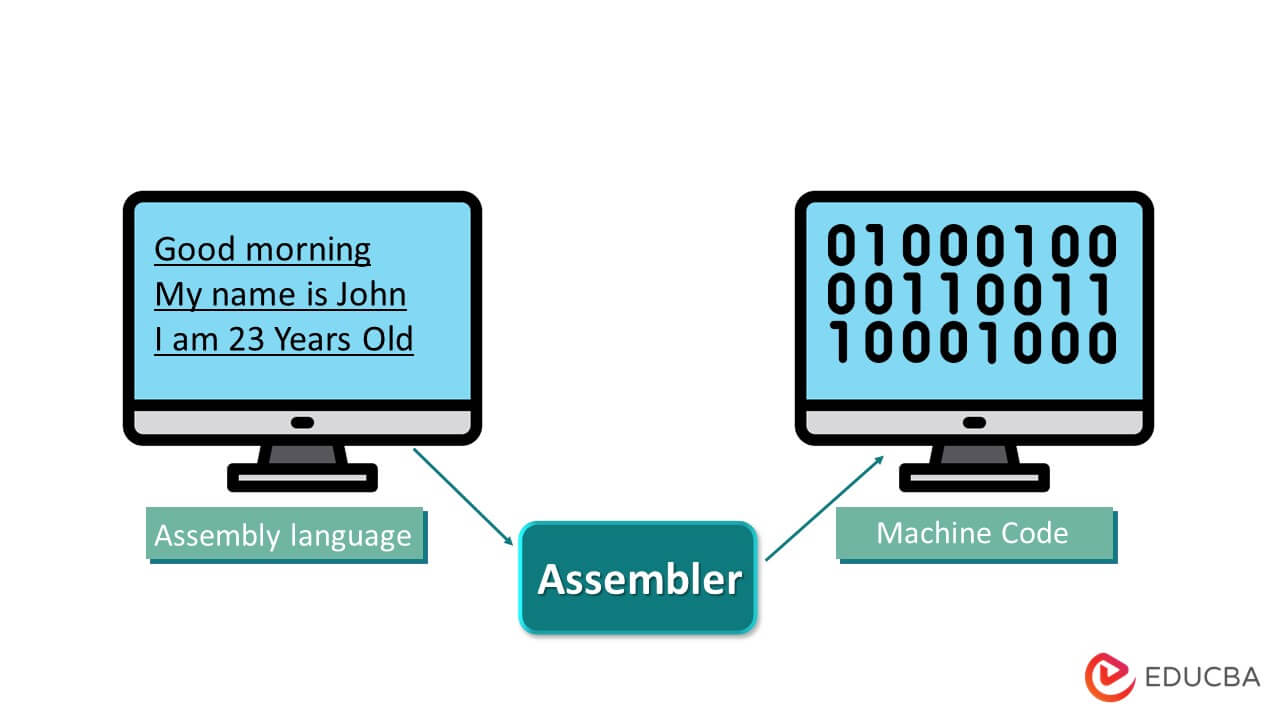
Computers easily understand machine language, which is a binary language. As a result, the CPU can directly execute it without requiring compilers and interpreters.
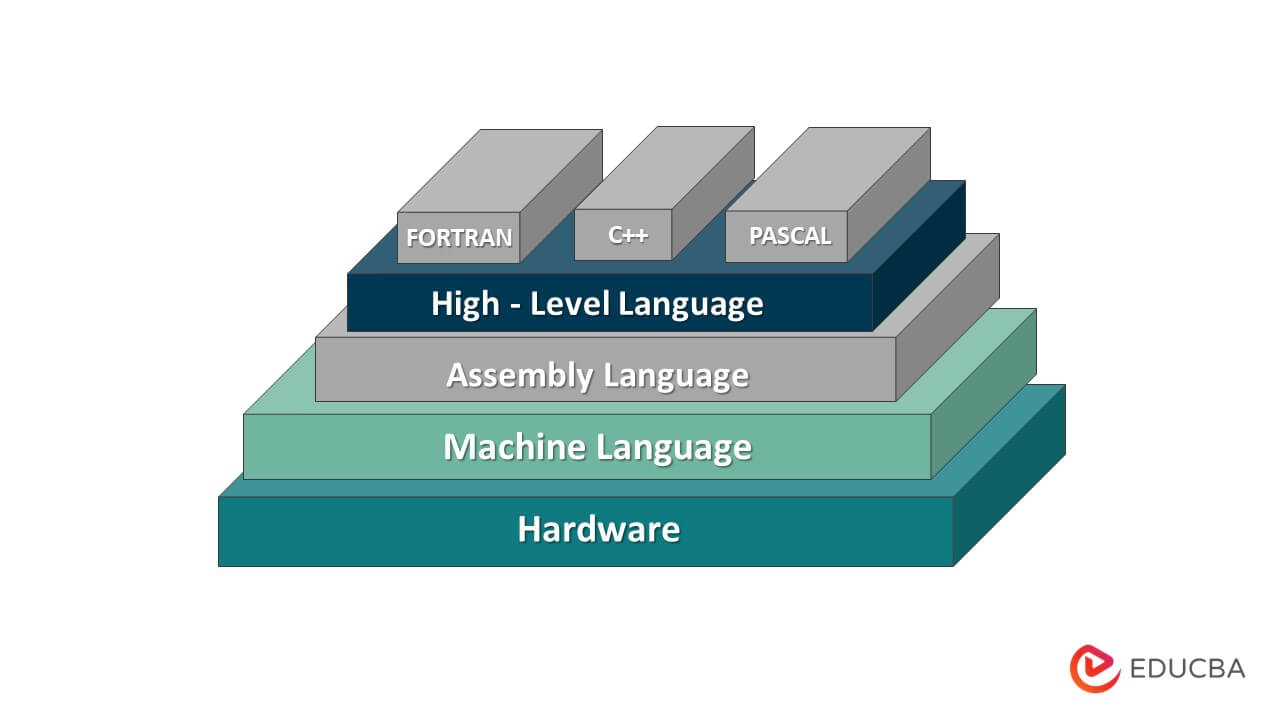
The figure shown above represents machine language, assembly language, and high-level language is clear form.
For e.g:001010001110
Represents a 12-bit machine language instruction. This instruction is divided into An operation code (or op code) and an operand.
Op code is 001, Operand is 010001110.
Along with remembering the dozens of code numbers for the operations, the programmer also has to keep track of the addresses for all the data items. Hence, Machine language is considered challenging and error-prone.
Head to Head Comparison between Assembly Language and Machine Language (Infographics)
Below is the top 7 difference between Assembly Language vs Machine Language.
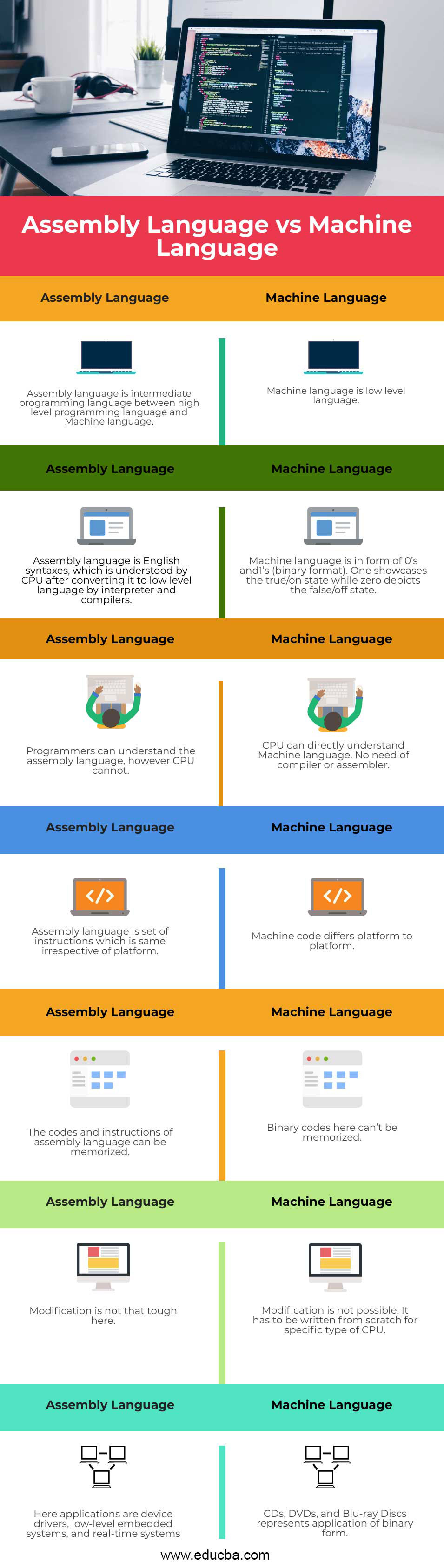
Key differences between Assembly Language and Machine Language
Let us discuss some of the major differences between Assembly Language vs Machine Language :
- Machine language consists of a sequence of bit patterns (i.e. binary form) that a computer executes directly, while Assembly language is a low-level language requiring a compiler and interpreter to transform the language into machine code, making it understandable to a computer.
- Machine language is platform-dependent, whereas Assembly is platform-independent. Platforms here referred to an operating system like Windows, Linux, etc.
- Machine language is not human-readable; however, you can interpret it by numbers by hand. Every instruction known as an “op-code” is a number that might be followed in memory by “operands”
Assembly language is a set of instructions that can be read by humans and can be understood as well. Here instead to remember the op-codes, “mnemonics” are used. It is, however, less readable than high-level language. - Machine language can be extremely time-consuming, tedious, and error-prone. However, that’s not the case with Assembly language, as mnemonic names and symbols are available here. It is much less tedious and error-prone than the binary machine code.
Programs written for one CPU architecture will not work for another CPU architecture – this is the problem with both these languages. Every new CPU architecture will have a new set of instructions; hence, to run the same program for other CPUs, one will have to write a program from scratch if it’s machine language. If it’s assembly language, accessing memory instruction will change; hence significant modifications will be a requirement.
Assembly Language vs Machine Language Comparison Table
Let’s look at the topmost Comparison between Assembly Language vs Machine Language.
| Assembly Language | Machine Language |
| Assembly language is an intermediate programming language between a high-level programming language and Machine language | Machine language is a low-level language. |
| Assembly language is English syntaxes, which the CPU understands after converting it to low-level language by interpreter and compilers. | Machine language is in the form of 0’s and 1’s (binary format). One showcases the true/on state, while zero depicts the false/off state. |
| Programmers can understand the assembly language; however, CPUs cannot. | CPU can directly understand Machine language. No need of a compiler or assembler. |
| Assembly language is a set of instructions that are the same irrespective of platform. | Machine code differs from platform to platform. |
| The codes and instructions of assembly language can be memorized. | You can’t memorize binary codes here. |
| Modification is not that tough here. | Modification is not possible. It has to be written from scratch for a specific type of CPU. |
| Here applications are device drivers, low-level embedded systems, and real-time systems | CDs, DVDs and Blu-ray Discs represent an application of binary form. |
Conclusion
To summarize, we can say assembly language is a level up from binary language. The CPU executes machine language directly, while the compiler first converts machine language to binary and then the CPU executes it. In this era, programmers widely use high-level language because of their ease of code, and that’s easy to understand.
Recommended Articles
We hope that this EDUCBA information on “Assembly Language vs Machine Language” was beneficial to you. You can view EDUCBA’s recommended articles for more information.