


Updated August 31, 2026
Introduction to Analytics Frameworks in Business
In the data-driven world, businesses collect more information than ever, but many still struggle to turn it into a real strategy. That is where frameworks like SWOT analysis bridge the gap between analytics and decision-making. While people often use Business Intelligence (BI), Business Analytics (BA), and Strategic Analytics (SA) interchangeably, each one actively transforms raw data into insight and turns that insight into action. Understanding how these three layers connect is essential for anyone who wants to make data actually drive business outcomes.
What Is Business Intelligence (BI)?
Business Intelligence represents the foundation of any data-driven organization. It is all about visibility, transforming raw data into accessible dashboards, reports, and key performance indicators (KPIs) that describe what is happening across the business. Within the broader scope of Analytics Frameworks in business, BI focuses on descriptive insights, the starting point for informed decision-making.
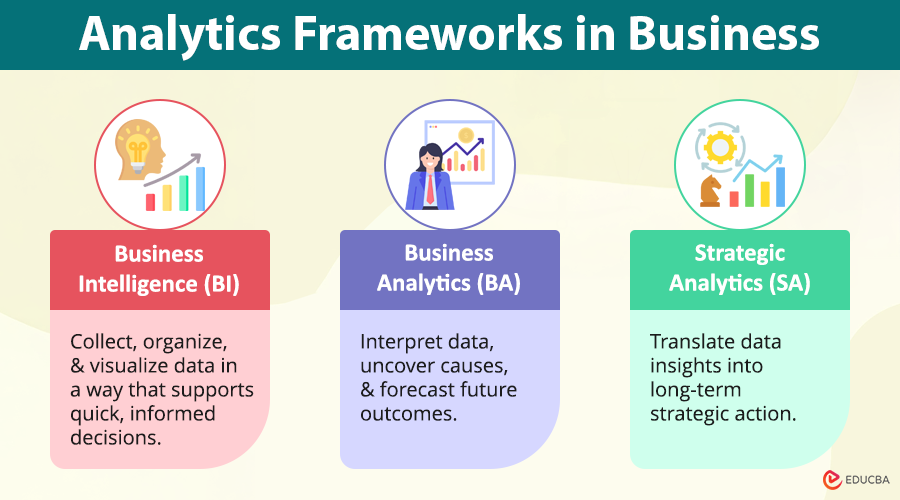
- Purpose: To collect, organize, and visualize data in a way that supports quick, informed decisions.
- Key Question: What happened?
- How It Works: BI systems integrate information from various sources such as sales, operations, marketing, and finance to provide a comprehensive snapshot of business performance. These systems help identify trends, detect inefficiencies, and track metrics in real time.
- Common Tools: Microsoft Power BI, Tableau, Looker, Google Data Studio.
- Example: Imagine a retail company using BI dashboards to track its daily sales performance. Executives can immediately see which stores are underperforming, how regional trends are shifting, and whether certain product categories are driving the most revenue.
In short, Business Intelligence provides the “what,” but not necessarily the “why.” It forms the first step in applying Analytics Frameworks in business.
What Is Business Analytics (BA)?
If Business Intelligence shows what happened, Business Analytics goes further to explain why it happened and what might happen next. This second layer of Analytics Frameworks in business focuses on interpretation and prediction.
- Purpose: To interpret data, uncover causes, and forecast future outcomes.
- Key Question: Why did it happen, and what is next?
- How It Works: BA uses statistical methods, predictive modeling, and advanced data processing to generate insights beyond descriptive reporting. It helps companies move from reactive decision-making to proactive problem-solving.
- Common Techniques: Regression Analysis, Forecasting Models, Data Mining, Clustering and Segmentation, Predictive Analytics.
- Example: Let us return to our retail example. After discovering declining sales in certain regions, the analytics team uses predictive modeling and finds that slower delivery times are causing customer churn. By identifying this relationship, the business can implement logistical improvements before the issue worsens.
Outcome: While BI provides the scoreboard, BA gives you the playbook. Together, they represent the operational side of Analytics Frameworks in Business, helping organizations optimize performance and anticipate change.
What Is Strategic Analytics (SA)?
The final layer, and often the most overlooked, is Strategic Analytics. This is where insights evolve into direction and strategy. It is the most forward-looking element of Analytics Frameworks in business.
- Purpose: To translate data insights into long-term strategic action.
- Key Question: What should we do, and why?
- How It Works: Strategic Analytics integrates frameworks from strategy and management, such as SWOT, PESTEL, Porter’s Five Forces, and Value Chain Analysis, with quantitative data from BI and BA. Instead of focusing solely on operational metrics, SA explores the strategic implications of data.
- Common Tools and Frameworks: SWOT Analysis, PESTEL Analysis, Porter’s Five Forces, Value Chain Analysis, Scenario Planning.
- Example: A retail company considering expansion into a new market uses Strategic Analytics to evaluate internal strengths and weaknesses (using SWOT), external market opportunities, customer behavior forecasts, and competitive threats. The outcome is a clear, data-backed strategy for growth, not just a report of what is happening now.
Why It Matters: Strategic Analytics transforms numbers into narratives, showing how a business can adapt, compete, and thrive in a changing environment. It connects technical teams and executives so that insights lead to real business results. In essence, it completes the cycle of Analytics Frameworks in Business.
Key Differences in Analytics Frameworks in Business
| Aspect | Business Intelligence (BI) | Business Analytics (BA) | Strategic Analytics (SA) |
| Main Focus | Reporting and Visualization | Understanding and Prediction | Strategy and Decision-Making |
| Core Question | What happened? | Why did it happen? | What should we do? |
| Time Horizon | Past | Present and Near Future | Future and Long Term |
| Typical Users | Analysts, Managers | Data Scientists | Executives, Strategists |
| Output | Dashboards, KPIs | Insights, Forecasts | Strategic Actions |
| Example Tool | Power BI | Python, R | SWOT, PESTEL |
Why Understanding Analytics Frameworks in Business Matters?
Many organizations confuse reporting with strategy. However, while BI and BA are valuable, they often stop short of real decision-making.
- BI without BA = Data with no interpretation.
- BA without SA = Insights with no direction.
- SA without BI or BA = Strategy without evidence.
When all three work together, businesses create a powerful data ecosystem, a hallmark of mature Analytics Frameworks in business:
- BI provides the foundation of clean, visualized data.
- BA provides an understanding of patterns and causes.
- SA provides the strategic alignment that drives competitive advantage.
Real-World Example:
Consider a telecommunications company noticing a rise in customer churn.
- BI identifies where churn is happening (specific regions or products).
- BA explains why (pricing model, network reliability, customer service quality).
- SA defines the next steps (pivoting pricing strategy, improving retention programs, or targeting new segments).
This integration shows how Analytics Frameworks in business can help organizations not only understand performance but also act on it strategically.
How to Implement Analytics Frameworks in Business?
- Collect and Centralize Data (BI): Build dashboards and systems that make key performance data visible across departments.
- Analyze for Insights (BA): Use statistical models and predictive analytics to uncover trends, patterns, and relationships.
- Align with Strategic Frameworks (SA): Apply structured tools such as SWOT to connect insights to high-level decisions.
- Act and Review: Translate strategy into measurable goals, execute, and refine using feedback loops.
The Future of Analytics Frameworks in Business
As AI and automation make analytics more accessible, the differentiator will not be who has the most data, but who asks the right strategic questions. Companies that integrate Analytics Frameworks into their business culture gain a sustainable edge. They not only react faster but also think better, using data as a compass, not just a mirror.
Strategic Analytics does not replace Business Intelligence or Business Analytics. It completes them.
Final Thoughts
In the end, Business Intelligence tells you what happened, Business Analytics tells you why it happened, and Strategic Analytics tells you what to do next. Organizations that master all three layers do not just collect data, they convert it into direction. They turn insights into impact. They make data meaningful.
Recommended Articles
We hope this guide on Analytics Frameworks in business helps you understand how BI, BA, and SA work together to turn data into strategy. Explore these articles for more insights on data analytics, business intelligence tools, and strategic decision-making in modern organizations.


