


Updated May 11, 2026
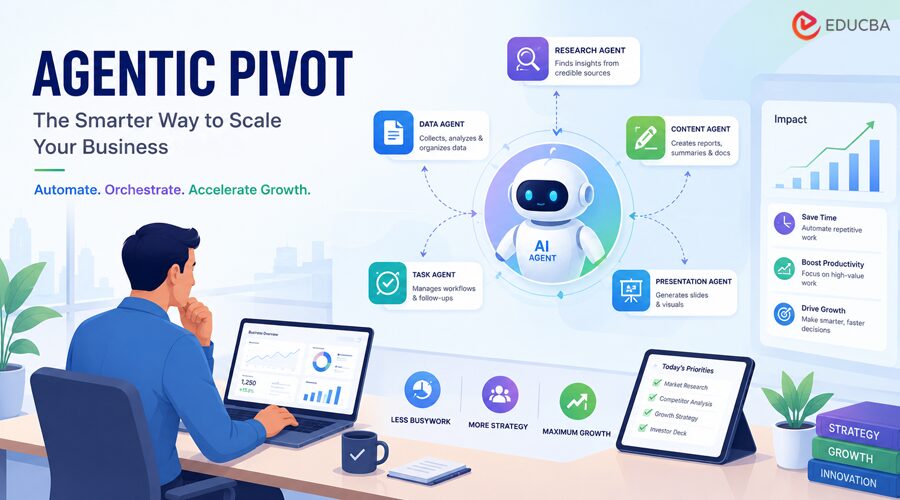
Not long ago, scaling a business often meant hiring more people to handle increasing amounts of paperwork and repetitive operational tasks. Many professionals found themselves working late into the night, managing countless browser tabs and acting as a “human bridge” between disconnected applications. This constant context-switching created an exhausting cycle of manual work that slowed productivity and limited strategic growth. Fortunately, 2026 has introduced a smarter solution through the Agentic Pivot.
This shift goes beyond simply using AI tools. The Agentic Pivot is a shift toward orchestrating an intelligent digital workforce capable of handling complex, multi-step tasks autonomously. This guide explores how the Agentic Pivot is reshaping modern business operations and how moving to a unified AI workspace can eliminate busywork, streamline workflows, and free teams to focus on meaningful business growth.
Table of Contents
- Understanding “Digital Glue-Work”
- The Five Steps to an Agentic Workflow
- Why “Reactive AI” is Failing Your Team?
- The Power of Unified Creation: Research to Slides
- HIX AI: The Definitive Agentic Workspace
- Safeguarding Your Intellectual Moat
The Hidden Tax: Understanding “Digital Glue-Work”
In many modern office environments, a significant portion of the workday is no longer spent on strategic thinking but on what can be described as Digital Glue-work. This includes repetitive tasks such as locating information across multiple tabs, summarizing data into documents, and manually formatting reports or presentations. These routine processes consume valuable time and mental energy while adding little strategic value. Research and workplace trends show professionals spend a substantial share of productivity on administrative coordination.
This creates an invisible drain on efficiency and return on investment. By adopting the Agentic Pivot and moving to platforms like HIX AI and The AI Agent Workspace, businesses are not simply adopting another software tool; they are implementing an intelligent cognitive system that can autonomously execute multi-step workflows. This shift allows professionals to move away from repetitive operational labor and focus more on strategic decision-making and business leadership.
The Five Steps to an Agentic Workflow
Organizations aiming to create a future where workflows operate with greater automation and efficiency can follow a structured roadmap to achieve a successful Agentic Pivot.
1. Identify the Context-Switches
Take a week to track every time your team has to move data between apps. These “context-switches” are where your momentum dies. Pinpointing these gaps is the first step toward automation.
2. Transition from Tools to Agents
Businesses should stop viewing AI merely as a “chatbot” and begin adopting intelligent “agents” capable of autonomous execution. Traditional chatbots depend entirely on user prompts, whereas AI agents can independently manage and complete multi-step tasks with minimal supervision. Modern organizations are increasingly prioritizing systems that seamlessly combine research, analysis, and content production within a single workflow to improve efficiency and reduce operational friction.
3. Establish the “Golden Thread” of Data
For AI to work effectively, it needs to learn your specific operational rhythm. You must feed your workspace the unique data points that define your brand. This creates a “Golden Thread” of intelligence that runs through every report and presentation you produce.
4. Foster a Culture of Leverage
Organizations must clearly communicate to their teams that this technology is not designed to replace employees but to enhance their capabilities through powerful digital support. When employees learn to manage and collaborate with AI agents, productivity, innovation, and creativity can rise significantly.
5. Audit for Accuracy
Despite their advanced capabilities, AI models can still produce inaccurate or misleading information, often referred to as “hallucinations.” Maintaining a human-in-the-loop review process for the final stage of work helps ensure accuracy, preserve brand credibility, and maintain a high standard of quality across all outputs.
Why “Reactive AI” is Failing Your Team?
One of the most common frustrations among executives is that many current AI tools create additional work rather than reducing it. This happens because most traditional AI systems are reactive; they wait for user prompts and require constant manual input before taking action. In 2026, we have moved past this. The new standard is Agentic Autonomy. An agentic system understands a high-level goal, such as “Analyze the 2026 tech trends in Singapore and draft a market entry brief,” and breaks it down into subtasks without needing to hold your hand. This is how you reclaim your valuable hours.
The Power of Unified Creation: Research to Slides
Instead of juggling five different subscriptions, imagine a single workflow where the “thinking” and the “showing” are perfectly synced. Modern AI systems can now perform deep research using primary sources and instantly transform that information into visually compelling presentations. Within minutes, businesses can move from raw, complex data to polished, boardroom-ready slide decks using specialized tools such as HIX AI’s AI Slide Generator. This end-to-end automation significantly reduces the time previously spent on tedious manual formatting and presentation design, allowing teams to focus more on analysis, strategy, and decision-making.
HIX AI: The Definitive Agentic Workspace
For organizations looking to implement these strategies in practice, HIX AI is often positioned as a strong option to integrate into daily operations. It serves as a unified command center for handling complex, multi-step tasks that typically consume significant team time and energy. Its autonomous agents can manage workflows ranging from technical research and analysis to marketing asset creation. By shifting these analytical and operational responsibilities to a unified workspace, businesses can significantly increase overall output. This approach reduces time spent managing disconnected tools, allowing teams to focus on strategic growth and business development.
Safeguarding Your Intellectual Moat
When AI is woven into a business’s core operational system through the Agentic Pivot, privacy becomes a critical factor for long-term survival. Many firms expose proprietary and sensitive data to unsecured AI environments, risking leaks and competitive harm. To mitigate this risk within the Agentic Pivot framework, organizations must operate within a Sandboxed Environment that ensures strict data isolation and control.
This concept of “Digital Sovereignty” enables businesses to develop and maintain a private, secure knowledge base that protects internal information. Over time, as the system is used more extensively in an Agentic Pivot-driven workflow, the AI agents become increasingly aligned with the organization’s specific processes, brand voice, and industry context. This ongoing refinement strengthens operational intelligence and helps build a durable competitive advantage that external competitors cannot replicate.
Final Thoughts
Embracing the Agentic Pivot is no longer optional for those aiming to lead; it has become a necessity for scaling in 2026. By implementing the outlined strategies, organizations can completely reshape their daily operations. This technological shift is positioned to save countless hours by reducing reliance on repetitive, time-consuming tasks. Instead of letting routine tasks control schedules, businesses can start small, use a unified workspace, and scale adoption gradually. As a result, teams can reach new productivity levels, freeing time for higher-value strategic work.
Recommended Articles
We hope this guide on the Agentic Pivot helps you reduce manual work, improve efficiency, and scale your business with AI-driven workflows. Explore the recommended articles below to learn more about AI automation, unified workspaces, and modern productivity strategies for 2026.


