


Updated August 26, 2026
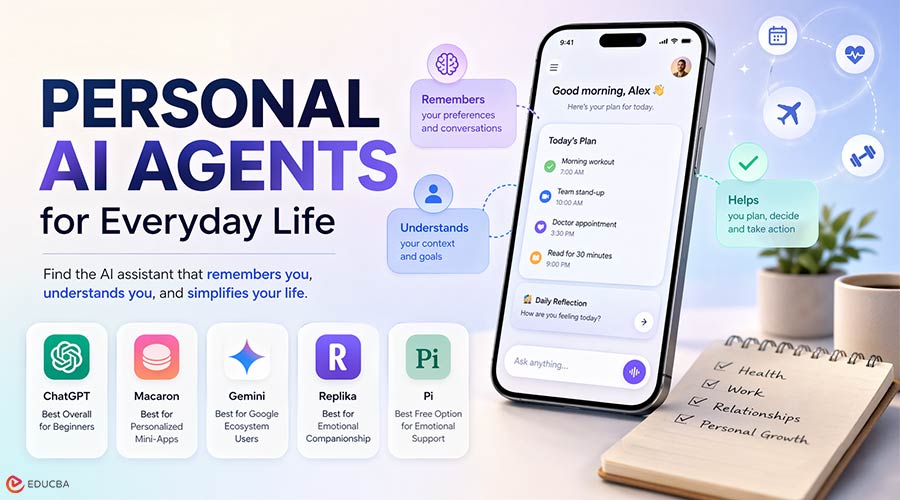
This guide is for everyday users who have tried ChatGPT or a similar tool and are now wondering whether there is a better, more personalized AI for daily life, not just for work tasks. A personal AI agent is an AI application designed to remember you across conversations and help with recurring parts of your personal life, such as schedules, health routines, travel, relationships, and decision-making. Unlike a generic chatbot that resets its state every session, it builds persistent context about you and uses it to provide more relevant responses over time. In 2026, the personal AI agents category has matured enough that beginners have several strong options. This guide compares the top 5 personal AI agents for everyday life, explains what each does best, and helps you decide which fits your routine.
Table of Contents
- What is a Personal AI Agent?
- How We Compared the Top 5 Personal AI Agents?
- Top 5 Personal AI Agents for Everyday Life
- Side-by-Side Comparison Table
- How to Choose the Right Personal AI Agent for You?
What is a Personal AI Agent?
A personal AI agent is an AI system built around three ideas:
- Persistent memory: it remembers details from previous chats, so you do not have to start fresh each time.
- Personal context: its output is shaped by what it knows about you specifically, not generic prompts.
- Multi-step helpfulness: it can plan, remind, draft, and (in some cases) generate small tools or actions on your behalf.
Technically, modern personal AI agents represent a shift from stateless chat sessions to stateful AI systems that carry user context across interactions.
Most modern personal AI agents combine technologies such as:
- Retrieval-augmented generation (RAG) to power LLM long-term memory by retrieving relevant past information
- Vector embeddings for semantic search across previous conversations
- Reinforcement learning systems decide which personal details to remember and store.
The personal AI agents category sits between two older product types:
- Traditional AI chatbots that answer questions but forget users between sessions
- AI companions are designed mainly for emotional conversation.
Modern personal AI agents combine both approaches, focusing on practical everyday usefulness. As of 2026, memory-enabled personal AI agents are no longer experimental. Major AI companies, including OpenAI, Google, Anthropic, and several startups, have introduced persistent-memory AI systems for everyday users.
How We Compared the Top 5 Personal AI Agents?
To rank the best personal AI agents for everyday life, we evaluated five criteria that matter in real-world settings.
- Memory depth: how much the AI remembers and how consistently it uses that memory across sessions
- Everyday-life usefulness: whether the product is actually designed for personal routines, not just work tasks
- Ease of use for beginners: how quickly a new user gets value without technical setup
- Platform availability: web, iOS, Android, and whether key features work on free plans
- Transparency and privacy controls: whether you can view, edit, or delete what the AI remembers.
No single product dominates every category. The following ranking highlights the best personal AI agents for beginners in 2026.
Top 5 Personal AI Agents for Everyday Life
1. ChatGPT (with Memory) — Best Overall for Beginners
Best for: users who want a familiar, general-purpose assistant with persistent memory layered on top.
ChatGPT ranks first among personal AI agents because it is already the most widely used AI platform globally. With the introduction of memory features in recent years, it now functions as a true personal AI agent rather than just a chatbot.
OpenAI’s system works through:
- Saved memories that you explicitly ask it to remember
- Chat history reference that automatically pulls useful past context.
These features allow ChatGPT to behave like a long-term personal AI assistant that remembers preferences, writing styles, and ongoing projects.
Pros:
- Remembers dietary preferences, project context, writing style, and recurring topics across sessions
- Works for both work tasks and personal routines in the same app
- You can view, edit, or delete saved memories in settings at any time
- Temporary Chat mode lets you have sessions that do not update or reference memory.
Cons:
- ChatGPT builds on a general-purpose chatbot, so it does not optimize specifically for life management
- GDPR restricts Personal Context and advanced memory features in the EEA, the UK, and Switzerland
- It does not generate interactive mini-tools; output stays in chat.
Pricing: Free tier with basic memory; Plus at $20/month for full memory + chat history reference.
2. Macaron — Best for Personalized Mini-Apps
Best for: users who want an AI that turns everyday needs into small, personalized tools instead of chat replies.
Macaron is the strongest purpose-built personal AI agent on this list. Unlike ChatGPT, which adds memory on top of a general chatbot, Macaron was built from the ground up around memory and everyday life. It officially launched in August 2025 and is available in North America, Japan, and South Korea.
The feature that makes Macaron distinct is its ability to generate personalized mini-apps inside a chat. Instead of giving you only conversational replies, Macaron can spin up small, personalized tools, a calorie tracker that knows your dietary style, a travel planner that knows your pace, a reading companion that knows your genre preferences, or a habit tracker tied to goals you have actually stated. This replaces the usual pattern of downloading a separate app for every life task.
Macaron’s memory system, which the team calls Deep Memory, uses reinforcement learning to identify which details are worth retaining, preferences, recurring goals, and emotionally meaningful context, rather than logging everything.
Pros:
- Mini-apps inherit your full personal context automatically, so a new tracker is never generic
- Memory focuses on life patterns such as routines, goals, and preferences rather than just factual preferences
- Mobile-first product with a simple chat interface for beginners
- Free tier available; paid tiers unlock more mini-app complexity.
Cons:
- Currently, it is a mobile-first app, which may not suit desktop-heavy users
- The category of AI-generated mini-apps is new enough that some tools may still have rough edges
- Language coverage is currently English, Japanese, and Korean.
Pricing: Free tier; Classic Monthly around $18.99/month; Classic Annually around $167.99.
3. Google Gemini (with Personal Context) — Best for Google Ecosystem Users
Best for: users already inside Gmail, Google Calendar, and Google Drive who want an AI that pulls from those sources.
Gemini’s advantage is integration. If your life already runs through Google’s apps, Gemini can reference your calendar, email, and documents as personal context when answering questions, something no standalone AI agent can match for a Google-native user. Outside the European Economic Area, the UK, and Switzerland, users enable Personal Context by default, as GDPR excludes those regions.
Pros:
- Pulls from real personal data sources (Gmail, Calendar, Drive) when authorized
- Good for logistics: “What is on my calendar next Tuesday?” “What did I discuss with Sarah last month?”
- Works across web, Android, iOS, and inside Workspace apps.
Cons:
- OpenAI disables Personal Context by default in parts of Europe, which reduces its usefulness there
- Less focused on long-term personal growth than Macaron or the companion-first apps
- Users have raised transparency concerns because memory storage is less inspectable than that of some competitors.
Pricing: Free tier with limited features; Google AI Pro plan from around $20/month.
4. Replika — Best for Emotional Companionship
Best for: users whose primary need is a warm, long-term conversational companion for venting, journaling, loneliness, and social practice.
Replika has been operating since 2017 and now serves over 10 million users worldwide. It occupies a different corner of the personal AI space. Rather than helping you plan logistics or build tools, it provides emotional support and helps you develop a relationship with it over time. Users widely regard its memory system as one of the most mature in the companion category. Users report the AI remembering small details from months earlier.
Pros:
- Customizable 3D avatar, voice calls, and (on higher tiers) AR mode
- Memory bank and conversation diary that users can inspect and correct
- Available on iOS, Android, web, and Meta Quest
- Strong fit for users interested in mental-wellness journaling and social practice.
Cons:
- Not designed for productivity, scheduling, or practical life management
- Premium pricing is high relative to feature depth (Pro around $20/month)
- Some users report repetitive phrasing on the free tier.
Pricing: Free tier; Pro around $19.99/month; Ultra tier around $12.50/month (annual-priced); Lifetime around $299.99.
5. Pi by Inflection — Best Free Option for Emotional Support
Best for: users who want a free, low-pressure AI to talk through feelings, prep for hard conversations, or vent.
Pi, from Inflection AI, was built specifically as an emotionally intelligent AI. Its personality is warm, diplomatic, and non-judgmental, closer to a patient friend than a productivity tool. Pi remained operational after Inflection’s 2024 leadership transition (co-founders moved to Microsoft; the company brought in a new CEO), and it continues to receive app updates in 2026.
Pros:
- Free to use, with free voice mode
- Excellent onboarding for users new to AI; no setup required
- Tone is genuinely calming, which suits venting, decision talk, and emotional support.
Cons:
- Free usage is now rate-limited as Inflection pivots toward enterprise products
- Messaging-app integrations (WhatsApp, Messenger) were discontinued in 2024
- Weaker on practical life management than Macaron or ChatGPT
- The long-term product roadmap is less certain than it was pre-2024.
Pricing: Free, with usage caps for heavy users.
Side-by-Side Comparison Table
| Product | Best For | Memory Depth | Mini-Apps / Tools | Free Tier | Starting Paid Price |
| ChatGPT | General-purpose assistant | Strong (saved + history) | No | Yes | $20/mo (Plus) |
| Macaron | Mini-app generation for life tasks | Strong (Deep Memory) | Yes | Yes | ~$18.99/mo |
| Google Gemini | Google ecosystem users | Medium (Personal Context) | No | Yes | ~$20/mo |
| Replika | Emotional companionship | Strong (memory bank + diary) | No | Yes | ~$19.99/mo |
| Pi by Inflection | Free emotional support | Medium (session-level) | No | Yes (rate-capped) | N/A |
How to Choose the Right Personal AI Agent for You?
The best personal AI agent depends on what you want AI to do in your life. Use these short rules of thumb:
- If you want one AI that does everything, start with ChatGPT. The memory feature covers most everyday needs, and the learning curve is near zero.
- If you want an AI that builds tools for your life, try Macaron. Its mini-app model is structurally distinct from the others on this list, and it suits users who dislike juggling multiple apps for small tasks.
- If you already use Google Workspace, Gemini’s Personal Context gives you direct access to your actual calendar and inbox, which no standalone agent can match.
- If your main need is emotional connection, Replika is the most mature option in the companion space, and Pi is the strongest free alternative.
A helpful strategy for beginners is to test two personal AI agents simultaneously, one practical assistant and one conversational companion, to see which fits your lifestyle.
Final Thoughts
If you are new to personal AI agents, start by trying ChatGPT to understand how memory-enabled AI feels in everyday use. Once you are comfortable, try Macaron to experience a different model, one built specifically around life tasks and personalized mini-apps rather than generic chat. These two together cover the most common everyday use cases for beginners, and both offer free tiers to get started. Personal AI is still a young category, and the tools above will evolve. However, as of 2026, these are the five options worth knowing if you want an AI that actually fits into your daily life.
Frequently Asked Questions
Q1. What is the best personal AI agent?
Answer: For most beginners, ChatGPT with Memory is the best overall choice due to its broad capabilities and mature memory features. For users who want an AI that generates personalized tools for daily tasks, Macaron is the strongest purpose-built option.
Q2. Is ChatGPT a personal AI agent?
Answer: Yes, but only if you enable the Memory feature. With Memory on, ChatGPT remembers preferences, context, and ongoing projects across sessions. Without it, ChatGPT is a stateless chatbot that forgets you between chats.
Q3. What is the difference between a personal AI agent and an AI chatbot?
Answer: A traditional AI chatbot forgets you between conversations. A personal AI agent uses persistent memory to build long-term context about your preferences, goals, and routines, and can take multi-step actions on your behalf.
Q4. Are personal AI agents free?
Answer: Yes, most offer free tiers. ChatGPT, Macaron, Gemini, Replika, and Pi are all free. Advanced features like longer memory, voice calls, or higher message limits typically require a paid subscription.
Q5. Can a personal AI agent remember you?
Answer: Yes. All five tools in this guide offer persistent memory, though the depth varies. You can usually view and delete what the AI remembers about you directly in settings.
Recommended Articles
We hope this guide on Personal AI Agents helps you understand how memory-driven AI systems are transforming everyday life, from personal decision-making to habit tracking and digital companionship. Explore the recommended articles below to learn more about AI assistants, intelligent automation, and the future of personalized AI experiences.


