


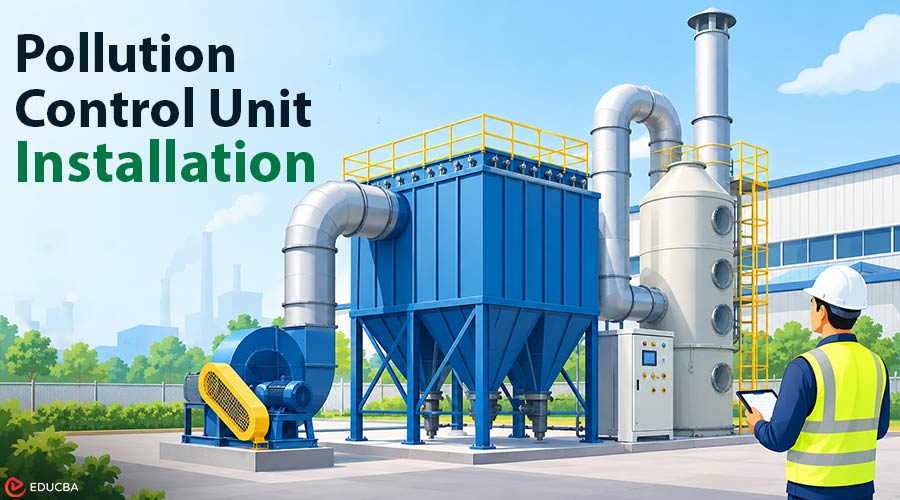
A pollution control unit installation may involve an indoor plant room, an outdoor service area, or a rooftop. These descriptions do not establish that the same configuration and documentation apply in every location. The installation review needs the proposed environment, system position, and model scope before a general product description can become a project decision.
Electrostatic precipitation, UV-C, and activated carbon can be configured as different stages, with different supporting documents. A manufacturer’s discussion of installation options is useful, but it should remain separate from confirmation that the proposed assembly and its conditions suit the specific site.
Identify the Position in the Exhaust System
Show the actual location. Identify the upstream hood, treatment sequence, downstream duct, and discharge arrangement so the supplier and responsible designer review the same installation. A model number without its system context leaves important assumptions unstated.
Polygee’s guide to a pollution control unit places the treatment in the grease exhaust duct and distinguishes it from the hood, fan, and other system components. The document request should preserve those boundaries rather than treating every item as part of a single certified product.
UL Solutions describes its pollution-control-unit safety outline as covering assemblies installed in line with commercial grease ducts that exhaust cooking emissions outdoors. That published context should not be extended into a claim about recirculation or another system arrangement without the applicable documents.
Confirm the Offered Outdoor Pollution Control Unit Installation Configuration
Polygee’s UV-C page states that a weather-rated enclosure is available for rooftop installations. Availability is not the same as inclusion in a particular order. A rooftop proposal needs to identify which enclosure and configuration are actually being supplied.
Outdoor and rooftop installations are also available on request, per the activated carbon page, with enclosure options to address environmental exposure. That statement does not provide a universal environmental rating for every standard carbon cabinet.
Describe the intended conditions to the supplier. The responsible project team needs the relevant installation instructions and limitations for the selected equipment, not the assumption that a product photograph taken outdoors proves suitability for every roof or external service area.
Keep the answer attached to the configuration. If the enclosure or supplied components change during procurement, the installation review should use the revised offer rather than rely on an earlier statement about another arrangement.
Consider a proposal moved from a sheltered plant room to an exposed roof during design. Retaining the same airflow does not preserve every installation assumption: the revised inquiry needs to identify the new location and ask whether the offered enclosure, access arrangement and instructions still apply. This is a reason to reopen the relevant configuration question, not evidence that the original equipment is necessarily unsuitable. Record the supplier’s answer against the revised offer so a later purchaser can distinguish an accepted change from an unresolved design suggestion.
Include the Cooking Process and Fuel in the Scope Inquiry
Identify what the exhaust serves. The appliance types, cooking methods and fuel should be part of the information given to the responsible designer and equipment supplier, because a broad description such as commercial kitchen does not answer every application question.
Do not infer unrestricted suitability. A product-family page or general safety explanation does not establish acceptance of every cooking process or fuel arrangement. The appropriate project participants must confirm the applicable scope rather than letting an unstated assumption enter the purchase schedule.
A generic legal claim cannot replace application review. Requirements depend on the project and the documents in force; this article does not determine a local code route or assert that a supplier’s summary establishes one. Record the actual review decision and any conditions that remain unresolved.
Check Model and Electrical Requirements for Pollution Control Unit Installation
Polygee lists a standard 220 V/50 Hz supply for the LK-E engineering range. The same page states that its UL 867 listing for specified packaged models does not extend to LK-E. Sharing a manufacturer or a treatment mechanism does not give the engineering stage that other model’s document scope.
According to the supplier, UL 867 File E522667 covers the LK/SE-6K, LK/SE-12K, and LK/SE-18K models at 230 V/50 Hz. These are stated model and supply conditions. They should not be rewritten as evidence that an arbitrary combined assembly holds a UL 8782 listing.
Match the submitted documents to the offered equipment. The model, supply, and assembly arrangement need to be identifiable in the review, with a clear explanation of where a document applies to a component rather than the full installed treatment train.
Resolve discrepancies before relying on the paperwork. A familiar logo or related model name cannot fill an unexplained difference between the certificate scope, quotation, and equipment intended for the site.
Distinguish Service Space From Other Installation Clearances
Polygee specifies 1,000 mm of maintenance clearance on the UV-C lamp-rack access side. This is a service provision for the described module. It is not a general fire clearance or proof that all installation spacing requirements have been met.
Label the purpose of each dimension. Review cell removal, lamp-rack access, carbon-frame handling, and any other applicable installation conditions for the actual equipment, without substituting a convenient maintenance dimension for an unrelated requirement.
Check the finished environment. An enclosure suitable for the proposed location still needs workable access there, and a large service space does not prove the supplied enclosure is appropriate. These are related design questions with different evidence.
Do Not Turn Safety-test Temperatures Into Operating Limits
UL’s published account describes earlier elevated-temperature flue-gas tests at 260°C for normal conditions and 1,093°C for abnormal conditions in the development of the safety approach. Those are test conditions in UL’s explanation, not advertised operating temperatures for any particular Polygee unit.
Use the selected equipment’s instructions for its actual limits. A temperature in a standards discussion cannot establish what any proposed lamp, carbon module, or electrical assembly can continuously tolerate in service.
Keep the provenance visible. Technical summaries help when they explain why a safety review exists, but copying a striking test number into an equipment schedule without context changes what the number claims. Keep the installation decision tied to the appropriate product and project documents.
Separate Location Suitability From Treatment Performance
UL Solutions explicitly distinguishes the safety scope of its pollution-control-unit outline from grease-removal effectiveness. A safety assessment for an assembly therefore does not establish the site’s particle-removal result or guarantee that a gas-phase odor concern will be resolved.
Electrostatic precipitation, UV-C, and activated carbon address different treatment functions. The ecology guide also links odor outcomes to the discharge situation and source. A suitable enclosure and applicable documents remain necessary project questions, but they do not replace the separate treatment review.
Keep both outcomes visible in the handover. The operator needs to know the accepted installation conditions and the basis for assessing operation, rather than receiving a single statement that the equipment is approved with no explanation of its scope.
Final Pollution Control Unit Installation Checklist
A useful installation decision identifies the equipment and the conditions under which it is being accepted. Any unresolved issue should remain assigned to the responsible project participant rather than being filled in with assumptions from a related product page.
- Identify the system position and intended discharge arrangement
- Confirm the supplied indoor, outdoor, or rooftop configuration
- Include the cooking application and fuel in the scope inquiry
- Match model, electrical, and assembly-document coverage
- Distinguish maintenance access from other applicable clearances
- Keep safety evidence separate from treatment-performance evidence.
A pollution control unit’s installation suitability belongs to a defined configuration in a defined location. Marketing descriptions, related certificates, and general standards explanations can inform the review, but they cannot silently broaden the accepted scope. Keeping those boundaries explicit makes the final decision easier to inspect and maintain.
Recommended Articles
We hope this guide to Pollution Control Unit Installation helps you verify equipment suitability, safety documentation, and site-specific requirements. Explore our recommended articles for more insights into commercial kitchen ventilation, air pollution control systems, and exhaust filtration technologies.

