


What is Product Bundling?
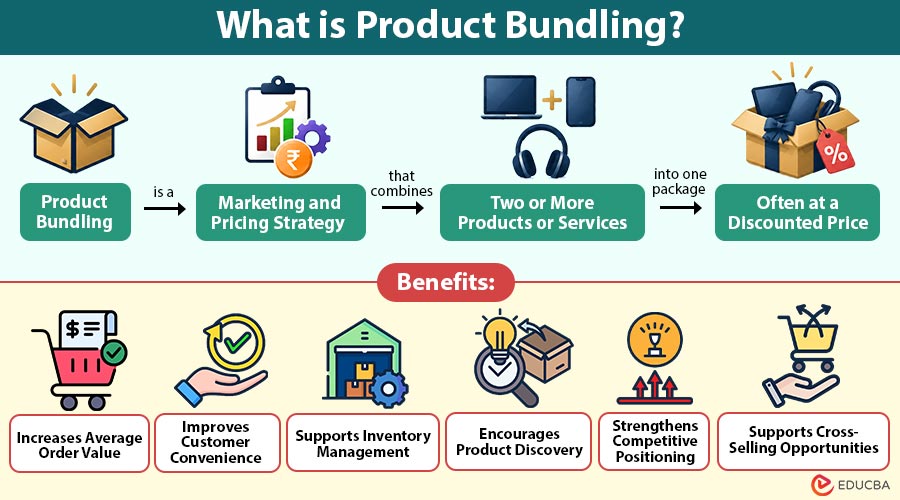
Product bundling is a marketing and pricing strategy that combines two or more products or services into one package, often at a discounted price.
Businesses use this approach to increase sales, improve customer convenience, promote complementary products, and encourage larger purchases. Customers benefit from simplified purchasing decisions and potentially lower overall costs.
For example, an electronics retailer may offer a laptop, wireless mouse, and laptop bag together at lower combined price than purchasing each item individually.
Product bundling is commonly used in retail, e-commerce, telecommunications, software, hospitality, and subscription-based businesses. An effective bundling strategy provides meaningful customer value while supporting business profitability and sales objectives.
Table of Contents:
- Meaning
- Working
- Types
- Examples
- Benefits
- Challenges
- Difference
- How to Create Effecive Product Bundling Strategy?
- Applications
Key Takeaways:
- Product bundling helps businesses simplify purchasing decisions by offering convenient solutions tailored to specific customer requirements.
- Effective bundles balance customer expectations with business objectives, ensuring attractive offerings without compromising long-term financial sustainability.
- Customer purchasing patterns and product compatibility play key roles in creating relevant, appealing bundles.
- Regular performance evaluations help businesses refine bundle offerings, adapt to changing demand, and maintain competitiveness.
How Does Product Bundling Work?
It combines selected products into a package that offers convenience, added value, or potential cost savings.
The process generally involves the following stages:
1. Product Selection
Businesses identify products that customers frequently purchase together or that complement each other in functionality, purpose, or usage.
2. Bundle Creation
Businesses group selected products into a package based on customer preferences, purchasing patterns, product compatibility, and overall usefulness.
3. Pricing Strategy
Businesses determine a suitable bundle price by considering individual product costs, customer expectations, competitor pricing, and desired profit margins.
4. Marketing and Promotion
Businesses promote the bundle through product pages, advertisements, email campaigns, and other marketing channels to communicate its benefits.
5. Customer Purchase
Customers evaluate the combined offering and purchase the bundle when its convenience, usefulness, or price provides sufficient value.
For example, a skincare company sells a cleanser for ₹400, moisturizer for ₹600, and sunscreen for ₹500. Instead of charging ₹1,500 separately, it offers all three products as a skincare bundle for ₹1,299. The customer saves ₹201, while the business encourages buying multiple products.
Types of Product Bundling
Businesses use different types depending on their products, customer needs, and marketing objectives.
1. Pure Bundling
Pure bundling involves selling multiple products exclusively as one package, requiring customers to buy the complete bundle rather than individual components.
For example, a software provider may offer certain features only through a complete subscription package.
2. Mixed Bundling
Mixed bundling lets customers buy products individually or together as a discounted package, offering flexibility and encouraging combined purchases.
For example, a restaurant may sell burgers, fries, and beverages separately or as a discounted meal combination.
3. Complementary Product Bundling
Complementary product bundling combines related products that work together, enhance functionality, and offer customers greater convenience in a single purchase.
For example, a camera retailer may bundle a camera with memory card, carrying case, and additional battery.
4. Cross-Category Bundling
Cross-category bundling combines products from different categories that address related customer needs, offering convenience and encouraging purchases across multiple product categories.
For example, a travel retailer may bundle luggage, travel organizers, and personal care accessories.
5. Buy-One-Get-One Bundling
Buy-one-get-one bundling encourages customers to buy qualifying products by offering an additional item free or at a discount with their purchase.
For example, a clothing retailer may offer a second T-shirt at 50% off when purchasing the first.
6. Subscription Bundling
Subscription bundling combines multiple products, services, or features into one recurring payment plan, giving customers ongoing access and simplified billing.
For example, a digital service provider may combine cloud storage, productivity tools, and security features in a single subscription plan.
Examples of Product Bundling
It appears across different industries and business models.
1. Electronics Industry
Electronics retailers bundle smartphones, protective cases, and screen protectors at combined prices, offering customers convenience and potential savings.
2. Food and Beverage Industry
Restaurants combine main dishes, sides, and beverages into discounted meal packages, offering convenience and better overall value.
3. Beauty and Personal Care
Cosmetics companies offer skincare kits with cleansers, toners, moisturizers, and sunscreens, letting customers buy complementary products together at attractive prices.
4. Software Industry
Software providers combine document editing, cloud storage, and collaboration tools into subscription packages, offering users integrated functionality and simplified billing.
5. Travel and Hospitality
Travel companies bundle accommodation, airport transfers, and sightseeing activities into holiday packages, giving travelers convenience and simplifying trip planning.
Benefits of Product Bundling
When implemented effectively, it provides several benefits for businesses and customers.
1. Increases Average Order Value
Bundles encourage customers to purchase multiple products within a single transaction, potentially increasing overall spending and average order value.
2. Improves Customer Convenience
Customers can purchase related products together without spending additional time searching for and comparing individual items.
3. Supports Inventory Management
Businesses can pair slower-moving products with popular items to improve inventory movement, as long as the combination remains valuable to customers.
4. Encourages Product Discovery
Bundling introduces customers to additional products they may not have considered purchasing individually.
5. Strengthens Competitive Positioning
Well-designed bundles can differentiate a business through convenience, relevant combinations, and attractive overall value.
6. Supports Cross-Selling Opportunities
Businesses can recommend complementary products through bundles, increasing opportunities to sell items beyond the customer’s original purchase.
Challenges of Product Bundling
Despite its advantages, it presents certain challenges.
1. Reduced Profit Margins
Excessive discounts on bundled products can reduce overall profit margins, especially when combined selling prices don’t adequately cover production, packaging, and operational costs.
2. Limited Customer Flexibility
Customers may hesitate to buy bundled products when packages include unnecessary items, limit individual choices, or don’t match their specific needs and preferences.
3. Inventory Imbalances
Bundling products with different demand levels can create inventory imbalances, resulting in stock shortages, excess inventory, and difficulties maintaining consistent product availability across sales channels.
4. Pricing Complexity
Businesses must carefully evaluate individual product costs, discount structures, customer expectations, and operational expenses to establish competitive bundle prices while maintaining sustainable profitability over time.
5. Perceived Value Concerns
Customers may view bundles as unattractive when discounts are unclear, included products aren’t relevant, or combined pricing doesn’t show meaningful savings or practical benefits.
Difference Between Product Bundling and Cross-Selling
The table below highlights the key differences between the two:
| Basis | Product Bundling | Cross-Selling |
| Meaning | Combines products into one package | Recommends additional related products |
| Pricing | Often offers combined pricing | Usually retains individual pricing |
| Purchase | Multiple items purchased as a package | Additional items purchased alongside the main product |
| Objective | Increase package value and convenience | Encourage complementary purchases |
| Example | Laptop, mouse, and bag bundle | Suggesting a mouse during laptop checkout |
How to Create Effective Product Bundling Strategy?
Developing a successful bundling strategy requires understanding customer behavior, product relationships, and financial performance.
1. Analyze Customer Purchasing Behavior
Study purchase histories, frequently bought-together products, and customer preferences to identify relevant combinations.
2. Select Complementary Products
Choose products that work together, address related requirements, or improve the customer’s overall experience.
3. Establish Appropriate Pricing
Calculate product costs, discounts, operational expenses, and expected margins before determining the final bundle price.
4. Communicate Bundle Value
Clearly explain the included products, their individual prices, combined price, and potential savings.
5. Test Different Combinations
Experiment with different product selections, bundle sizes, and pricing approaches to identify effective offerings.
6. Monitor Performance
Track sales, profitability, conversion rates, average order value, and customer feedback to evaluate how effective bundles are.
Applications of Product Bundling
It is widely used across industries to boost sales, improve convenience, and increase customer engagement.
1. E-Commerce
Online retailers combine complementary products into packages that simplify purchasing decisions and encourage higher-value orders.
2. Retail Marketing
Physical stores offer product combinations, promotional kits, and seasonal packages to increase sales and encourage additional purchases.
3. Software and Technology
Technology companies bundle applications, features, and services into subscription packages tailored to different customer needs.
4. Telecommunications
Telecommunications providers combine mobile connectivity, broadband, television, and related services into integrated customer plans.
5. Hospitality and Tourism
Hotels and travel businesses offer packages combining accommodation, meals, transportation, and activities to simplify travel planning.
6. Subscription Businesses
Subscription providers combine products or services under recurring payment plans to offer convenience and encourage continued customer relationships.
Final Thoughts
Product bundling is effective marketing strategy that combines products or services into convenient packages, increasing sales, customer satisfaction, and average order value. Successful bundling requires relevant product combinations, transparent pricing, and careful profitability analysis. By understanding customer preferences and evaluating performance, businesses can achieve sustainable growth and improved profitability.
Frequently Asked Questions (FAQs)
Q1. What is the main purpose of product bundling?
Answer: The main purpose of product bundling is to encourage the customers to purchase multiple items together while offering convenience, perceived value, and potential cost savings.
Q2. Is product bundling suitable for small businesses?
Answer: Yes, small businesses can use product bundling to promote complementary products, attract customers, increase order values, and boost sales without needing large marketing budgets.
Q3. How does product bundling influence consumer buying behavior?
Answer: Product bundling can simplify purchasing decisions, increase perceived value, and encourage customers to consider additional products they might otherwise overlook.
Q4. Can product bundling increase customer loyalty?
Answer: Yes, thoughtfully designed bundles can boost customer satisfaction and encourage repeat purchases by offering convenient solutions that consistently meet expectations.
Recommended Articles
We hope that this EDUCBA information on “Product Bundling” was beneficial to you. You can view EDUCBA’s recommended articles for more information.

