


Updated October 6, 2026
The Pew Research Center (2025) found that 58% of U.S. Google users encountered at least one AI Overview in March 2025, and that when an AI summary appears, users click a traditional result on only 8% of searches. That shift lands harder locally than nationally: a growing share of “near me” and service queries now resolve inside the map pack or an AI answer before a single blue link is read. So the question local SEO tools have to answer is no longer just “where do I rank?” It is “am I visible in the pack, and in the AI layer, across the exact locations I serve?” Measurement, not ranking alone, is the job now.
SE Ranking is the strongest pick for most teams because it covers the most local jobs inside one measured platform – local rank tracking, site audits, listings-adjacent workflows, and client reporting – alongside national SEO and AI-visibility data. One honest, quantified nuance: a dedicated geo-grid scanner samples more map points per scan, so if map-pack precision is your single priority, weigh that trade-off. See how the nine stack up on the local-marketing workflow in the comparison below.
How the Local SEO Tools Were Scored?
Each tool was rated from 0–3 on five dimensions: map-rank method and geo-grid density; listings and citation coverage; review workflow; reporting and API depth; and per-location cost. Product facts were pulled from each vendor’s own pricing pages; scores reflect local-job coverage, not brand preference.
The Comparison Matrix
| Tool | Map-rank method | Listings & citations | Reviews | Reporting / API | Starts at |
| 1. SE Ranking | Local rank tracker, 1,500 local keywords | In-platform listings + audit | Monitoring | Report builder + API/MCP (all plans) | $129/mo |
| 2. BrightLocal | Geo-grid (Local Search Grid) | Citation Builder, from $2/citation | Monitoring + generation (top tier) | Client reports | ~$39/mo per location |
| 3. Semrush Local | Geo-grid (Map Rank Tracker) | Partner-network syndication | Management | Inside Semrush | ~$30/mo per location |
| 4. Moz Local | None (no geo-grid) | Aggregator sync + duplicate suppression | Monitoring | Basic | ~$14/mo per location |
| 5. Local Falcon | Geo-grid up to 21×21, Google + Apple | None | None | Scan reports + Falcon AI | $24.99/mo |
| 6. Whitespark | Ranking Grids | Citation Finder + done-for-you | Reputation Builder | Per-module | $1/mo per location (à la carte) |
| 7. Localo | GBP position map by keyword | Citations Manager | AI-reply management | GBP dashboards | $39/mo (billed annually) |
| 8. Yext | None (listings focus) | 200+ directory network | Monitoring | Console + landing Pages | ~$199/yr per location |
| 9. Birdeye | None (listings focus) | Listings sync | Review generation at scale | CX dashboards | ~$299/mo per location |
How to Read this Table?
Read across, not down. No single tool leads every column, so match the columns you will actually measure to your job: geo-grid density if map-pack precision is the priority, listings coverage if consistency across directories is, review workflow if reputation is the lever. The “Starts at” column is a floor; per-location models scale with the number of sites you track.
The 9 Best Local SEO Tools Reviewed
The nine local SEO tools below are evaluated using the same five criteria: map-rank measurement, listings and citation coverage, review functionality, reporting and API access, and per-location cost.
1. SE Ranking

Image Source: SE Ranking
SE Ranking is a measured SEO and AI-visibility platform whose Local Marketing Module covers more distinct local jobs in one dataset than any rival here.
Best for: Agencies consolidating five local dimensions – rank, audit, research, backlinks, AI visibility – into one login instead of stitching three subscriptions.
Standout: The Local Marketing Module ships in every plan and tracks up to 1,500 local keywords across 3 included locations, with extra locations from $23/mo. A single dataset spans rank tracking, website audits, keyword and competitor research, backlink checking, and AI-search visibility across ChatGPT, Perplexity, Gemini, AI Overviews, and AI Mode.
Pros:
- Consolidates rank, audit, research, backlinks, and AI visibility into one dataset.
- Tracks AI-search presence across five engines most local suites still omit.
- Ships API and MCP access in every plan, enabling automated client reporting.
Cons:
- Samples fewer map points per scan than a dedicated geo-grid scanner.
- Handles listings in-platform rather than through a done-for-you citation service.
Pricing: Core starts at $129/month (103.20/mo billed annually); Growth 279/mo (223.20/mo annually); 14-day free trial.
Verdict: Across the five dimensions, it posts the widest local-job coverage in one dataset: 1,500 local keywords and API included where others charge extra or omit them. Cede geo-grid depth to a specialist; for consolidated local SEO software plus AI visibility, it leads.
2. BrightLocal
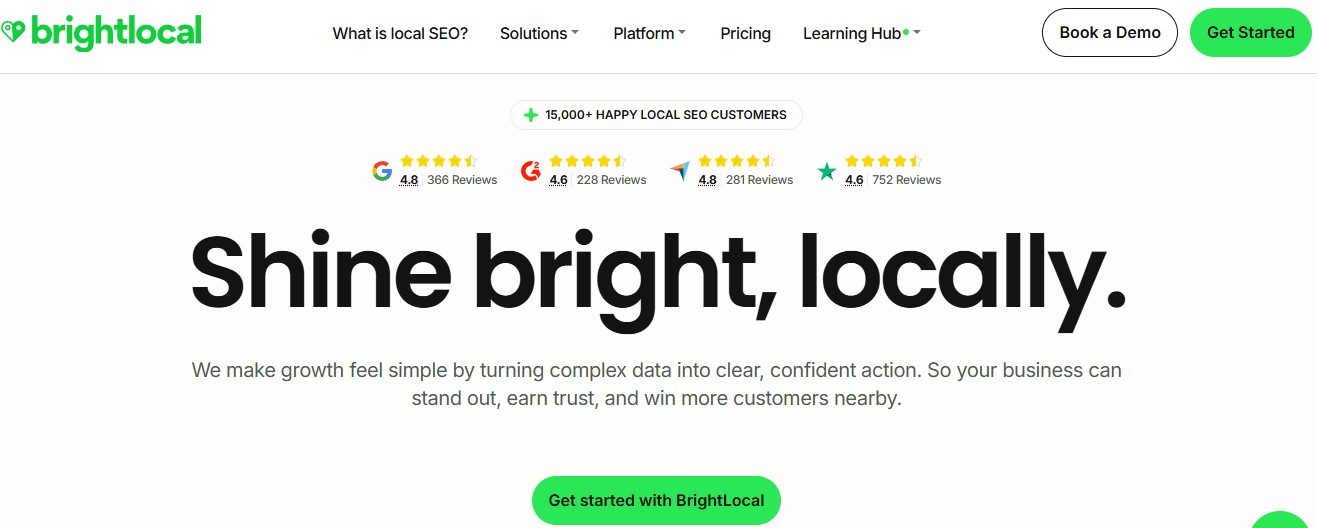
Image Source: BrightLocal
BrightLocal is a dedicated local suite built around geo-grid rank mapping and citation coverage rather than broad organic SEO.
Best for: Measuring map visibility per grid point with side-by-side comparisons against named local competitors.
Standout: The Local Search Grid plots geo-grid rankings against competitors, GBP audits flag profile gaps, and review monitoring tracks incoming feedback. Citation Builder adds listings from $2 per citation, so citation spend scales as a measurable line item rather than a flat fee.
Pros:
- Maps geo-grid rankings against specific competitors per location.
- Audits GBP profiles and monitors reviews in one workflow.
- Prices citations per unit at $2, keeping listing spend traceable.
Cons:
- Publishes tier pricing quote-gated on-page, complicating multi-location budget forecasting.
- Restricts full review generation to the top tier only.
Pricing: From ~$41/mo per location across Track, Manage, and Grow tiers (~25% off annual); Citation Builder from $2/citation.
Verdict: On geo-grid depth and citation granularity, it scores high, but cost rises linearly per location, and full review generation sits behind the top tier. Strong for map-rank precision; weaker as a single platform for wider SEO work.
3. Semrush Local
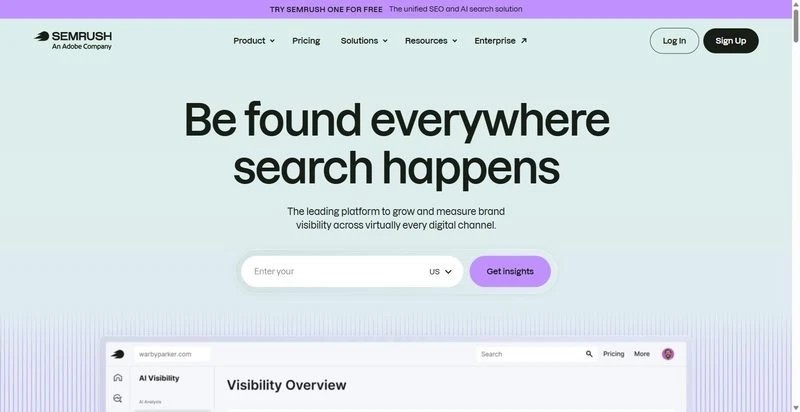
Image Source: Semrush Local
Semrush Local is an add-on whose per-location economics only justify themselves if you already run the wider Semrush platform.
Best for: Teams already paying for Semrush who want a Map Rank Tracker bolted onto existing organic workflows.
Standout: The Map Rank Tracker plots geo-grid positions, Listing Management distributes to a partner network, and GBP plus review tools cover profile upkeep. Add-on pricing runs roughly $30/mo Base and $60/mo Pro per location, though those figures are not confirmed on the official page.
Pros:
- Adds geo-grid map tracking to an existing Semrush subscription.
- Distributes listings through an established partner network.
- Manages GBP profiles and reviews from the same dashboard.
Cons:
- Prices economically only when the base Semrush cost is already sunk.
- Ties listing accuracy to partner-network coverage rather than direct control.
Pricing: Add-on $30/mo(Base) and $60/mo (Pro) per location.
Verdict: As a standalone local SEO platform, the per-location math is weak, but layered onto an existing Semrush seat the marginal cost is low. Value is conditional; price it as an add-on, not a primary local tool.
4. Moz Local
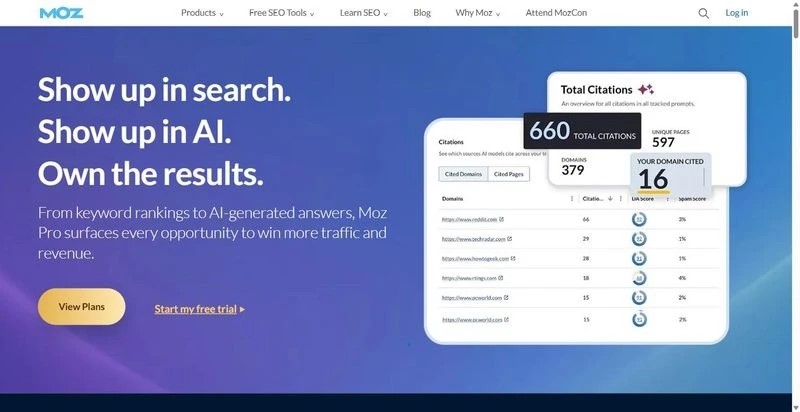
Image Source: Moz Local
Moz Local is a listings-distribution tool measured mainly on citation accuracy and duplicate suppression, not on rank tracking.
Best for: Standardizing NAP data across aggregators where citation consistency, not map rank, is the metric.
Standout: Distribution pushes listings through aggregator partners, duplicate suppression removes conflicting entries, and review monitoring plus Google and Facebook profile sync keep core listings aligned. Reported pricing runs ~$14–33/mo per location across Lite, Preferred, and Elite, though those figures are third-party and unverified.
Pros:
- Distributes citations through aggregator partners at scale.
- Suppresses duplicate listings that fragment local signals.
- Syncs Google and Facebook profiles with review monitoring.
Cons:
- Offers no true geo-grid map-rank measurement for tracking position.
- Depends on aggregator-network reach rather than direct publisher relationships.
Pricing: ~$20–40/mo per location (Lite/Preferred/Elite), third-party estimate, unverified.
Verdict: On citation accuracy, it scores well, but with no geo-grid rank tracking, it covers only part of the local job. Treat it as a listings-distribution layer inside a wider stack, not a full local rank tracker.
5. Local Falcon
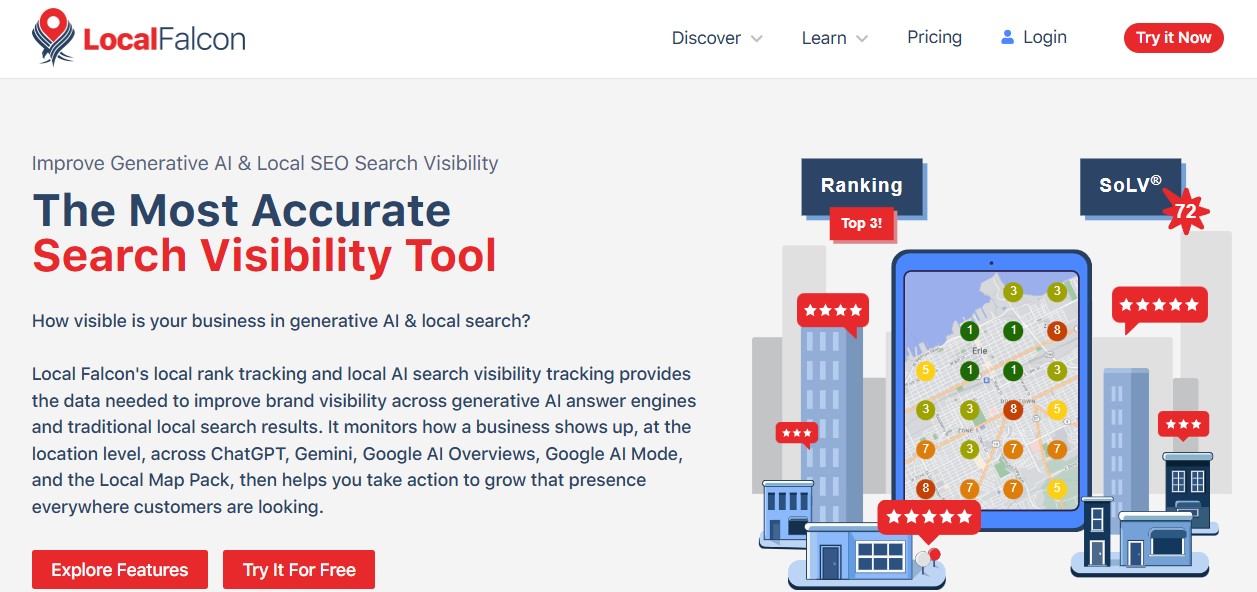
Image Source: Local Falcon
A specialist geo-grid scanner that measures map-pack visibility by sampling rank at fixed coordinates rather than reading a single location.
Best for: Teams quantifying map-pack presence across a service area, where single-point local rank tracking hides block-by-block variation.
Standout: Grids scale to 21×21 points across both Google and Apple Maps, so you can see where visibility drops off geographically. It reports share of local voice and average map rank as trackable numbers, adds Falcon AI analysis and competitor scans, and caps neither keywords nor locations.
Pros:
- Samples visibility at up to 441 grid points for block-level precision.
- Reports share of local voice and average map rank as tracked metrics.
- Runs competitor scans across the same grid for direct comparison.
Cons:
- Covers rank tracking only, with no citations, listings, or review signals to measure.
- Credit use scales with grid size and scan frequency, and credits expire each cycle.
Pricing: Credit-based from $24.99/mo (Starter, 7,500 credits); Basic $49.99, Pro $99.99, Premium $199.99; 100 free credits to test.
Verdict: Buy Local Falcon for one job, and it does it precisely – geographic rank sampling. If map-pack coverage across a territory is the main concern, the grid data provides a reliable measure. However, if citations or reviews are also important, those areas will need to be measured separately.
6. Whitespark
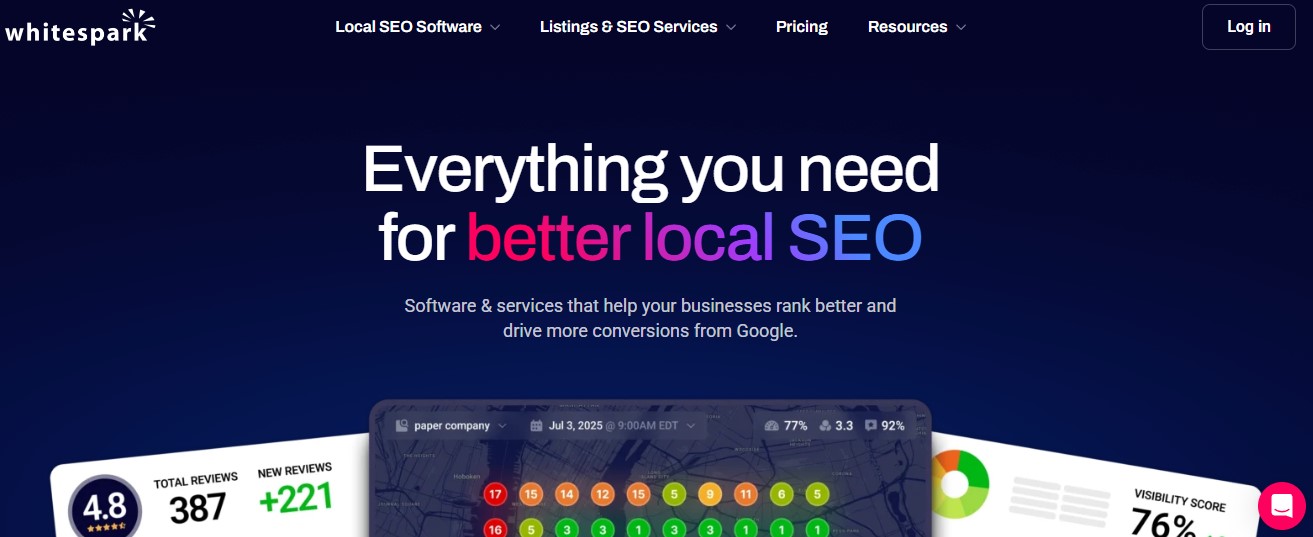
Image Source: Whitespark
The citation-coverage specialist, sold à la carte, so you pay per capability and measure directory presence as its own line item.
Best for: Teams treating citation accuracy and coverage as a measurable workstream, plus done-for-you building or cleanup at scale.
Standout: Local Citation Finder surfaces where competitors hold listings you are missing, quantifying citation gaps directly. Done-for-you building and cleanup handle the manual work, Local Ranking Grids add geo rank sampling, and bulk Google Business Profile editing carries edit protection. Everything is priced per module, so you scope spend to the capabilities you actually measure.
Pros:
- Quantifies citation gaps against competitors with Local Citation Finder.
- Builds or cleans citations for you, reducing manual audit hours.
- Protects bulk Google Business Profile edits from being overwritten.
Cons:
- Splits capabilities across separate line items, with no unified dashboard to measure them together.
- Reporting UI is dated, which slows reading coverage trends at a glance.
Pricing: Modular monthly: Local Platform (GBP) $1/location, Ranking Grids from $10, Local Rank Tracker $ 200, Citation Finder $ 149, Reputation Builder $79/location.
Verdict: Whitespark is the right instrument when citation coverage is the metric that matters, and the à la carte model lets you pay only for what you track. The trade-off is fragmentation – measuring across five separate products takes more assembly than a single dashboard would.
7. Localo
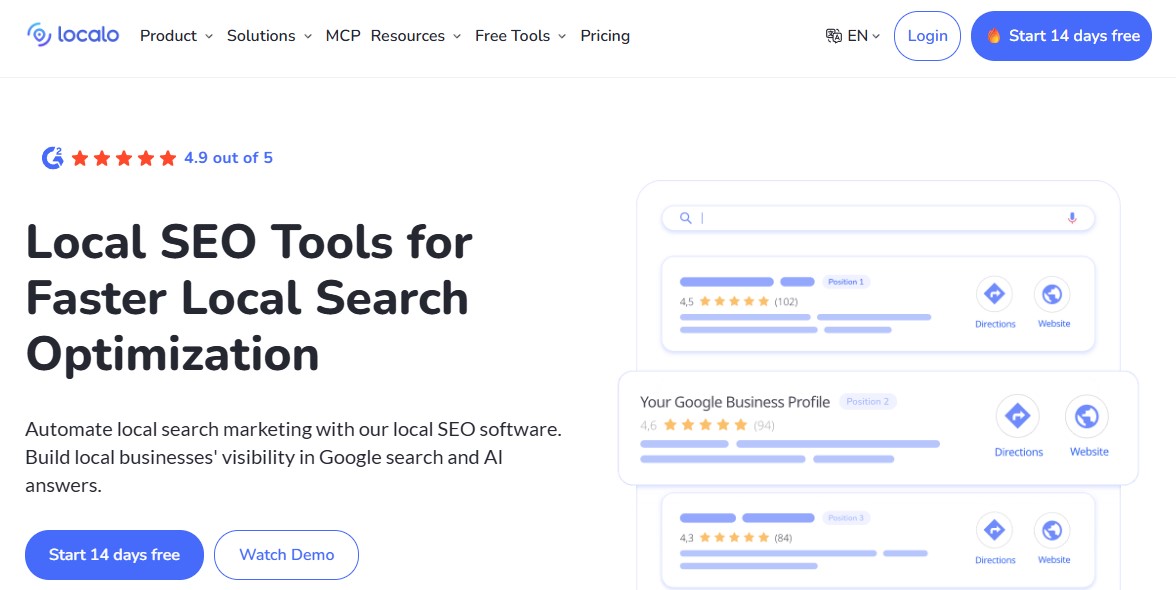
Image Source: Localo
A Google Business Profile-first tool measured on local pack visibility and the cadence of automated posting rather than broad organic reach.
Best for: Teams running local rank tracking on Google Business Profile by keyword and automating posting cadence across many locations.
Standout: A GBP position map and local rank by keyword give you the visibility numbers, while the AI Content Publisher automates GBP and Facebook posts on a set schedule. Review management with AI replies, a Citations Manager, GBP protection, and weekly tasks round it out. Most measurement stays inside the profile, not organic search.
Pros:
- Maps Google Business Profile position by keyword for tracked local visibility.
- Automates GBP and Facebook posting, holding a consistent cadence.
- Manages reviews with AI-drafted replies to cut response time.
Cons:
- Scopes measurement to GBP only, with no broad organic coverage to track.
- Optimization seats cap how many profiles get fully analyzed.
Pricing: Single Business (49 monthly); Pro $149/mo annual; Enterprise custom.
Verdict: Localo is a focused local rank tracker for Google Business Profile with posting automation attached, which suits multi-location teams optimizing the profile itself. Just size the plan to your profile count, since optimization seats cap how many you can fully analyze.
8. Yext
Image Source: Yext
Enterprise listings syndication measured on directory-network breadth – how many places one edit reaches from a single source of truth.
Best for: Enterprise brands managing listings across large location counts from one authoritative record.
Standout: Yext’s knowledge network pushes structured business data to 200+ directories, apps, and voice assistants from one record, with centralized listings management at scale, review monitoring, and hosted landing Pages. As a result, the key value is greater reach because one correction can be propagated across the network, rather than being updated separately at each location.
Pros:
- Syndicates one data record to 200+ directories, apps, and voice assistants.
- Centralizes listings management across large location counts.
- Monitors reviews and publishes hosted landing Pages.
Cons:
- Entry “Emerging” tier reportedly excludes Google Business Profile and Apple syndication.
- Network-license model: enhancements can revert if you cancel.
Pricing: Roughly 999 per location per year (third-party estimates; entry “Emerging” near $199/yr).
Verdict: Yext earns its cost when you manage listings across many locations and need one authoritative record feeding the network. Below that scale, the per-location price and the revert-on-cancellation model outweigh the reach. Confirm the entry tier covers Google Business Profile before buying.
9. Birdeye

Image Source: Birdeye
A reputation and listings platform measured on review-generation throughput – how many verified reviews it requests and captures per location per month.
Best for: Multi-location organizations treating review volume as a primary growth lever.
Standout: Birdeye helps businesses get more reviews by sending SMS and email requests at scale. It also manages listings, including Google Business Profile, and offers web chat, messaging, and social publishing. Its main strength is handling review requests at scale, while also supporting reputation management and customer experience beyond local SEO reporting.
Pros:
- Generates reviews via SMS and email at high volume.
- Syncs listings and Google Business Profile from one dashboard.
- Adds webchat, messaging, and social publishing.
Cons:
- Per-location, annual-contract pricing runs high.
- Scope spans customer experience beyond local SEO measurement.
Pricing: Roughly $299 Starter / $349 Growth / $449 Dominate per location per month (third-party; official pricing is quote-based).
Verdict: Birdeye fits organizations that treat review generation as a growth lever and will use the wider customer-experience stack. If your goal is local-SEO measurement, you pay for CX breadth you may not report on. Price it per location against the reviews you actually need.
How to Choose?
Match the tool to the job you can measure. If you need one platform covering the most local SEO tasks, including rank tracking, audits, citations, and both local and national visibility in a single dataset, SE Ranking is the default choice and ranks first overall in this comparison. However, if map-pack sampling density is the main priority, a dedicated geo-grid scanner may be more suitable because it reports the number of points checked in each scan rather than showing only an average position. Furthermore, for businesses managing listings across dozens or hundreds of locations, an enterprise listings platform such as Yext can provide broader distribution. Alternatively, a reputation management platform such as Birdeye can complement the core solution by adding review and customer-experience capabilities.
Skip if: Do not buy Yext below multi-location scale, and do not treat a geo-grid-only scanner as a full local stack, it measures one axis.
Start with the core dataset, then add a specialist only where a measured gap remains.
Frequently Asked Questions (FAQs)
Q1. Do local SEO tools measurably improve local rankings?
Answer: Not directly. Tools measure and diagnose; the ranking movement comes from the actions they surface: Google Business Profile completeness, consistent citations, and review volume. A tool quantifies the gap and tracks whether your changes moved it. Attribute gains to the work executed, not to the software that flagged it.
Q2. Which local SEO tool has the widest data coverage?
Answer: On breadth, SE Ranking leads: local rank tracking, site audits, citation and listing management, plus national keyword and AI-visibility data in one dataset. Specialists go deeper on a single axis – geo-grid density or listings syndication – but cover less overall. For teams wanting the most measured surface in one place, breadth favors SE Ranking.
Q3. Which Local SEO Tool Is Best for Map-Pack Tracking?
Answer: Local Falcon and BrightLocal are strong choices for businesses that prioritize detailed geo-grid map tracking. As a result, they can measure visibility across multiple geographic points rather than relying solely on a single location. The best option depends on the required grid size, scan frequency, competitor tracking, and budget.
Q4. Are Local SEO Tools Useful for Small Businesses?
Answer: Yes. Small businesses can use local SEO tools to monitor Google Business Profile visibility, identify listing inconsistencies, track local rankings, and monitor reviews. However, not every small business needs an enterprise platform. A simpler tool with essential rank tracking and listing features may provide better value for a business with one or a few locations.
Recommended Articles
This comprehensive guide to local SEO tools can help you choose the right platform for your business. Check out these articles for more insights and strategies to strengthen your local search performance.

