
What is Loss Aversion?
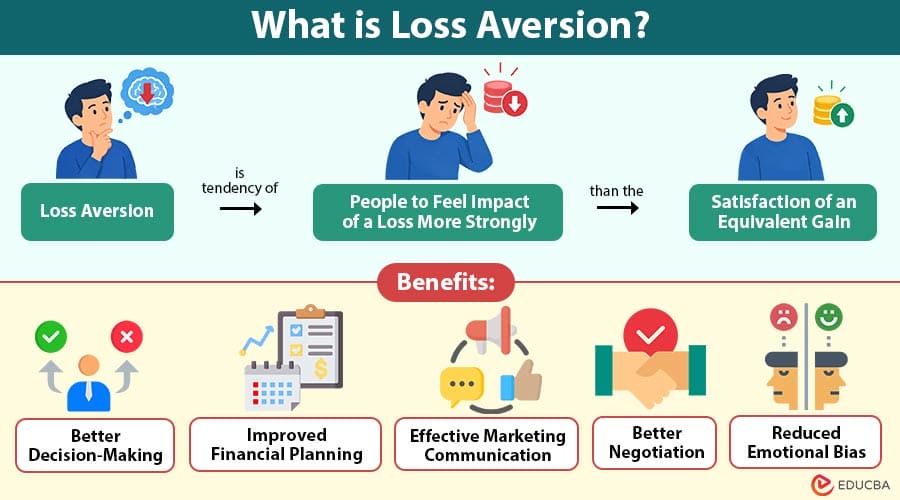
Loss aversion is tendency of people to feel the impact of a loss more strongly than the satisfaction of an equivalent gain.
When people make decisions, they often give greater importance to avoiding losses than achieving similar gains. For example, losing ₹1,000 may feel more significant than gaining ₹1,000 feels rewarding. This tendency can influence purchasing, investing, negotiations, marketing, and everyday choices.
Loss aversion is an important concept in the behavioral economics and is closely associated with Daniel Kahneman and Amos Tversky, whose research on decision-making helped establish prospect theory.
Table of Contents:
- Meaning
- Importance
- Working
- Types
- Examples
- Benefits
- Limitations
- Difference
- Applications
- How Can Businesses Use Loss Aversion Responsibly?
Key Takeaways:
- Loss aversion means losses generally have a stronger psychological impact than equivalent gains.
- It can influence financial, purchasing, workplace, and everyday decisions.
- People may avoid beneficial opportunities because they focus more on possible losses.
- Businesses can use loss-related messaging to communicate risks or potential missed benefits.
- Understanding loss aversion can help people make more balanced decisions.
Importance of Loss Aversion
Loss aversion helps explain why people do not always make decisions based only on potential financial outcomes. Emotional reactions to losing something can influence how individuals evaluate alternatives.
For example, an investor may hold an underperforming investment for too long because selling it would make the loss feel real. Similarly, a customer may purchase an extended warranty because the possibility of losing money through an unexpected repair feels more significant than the cost of the warranty.
Understanding this behavior helps marketers, financial professionals, managers, and consumers because it explains many decisions that seem inconsistent with purely rational economic reasoning.
How Does Loss Aversion Work?
Loss aversion generally operates through how people perceive and evaluate potential gains and losses. The process can be explained as follows:
1. Establishing a Reference Point
People compare potential outcomes with a current situation, expectation, previous price, or another relevant reference point.
2. Identifying Potential Outcomes
Individuals consider the possible gains and losses associated with each option before deciding.
3. Comparing Losses and Gains
People may perceive a potential loss as more significant than an equivalent gain, even when the financial value is the same.
4. Influencing the Decision
The stronger emotional impact of a possible loss may lead people to avoid risks, change preferences, or protect what they already have.
Types of Loss Aversion
Loss aversion can appear in different forms depending on the decision-making situation.
1. Financial Loss Aversion
Financial loss aversion occurs when people strongly prioritize avoiding monetary losses. Investors may hesitate to sell declining assets because realizing a loss can feel uncomfortable.
2. Status Quo Loss Aversion
This occurs when individuals prefer maintaining their existing situation because changing it creates a perceived risk of losing something familiar.
3. Opportunity Loss Aversion
People may focus on what they could lose by choosing an alternative rather than what they could gain. This can affect investments, purchases, and career decisions.
4. Ownership-Based Loss Aversion
Once people own an item, they may value keeping it more than they did before owning it. This behavior is related to the endowment effect.
5. Social Loss Aversion
People may avoid decisions because they fear losing approval, relationships, status, or acceptance from others.
Examples of Loss Aversion
Loss aversion shows up in many everyday and business situations.
1. Retail Pricing
A store may advertise, “Avoid paying the regular price—sale ends tonight.” Customers may feel pressure because they perceive missing the discount as a loss.
2. Investment Decisions
An investor buys a stock for ₹500, and its price falls to ₹400. Instead of selling, the investor continues holding it because selling would confirm the ₹100 loss.
3. Subscription Services
A subscription platform may offer a free trial and remind users that access to premium features will end when the trial expires. The possibility of losing access can encourage users to continue the subscription.
4. Insurance
People may purchase insurance because they want to avoid the financial consequences of a possible future loss. The potential cost of an accident, theft, or damage can feel more significant than the insurance premium.
Benefits of Understanding Loss Aversion
Understanding loss aversion can provide several practical benefits in personal decisions, financial planning, marketing, and professional interactions.
1. Better Decision-Making
Recognizing emotional responses to potential losses can help individuals assess alternatives more objectively and make more balanced decisions.
2. Improved Financial Planning
Investors can recognize loss-related biases that may influence portfolio choices, helping them evaluate investments according to their goals and risk tolerance.
3. Effective Marketing Communication
Businesses can better understand customer responses to perceived risks, limited-time offers, warranties, guarantees, and messages highlighting potential losses.
4. Better Negotiation
Understanding what another party considers a potential loss can help negotiators present proposals in ways that address concerns and priorities.
5. Reduced Emotional Bias
Awareness of loss aversion can help people separate emotional reactions from the actual value, benefits, risks, and consequences of an option.
Limitations of Loss Aversion
Below are the key limitations of loss aversion that can affect how people perceive losses and make decisions.
1. Individual Differences
People respond differently to potential losses depending on their experiences, preferences, financial situations, personality traits, and individual circumstances.
2. Context Dependence
The strength of loss aversion may vary depending on the type, size, importance, and perceived consequences of potential outcomes.
3. Reference Points Can Change
A person’s perception of gain or loss can change when the reference point used for comparison changes.
4. Difficult to Measure Precisely
Psychological responses to losses are difficult to measure precisely because individuals may assign different emotional values to similar outcomes.
5. Other Factors Influence Decisions
Risk tolerance, available information, financial conditions, social influences, personal goals, and previous experiences can also affect individual decisions.
Difference Between Loss Aversion and Risk Aversion
The table below highlights the key differences between the two:
| Basis | Loss Aversion | Risk Aversion |
| Meaning | Gives greater psychological weight to losses than equivalent gains | Preference for reducing uncertainty or risk |
| Main Focus | Potential loss compared with a gain | Variability and uncertainty of outcomes |
| Psychological Effect | Losses may feel especially painful | Uncertain outcomes may be avoided |
| Example | Holding a declining stock to avoid realizing a loss | Choosing a stable investment over a volatile one |
| Key Concern | Impact of losing something | Uncertainty surrounding an outcome |
Applications of Loss Aversion
Below are the key applications of loss aversion:
1. Marketing
Businesses use loss-focused messages to highlight expiring discounts, limited availability, missed benefits, or opportunities that customers may lose.
2. Finance
Investors and financial professionals consider loss-related behavior when evaluating investment decisions, portfolio changes, and responses to market fluctuations.
3. Insurance
Insurance providers address concerns about potential financial losses by emphasizing protection against unexpected expenses, damages, or other risks.
4. E-Commerce
Online stores may use limited-time offers, low-stock notifications, and expiring promotions to emphasize opportunities customers could miss.
5. Negotiation
Negotiators can identify outcomes that another party considers costly to lose and use this understanding to structure mutually acceptable proposals.
6. Product Design
Companies can design reminders, alerts, and retention features that highlight useful benefits customers could lose when discontinuing a product or service.
How Can Businesses Use Loss Aversion Responsibly?
Businesses can use loss aversion to make communication more relevant without misleading customers. They can clearly explain genuine deadlines, actual product availability, potential costs, and realistic consequences.
For example, a company can state that a genuine promotional price expires on a particular date. However, creating a false deadline or falsely claiming that products are almost unavailable can mislead customers.
Responsible use focuses on providing useful information rather than creating unnecessary fear or pressure.
Final Thoughts
Loss aversion explains why people often react more strongly to losses than to equivalent gains. It influences financial decisions, purchasing behavior, negotiations, and everyday choices. Understanding this behavioral tendency can help individuals recognize emotional biases and make more balanced decisions while helping businesses communicate potential costs, risks, and missed benefits responsibly.
Frequently Asked Questions (FAQs)
Q1. Is loss aversion present in everyday life?
Answer: Yes, people may experience loss aversion when making choices involving money, possessions, time, opportunities, relationships, or personal preferences.
Q2. Why do people remember losses more strongly than gains?
Answer: Losses can attract greater emotional attention, making negative outcomes feel more significant and memorable than comparable positive outcomes.
Q3. Can loss aversion affect career decisions?
Answer: Yes, individuals may remain in familiar jobs or avoid career changes because they focus on what they might give up rather than potential future opportunities.
Q4. Does loss aversion affect consumer loyalty?
Answer: It can influence loyalty when customers perceive switching products or services as a risk of losing familiar features, benefits, rewards, or convenience.
Recommended Articles
We hope that this EDUCBA information on “Loss Aversion” was beneficial to you. You can view EDUCBA’s recommended articles for more information.

