


Updated September 17, 2026
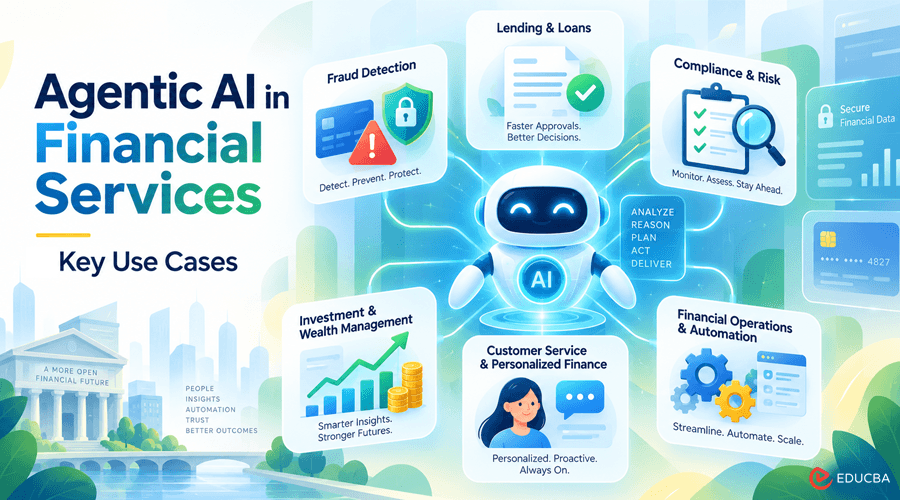
Artificial intelligence is moving beyond chatbots, predictive analytics, and rule-based automation. In 2026, financial institutions are increasingly exploring Agentic AI in Financial Services AI systems that can reason, plan, make decisions, use tools, and execute multi-step tasks with limited human intervention.
For banks, fintech companies, insurers, investment firms, and payment providers in the United States, this shift could significantly change how financial services are delivered. Instead of simply recommending what should happen next, agentic AI can potentially take action across connected systems while adapting to changing conditions.
From automating financial operations to improving fraud detection and delivering personalized customer experiences, Agentic AI in Financial Services is becoming an important area of innovation for the financial services industry.
What is Agentic AI in Financial Services?
Agentic AI in Financial Services refers to AI systems designed to pursue specific goals by independently planning and executing a sequence of actions. Unlike conventional AI applications that typically respond to predefined inputs, AI agents can evaluate a situation, determine the next step, use connected tools or applications, and adjust their actions based on the results.
In financial services, this could mean an AI agent reviewing a transaction, identifying an anomaly, checking relevant customer information, initiating additional verification, and escalating the case to a compliance team when necessary.
The objective is not necessarily to remove humans from financial decision-making. Instead, agentic AI can handle repetitive, multi-step processes, allowing financial professionals to focus on higher-value decisions.
6 Ways Agentic AI in Financial Services Is Transforming the Industry
1. Automating Financial Operations
Financial institutions manage thousands of repetitive processes every day, from document processing and reconciliation to customer onboarding and internal reporting.
Agentic AI can coordinate multiple steps involved in these workflows. For example, an AI agent could collect information from different systems, validate documents, identify missing data, update relevant records, and notify employees when human intervention is required.
This can help financial organizations reduce manual workloads while improving operational efficiency.
2. Enhancing Fraud Detection and Financial Crime Prevention
Fraud detection is one of the most promising applications of Agentic AI in Financial Services.
Traditional fraud detection systems often rely on predefined rules and models to identify suspicious behavior. Agentic AI can complement these approaches by analyzing multiple information sources, investigating unusual activity, and determining which additional checks may be required.
For instance, when an unusual transaction is detected, an AI agent could investigate the customer’s transaction history, evaluate contextual signals, check relevant risk indicators, and prepare an investigation summary for a fraud analyst.
Human investigators can then review the findings rather than starting the investigation from scratch.
3. Personalizing Customer Financial Experiences
Consumers increasingly expect financial services to be personalized, responsive, and available across digital channels.
Agentic AI in Financial Services can support this expectation by continuously analyzing customer interactions and financial preferences to deliver contextual assistance.
For example, an AI-powered financial assistant could help a customer understand spending patterns, identify recurring expenses, suggest relevant financial products, or guide them through a service request.
For financial institutions, this creates opportunities to move from reactive customer support toward proactive engagement.
However, financial organizations must establish appropriate safeguards when AI agents interact with sensitive customer data or provide financial recommendations.
4. Streamlining Lending and Credit Workflows
Loan processing involves multiple stages, including application intake, document verification, credit assessment, risk analysis, underwriting, and communication.
Agentic AI can help coordinate these workflows by moving information between systems and performing routine checks.
For example, an AI agent could identify missing documentation, retrieve relevant information, verify submitted documents, organize applicant data, and route complex applications to human underwriters.
This can potentially shorten processing times while allowing underwriting professionals to focus on cases that require deeper judgment.
Financial institutions must still ensure that AI-supported lending processes comply with applicable consumer protection, fair lending, privacy, and regulatory requirements.
5. Improving Investment and Wealth Management
Investment management is another area where Agentic AI in Financial Services can support financial professionals.
AI agents can monitor market information, analyze portfolios, identify changes in predefined investment conditions, and generate insights for advisors or investment teams.
For example, an agent could monitor a portfolio against specific risk parameters and alert an advisor when an asset allocation moves outside the desired range.
In wealth management, AI agents could also assist with client reporting, portfolio analysis, research preparation, and routine communications.
The most effective implementations will likely combine autonomous AI capabilities with human oversight, particularly when decisions could materially affect an investor’s financial position.
6. Strengthening Compliance and Risk Management
Compliance teams deal with continuously changing regulations, large volumes of documentation, transaction monitoring, and extensive reporting requirements.
Agentic AI in Financial Services can help organizations coordinate compliance workflows by monitoring information, identifying potential issues, gathering supporting evidence, and preparing reports for review.
For example, an AI agent could monitor a defined set of compliance signals, identify an exception, investigate relevant records, and create a structured case for a compliance professional.
This approach can help compliance teams spend less time on manual information gathering and more time on risk assessment and decision-making.
Why Agentic AI in Financial Services Matters to US Financial Institutions?
The US financial services market includes banks, credit unions, fintech companies, payment providers, insurers, investment firms, and other highly regulated organizations. These businesses operate complex technology environments where customer data, transaction systems, legacy platforms, and third-party services must work together.
This makes integration a critical consideration for adopting Agentic AI in Financial Services.
Financial institutions cannot simply introduce an AI agent and expect it to operate effectively across their technology ecosystem. Agents need controlled access to APIs, databases, enterprise applications, identity systems, and other digital tools.
Security and governance are equally important. Organizations need mechanisms to define what an AI agent can access, which actions it can perform, when human approval is required, and how its decisions and actions are recorded.
Building an Agentic AI Strategy for Financial Services
Successful adoption requires more than selecting an AI model. Financial institutions need to identify suitable use cases, assess their technology infrastructure, define governance requirements, and establish clear human oversight mechanisms.
This is where fintech consulting services can help organizations evaluate potential applications of Agentic AI in Financial Services and create an implementation roadmap aligned with their business and technology objectives.
Consultants can also help financial businesses assess existing systems, identify integration requirements, define AI governance frameworks, prioritize use cases, and establish measurable implementation goals.
Organizations should generally start with well-defined workflows where AI agents can deliver measurable operational value without creating unnecessary risk. Once these use cases demonstrate value, organizations can gradually expand agentic capabilities across additional processes.
Technology architecture should also support scalability. AI agents may need to communicate with core banking platforms, payment systems, CRM platforms, data warehouses, compliance tools, and other enterprise applications.
The Role of Fintech App Development Companies
Implementing Agentic AI in Financial Services often requires new applications, APIs, integration layers, dashboards, and AI-powered interfaces.
Fintech app development companies can help financial organizations build applications that connect AI agents with existing financial technology infrastructure while incorporating security, authentication, monitoring, and human-in-the-loop controls.
The development process may include AI agent architecture, API integration, data management, workflow orchestration, user interfaces, audit trails, and performance monitoring.
For organizations building customer-facing financial applications, fintech app development companies can also integrate agentic AI capabilities into mobile and web applications. These capabilities may include AI-powered financial assistants, automated customer support, personalized recommendations, intelligent onboarding, and workflow automation.
The goal should be to build an AI-enabled financial solution that is not only intelligent but also secure, explainable, scalable, and manageable within the organization’s existing technology environment.
Key Considerations Before Adopting Agentic AI in Financial Services
Financial institutions should evaluate several factors before deploying autonomous AI systems.
- Data security: AI agents may interact with highly sensitive financial and customer information, making access controls and data protection essential.
- Human oversight: Organizations should establish clear boundaries for autonomous actions and determine which decisions require human approval.
- Integration: AI agents need reliable connections with existing banking, payment, CRM, compliance, and data systems.
- Governance: Organizations should maintain appropriate monitoring, audit trails, accountability mechanisms, and policies for AI-generated decisions and actions.
- Scalability: The underlying architecture should support additional AI agents, use cases, users, and transaction volumes as adoption grows.
Working with experienced fintech consulting services providers can help organizations assess these considerations before moving from experimentation to production deployment.
What Does the Future Hold for Agentic AI in Financial Services?
Agentic AI in Financial Services is likely to become increasingly integrated into financial workflows as organizations gain experience with autonomous systems.
The next phase may involve multiple specialized AI agents working together. One agent could handle customer interactions, another could analyze risk, and another could manage compliance-related tasks. These agents could collaborate through controlled workflows while human professionals retain oversight of critical decisions.
Financial organizations may also increasingly work with fintech app development companies to create AI-native financial applications in which autonomous agents are integrated into the product architecture from the beginning rather than added as a separate feature.
Competitive advantage will not come simply from adopting AI. It will come from identifying the right processes for agentic automation and implementing those capabilities responsibly.
Final Thoughts
Agentic AI in Financial Services is changing the role of artificial intelligence in the financial industry. Instead of simply generating insights or responding to queries, AI systems can increasingly plan and execute multi-step workflows.
From fraud investigations and compliance to lending, investment management, customer service, and financial operations, the technology presents significant opportunities for US financial institutions.
However, successful adoption requires a strong foundation of security, governance, integration, and human oversight. Financial organizations that approach agentic AI strategically can use it to improve operational efficiency, deliver more personalized experiences, and build more intelligent financial products for the future.
With the right combination of fintech consulting services and technology implementation expertise, financial institutions can move from experimenting with agentic AI to developing practical, scalable applications that support their long-term digital transformation goals.
Recommended Articles
We hope this guide helps you understand Agentic AI in Financial Services and its key applications. Explore our recommended articles for more insights on AI, fintech, automation, and digital transformation.


