


Updated August 26, 2026
What is Agentic Commerce?
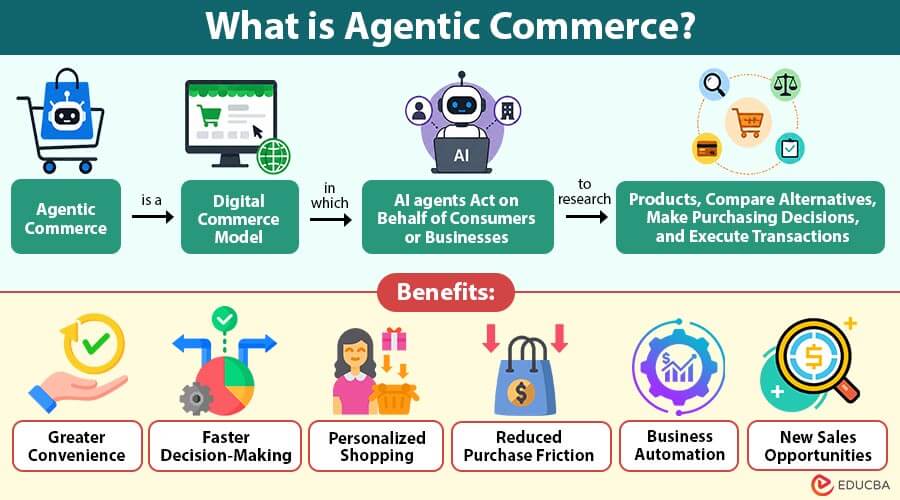
Agentic commerce is a digital commerce model in which AI agents act on behalf of consumers or businesses to research products, compare alternatives, make purchasing decisions, and execute transactions. Unlike traditional shopping assistants that mainly provide recommendations, agentic systems can take action across multiple steps of the buying journey.
For example, a customer could tell an AI agent, “Find me wireless headphones under ₹10,000 with strong noise cancellation and delivery within three days.” The agent could search eligible products, compare prices and specifications, check availability and delivery options, evaluate reviews, and present the best choices. With the user’s permission and suitable payment infrastructure, it could then complete the purchase.
This makes agentic commerce different from conventional e-commerce because the primary interaction can shift from websites and apps to AI-driven interfaces.
Table of Contents:
- Meaning
- Working
- Key Features
- Difference
- Benefits
- Challenges
- Use Cases
- How can Businesses Prepare for Agentic Commerce?
Key Takeaways:
- Agentic commerce enables AI agents to research, compare, select, and purchase products based on customer preferences and intent.
- AI agents can automate multiple shopping tasks, including product discovery, comparison, checkout, payment, and post-purchase activities.
- Security, privacy, trust, accurate product data, and reliable infrastructure remain essential for successful agentic commerce adoption.
- Businesses can prepare by improving product data, APIs, security controls, product differentiation, and AI-driven customer acquisition strategies.
How Does Agentic Commerce Work?
Agentic commerce combines artificial intelligence, product data, APIs, payment systems, and security mechanisms. A typical process includes several stages.
1. Understanding Customer Intent
The process begins when a customer describes a goal rather than searching for a specific product. The request may include a budget, preferred brand, delivery deadline, product features, or other requirements. The AI agent interprets these instructions and converts them into actionable criteria.
2. Product Discovery
The agent searches available product catalogs, retailers, marketplaces, and other sources. Structured, accurate product information matters because AI agents need reliable data to understand what businesses offer.
3. Comparing Options
The agent can evaluate products according to factors such as price, features, availability, shipping time, return policies, ratings, and customer preferences. Instead of making the shopper open multiple websites, the agent can consolidate relevant information into a smaller set of recommendations.
4. Making a Decision
Based on the user’s instructions, the agent can identify the most suitable option. Its decision may consider multiple factors rather than simply selecting the lowest-priced product. For example, a shopper may prioritize fast delivery and reliability over the cheapest available option.
5. Completing the Transaction
The final stage involves checkout and payment. Agentic commerce requires secure mechanisms that let authorized AI agents interact with merchants and payment providers without giving them unlimited access to a user’s financial information. Payment infrastructure is therefore becoming an important part of the agentic commerce ecosystem.
Key Features of Agentic Commerce
Below are the key features that make agentic commerce more autonomous, personalized, and efficient.
1. Autonomous Decision-Making
AI agents complete shopping tasks independently, reducing the need for users to provide continuous instructions throughout the purchasing process.
2. Personalization
Agents consider user preferences, budgets, brand choices, product requirements, and delivery expectations to provide recommendations aligned with individual shopping needs.
3. Multi-Step Execution
An agent can research products, compare alternatives, select suitable options, complete purchases, and potentially handle post-purchase activities automatically.
4. Cross-Platform Interaction
AI agents can interact with multiple merchants, services, and payment platforms, enabling smoother shopping experiences across different digital environments.
5. Intent-Based Shopping
Customers can explain their requirements using natural language, allowing AI agents to understand their intent without relying on complex menus or filters.
6. Automated Transactions
With proper authorization and supporting infrastructure, AI agents can complete purchases automatically, moving beyond recommendations to execute transactions on customers’ behalf.
Difference Between Agentic Commerce and Traditional E-Commerce
Below is a comparison of the key differences between agentic commerce and traditional e-commerce across the shopping journey.
| Aspect | Agentic Commerce | Traditional E-Commerce |
| Consumer Role | Consumers provide their objectives, preferences, and limitations while AI handles more tasks. | Consumers control most stages of the shopping journey. |
| Product Search | AI agents research products based on the user’s stated intent. | Users manually search and browse different websites. |
| Comparison | AI agents automatically analyze and compare available options. | Consumers manually compare products, prices, and features. |
| Decision-Making | AI agents can recommend or select products based on defined preferences. | Consumers select products after reviewing available information. |
| Checkout | AI agents can coordinate transactions after receiving appropriate authorization. | Users manually complete checkout and payment steps. |
| Interaction | Primarily based on natural-language instructions and user intent. | Primarily based on websites, menus, filters, and search bars. |
| Automation | AI can perform multiple connected tasks throughout the shopping journey. | Automation is generally limited to specific shopping functions. |
| Example Flow | State Intent → AI Researches → AI Compares → AI Selects → Authorized Transaction → Confirmation | Search → Browse → Compare → Select → Checkout → Payment |
Benefits of Agentic Commerce
The following are the benefits of agentic commerce for consumers and businesses.
1. Greater Convenience
AI agents automate product discovery, comparison, purchasing, and reordering, reducing consumer effort and making the overall shopping experience simpler, faster, and more convenient.
2. Faster Decision-Making
AI agents quickly analyze product prices, features, reviews, availability, and customer preferences, helping consumers evaluate alternatives and make informed purchasing decisions efficiently.
3. Personalized Shopping
AI agents consider individual preferences, budgets, requirements, and shopping behavior to recommend products that closely match each consumer’s specific needs and expectations.
4. Reduced Purchase Friction
Automated product searches, comparisons, checkout, payments, and order management simplify purchasing, reduce unnecessary steps, and create a smoother shopping experience for consumers.
5. Business Automation
Businesses can use AI agents to automate procurement, inventory management, customer support, product discovery, and other commerce activities, significantly improving operational efficiency.
6. New Sales Opportunities
Agentic commerce enables businesses to reach customers through AI-powered shopping channels, creating new opportunities for product discovery, customer acquisition, and revenue growth.
Challenges of Agentic Commerce
Despite its potential, agentic commerce faces several challenges.
1. Security Risks
AI agents may access sensitive customer data, accounts, payment details, and purchasing permissions, creating risks of unauthorized transactions, financial losses, and data breaches.
2. Privacy Concerns
AI agents may process personal information such as preferences, purchase histories, budgets, locations, and behavior, requiring businesses to implement strong privacy controls.
3. Lack of Trust
Consumers may hesitate to delegate purchasing decisions to AI agents because incorrect selections, unexpected purchases, or misunderstood instructions can reduce confidence.
4. Incorrect Recommendations
AI agents may provide unsuitable recommendations when product information is outdated, incomplete, inaccurate, or incorrectly interpreted, affecting customer satisfaction and purchasing decisions.
5. Infrastructure and Standards
Agentic commerce requires compatible systems, APIs, authentication methods, payment technologies, and industry standards to enable reliable communication between agents, merchants, and providers.
6. Customer Relationship Challenges
Greater reliance on AI intermediaries may reduce direct interactions between consumers and retailers, potentially affecting brand relationships, loyalty programs, customer data, and marketing strategies.
Use Cases of Agentic Commerce
Agentic commerce can be applied across many industries.
1. Retail
Customers can ask agents to find clothing, electronics, home appliances, groceries, or other products based on detailed requirements.
2. Travel
An AI agent could compare flights, hotels, transportation, and activities according to budget, dates, location, and personal preferences.
3. Grocery Shopping
Customers can provide a shopping list and dietary or budget requirements. An agent can identify products, compare prices, and potentially arrange purchases and delivery.
4. Financial Services
Agents may help users compare financial products or initiate permitted transactions. Because financial decisions involve higher risks, strong authorization, security, and regulatory controls are essential.
5. B2B Procurement
Businesses can use agents to identify suppliers, compare quotations, check inventory, and automate routine purchasing within predefined limits.
How Can Businesses Prepare for Agentic Commerce?
Businesses can begin preparing by making their digital commerce infrastructure easier for AI agents to understand and interact with.
First, companies should maintain accurate and structured product information. Product names, descriptions, specifications, prices, availability, shipping details, and return policies should be consistent and up to date.
Second, businesses should provide reliable APIs and integration capabilities where appropriate. AI agents need machine-readable ways to access relevant information and perform authorized actions.
Third, companies should strengthen security. Authentication, authorization, fraud detection, spending controls, and transaction monitoring are essential when software agents can participate in purchases.
Fourth, retailers should focus on clear product differentiation. When AI agents compare several products, accurate specifications, competitive pricing, customer reviews, delivery options, and policies can influence which products are recommended.
Finally, businesses should monitor how AI-driven channels affect sales, customer acquisition, and loyalty. The rise of AI intermediaries may require companies to rethink traditional search engine optimization, product discovery, and digital marketing strategies.
Final Thoughts
Agentic commerce is transforming digital shopping by enabling AI agents to understand customer intent, compare products, and complete authorized transactions. While it offers greater convenience, personalization, and automation, businesses must address security, privacy, trust, and infrastructure challenges. Preparing early can help companies succeed in an increasingly AI-driven commerce environment.
Frequently Asked Questions (FAQs)
Q1. What kind of products can be purchased through agentic commerce?
Answer: Agentic commerce can support many categories, including electronics, clothing, groceries, travel services, household products, subscriptions, and business supplies.
Q2. Does agentic commerce eliminate the need for online stores?
Answer: No. Online stores and marketplaces can remain important because agents still need access to product catalogs, pricing, inventory, policies, and transaction systems.
Q3. How could agentic commerce affect online advertising?
Answer: AI agents may change how customers discover products because they can evaluate options directly instead of relying primarily on advertisements, search rankings, or promotional content.
Q4. What role does payment technology play in agentic commerce?
Answer: Payment technology enables authorized agents to initiate or complete transactions securely while applying controls such as authentication, spending limits, and transaction verification.
Recommended Articles
We hope that this EDUCBA information on “Agentic Commerce” was beneficial to you. You can view EDUCBA’s recommended articles for more information.


