
What is Derivative Trading?
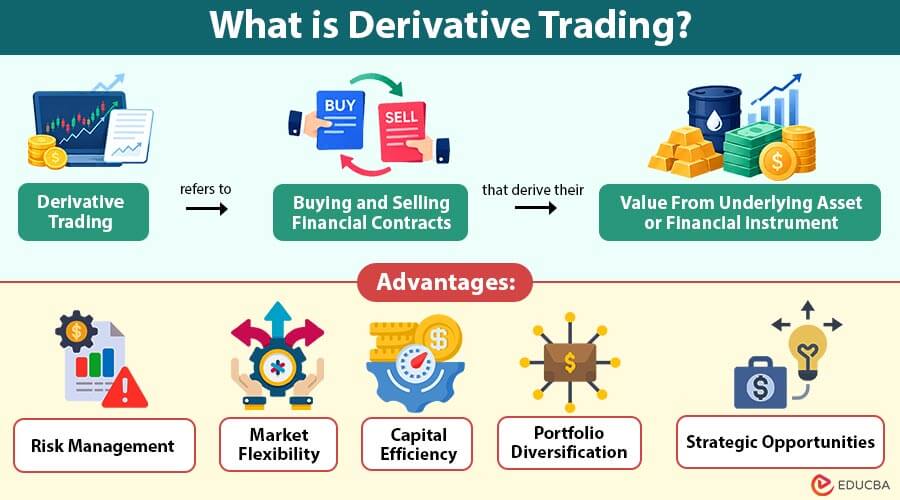
Derivative trading refers to buying and selling financial contracts that derive their value from the underlying asset or financial instrument. The underlying asset can include equities, bonds, commodities, currencies, interest rates, or stock market indexes.
For example, suppose a trader expects a stock’s price to rise. Instead of purchasing the stock directly, the trader may buy a futures or options contract linked to that stock. If the stock price moves in the expected direction, the derivative contract may increase in value.
The most common derivatives traded in financial markets are futures, options, forwards, and swaps. Futures and options are commonly traded on organized exchanges, while forwards and many swaps are generally traded privately over the counter.
Table of Contents:
Key Takeaways:
- Derivative trading involves contracts whose values depend on underlying assets like stocks, currencies, commodities, and indexes.
- Derivatives can help traders access specific market exposures without directly buying or selling underlying securities.
- Derivatives provide leverage and capital efficiency but can significantly increase losses when markets move against traders.
- Successful derivative trading requires understanding contracts, margins, expiration, market conditions, and disciplined risk management.
How Does Derivative Trading Work?
Derivative trading starts with an underlying asset and a contract whose value is connected to that asset. Traders take positions based on their expectations about future price movements.
For example, suppose an airline expects jet fuel prices to increase over the next few months. To manage this risk, it enters into a futures contract to purchase jet fuel at a predetermined price. If fuel prices rise, the futures position can help offset the higher cost of purchasing fuel in the market. If prices fall, the airline may benefit from cheaper fuel but could incur a loss on the futures position.
Options work differently because they give buyer right rather than an obligation, to buy or sell an underlying asset at a specified price. The buyer generally pays a premium for this right.
Therefore, depending on the type of contract and position acquired, derivative trading can offer opportunities to profit from both rising and declining markets.
Types of Derivatives
There are several major types of derivative contracts.
1. Futures
A futures contract is standardized agreement in which two parties commit to buying or selling underlying asset at agreed price on a specified future date.
2. Options
Under an options contract, a buyer has the right—but not the obligation—to buy or sell an asset at a predetermined price.
3. Forwards
A forward contract is private agreement between two parties to purchase or sell asset at predetermined price on a specified future date.
4. Swaps
A swap is contract where two parties agree to exchange specified cash flows based on predetermined terms over an agreed period.
Why Do Traders Use Derivatives?
Derivative trading serves several purposes.
1. Speculation
Traders can use derivatives to take positions based on their expectations about future price movements. For example, a trader who expects a stock index to rise may purchase index futures.
2. Hedging
Investors and businesses use derivatives to protect against unfavorable price movements and reduce potential losses from market fluctuations.
3. Leverage
Derivatives provide exposure to larger underlying positions with less capital, but leverage can significantly increase both profits and losses.
4. Portfolio Management
Institutional investors may use derivatives to adjust market exposure, manage risk, or implement investment strategies without buying or selling large quantities of the underlying assets.
Example of Derivative Trading
Suppose an investor expects the Nifty 50 index to rise from its current level of 25,000. Instead of buying all the underlying stocks, the investor purchases a Nifty 50 futures contract at 25,000. If the index rises to 25,500, the futures position may generate a profit based on the contract’s lot size and applicable costs. However, if the index falls to 24,500, the investor may incur a loss. This example shows how derivatives let traders gain exposure to market movements without directly buying the underlying assets.
Advantages of Derivative Trading
Derivative trading offers several potential advantages.
1. Risk Management
Derivatives help investors and businesses protect portfolios against unfavorable price movements, reducing potential losses and providing greater financial stability during uncertain market conditions.
2. Market Flexibility
Traders can use different derivative contracts to take positions in rising or falling markets, allowing them to pursue opportunities as conditions change.
3. Capital Efficiency
Certain derivatives require less upfront capital than purchasing underlying assets directly, allowing traders to gain exposure while managing available capital more efficiently.
4. Portfolio Diversification
Derivatives provide exposure to various asset classes, including indexes, commodities, currencies, and interest rates, helping investors diversify strategies and manage portfolio risks.
5. Strategic Opportunities
Options and other derivatives allow traders to develop strategies based on market direction, volatility, time, and risk expectations, creating flexible approaches for different conditions.
Risks of Derivative Trading
Derivative trading can involve substantial risks.
1. Leverage Risk
Leverage can magnify losses and profits. A relatively small unfavorable price movement can result in a significant loss.
2. Market Risk
Underlying asset prices can move unexpectedly because of economic conditions, corporate developments, interest rates, geopolitical events, or market sentiment.
3. Liquidity Risk
Some contracts may have limited trading activity, making it difficult to enter or exit position at the desired price.
4. Expiration Risk
Options and certain derivative contracts have expiration dates. If the underlying asset does not move as expected before expiration, the position may lose value.
5. Margin Risk
Futures and some other derivatives require margin. Traders may need to provide additional funds when adverse price movements cause losses.
6. Complexity Risk
Some derivative strategies involve multiple contracts and complicated payoff structures. A lack of understanding can increase the possibility of losses.
Difference Between Derivative Trading and Stock Trading
The table below highlights the differences between the two:
| Feature | Derivative Trading | Stock Trading |
| Asset Ownership | Usually does not involve direct ownership | Involves ownership when shares are purchased |
| Leverage | Commonly available | Generally lower for delivery trading |
| Expiration | Many contracts have an expiration | Shares generally do not expire |
| Risk | Can be high because of leverage | Depends on investment and market movement |
| Main Uses | Speculation, hedging, risk management | Investment and trading |
| Complexity | Generally higher | Relatively simpler |
Tips for Derivative Trading
Traders should follow disciplined risk-management practices when trading derivatives.
1. Understand the Contract
Understand the underlying asset, expiry, strike price, lot size, margin requirements, and settlement terms before entering any derivative trade.
2. Use Risk Limits
Determine maximum amount of capital you are willing to risk before entering a derivative trade, and follow it consistently.
3. Avoid Excessive Leverage
Avoid excessive leverage because higher exposure can magnify potential losses quickly when the underlying asset moves against your position.
4. Monitor Market Conditions
Monitor economic announcements, company news, interest-rate decisions, and market volatility because these factors can significantly influence derivative prices.
5. Use Stop-Loss Strategies Carefully
Use predefined exit levels to control potential losses, while recognizing that execution prices may differ during rapidly changing market conditions.
6. Maintain Sufficient Capital
Maintain sufficient capital to meet margin requirements and withstand adverse market movements without being forced to close positions.
7. Keep a Trading Record
Maintain detailed records of previous trades to identify recurring mistakes, evaluate strategies, and improve trading discipline over time.
Final Thoughts
Derivative trading provides traders and businesses with flexible tools for speculation, hedging, and managing financial risks. Futures, options, forwards, and swaps serve different purposes and involve varying levels of complexity. However, leverage can amplify losses significantly. Understanding contract terms, market conditions, margin requirements, and disciplined risk management is essential for making informed derivative trading decisions.
Frequently Asked Questions (FAQs)
Q1. What determines the price of a derivative?
Answer: A derivative’s price can depend on factors such as the underlying asset’s price, time to expiration, volatility, interest rates, strike price, and market demand.
Q2. Can derivative contracts be settled without delivering the underlying asset?
Answer: Yes, some derivatives are cash-settled, meaning the profit or loss is exchanged in cash instead of transferring the underlying asset.
Q3. What happens when a derivative contract expires?
Answer: At expiration, the contract may be settled according to its terms, exercised, or allowed to expire, depending on the type of derivative and whether it has value.
Q4. Can companies use derivatives for business purposes?
Answer: Yes, companies may use derivatives to manage exposure to currency movements, commodity prices, interest rates, and other financial uncertainties affecting their operations.
Recommended Articles
We hope that this EDUCBA information on “Derivative Trading” was beneficial to you. You can view EDUCBA’s recommended articles for more information.

