
What is Asset Stripping?
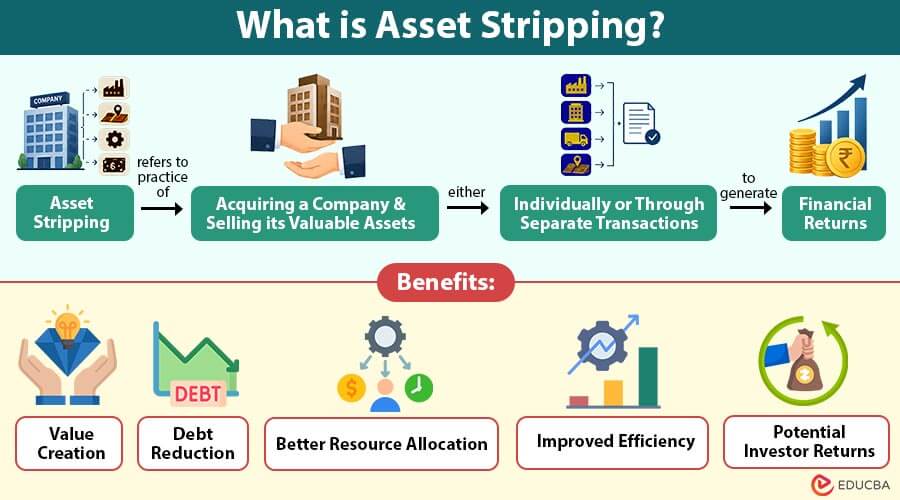
Asset stripping refers to practice of acquiring a company and selling its valuable assets, either individually or through separate transactions, to generate financial returns.
The strategy is often associated with private equity firms, activist investors, or companies involved in mergers and acquisitions. An investor may identify a business whose assets are undervalued by the market. After acquiring the company, the investor may sell selected assets and use the proceeds to repay debt, distribute cash to investors, or improve the company’s financial position.
For example, suppose an investor acquires a company for ₹100 crore even though it owns property, investments, and other assets that could collectively be sold for ₹140 crore. The investor may sell some of these assets and recover a significant portion of the acquisition cost.
However, asset stripping is not always beneficial to the acquired company. Selling essential assets may reduce its ability to generate revenue and compete in the future.
Table of Contents:
- Meaning
- Working
- Example
- Why Do Investors Use Asset Stripping?
- Benefits
- Risks
- Difference
- Factors to Consider Before Asset Stripping
- Is Asset Stripping Always Bad?
Key Takeaways:
- Asset stripping unlocks hidden value by selling selected company assets for financial returns.
- Investors may use asset sales to generate cash, reduce debt, and improve efficiency.
- Selling essential assets can weaken operations, reduce growth opportunities, and negatively affect employees.
- Responsible asset stripping requires careful valuation, strategic planning, regulatory compliance, and long-term sustainability considerations.
How Does Asset Stripping Work?
Asset stripping generally follows several steps:
1. Identify an Undervalued Company
An investor first identifies a company whose market value may be lower than the combined value of its assets. The company may own valuable property, investments, subsidiaries, patents, or other assets that are not fully reflected in its market valuation.
2. Acquire the Company
The investor purchases a controlling stake or acquires the entire company. Acquisition financing may include the investor’s own capital, debt financing, or a combination of both.
3. Assess the Company’s Assets
After the acquisition, the investor evaluates the company’s assets and determines which ones could be sold at attractive prices.
4. Sell Selected Assets
The investor sells non-core or valuable assets to generate cash. Depending on the strategy, these may include real estate, business divisions, investments, machinery, or intellectual property.
5. Use the Proceeds
The money generated from asset sales may be used to repay acquisition debt, fund operations, make distributions to shareholders, or finance other investments.
6. Restructure the Remaining Business
The remaining company may be reorganized to focus on its core operations. In some cases, the business may become smaller but more financially efficient.
Asset Stripping Example
The following example explains how asset stripping can involve selling non-core assets to unlock value and strengthen a company’s financial position.
Suppose a retail company owns several physical stores but decides to focus primarily on its online business. An investor may acquire the company and sell some stores that are no longer strategically important. The proceeds from these asset sales can be used to repay debt and invest in the company’s growing online operations.
Why Do Investors Use Asset Stripping?
Asset stripping can be attractive for several reasons.
1. Unlocks Hidden Asset Value
A company’s assets may be worth more individually than the company’s overall market valuation. Selling selected assets can help investors realize this hidden value.
2. Generates Immediate Cash
Asset sales can provide substantial cash that can be used to meet financial obligations, repay debt, or fund other investments.
3. Reduces Debt
Investors may use proceeds from asset sales to reduce acquisition-related debt. Lower debt can decrease interest expenses and improve financial stability.
4. Improves Operational Focus
Selling non-core assets can allow the remaining business to concentrate on its primary products, services, and markets.
5. Increases Investor Returns
When assets are purchased at a relatively low valuation and sold at higher prices, investors may generate attractive returns.
Benefits of Asset Stripping
Asset stripping can offer several potential benefits when implemented carefully.
1. Value Creation
Selling undervalued assets can unlock hidden value, allowing investors to realize stronger returns when assets are sold closer to their actual market worth.
2. Debt Reduction
Proceeds from asset sales can help repay outstanding loans, lower interest expenses, strengthen the balance sheet, and reduce the company’s overall financial burden.
3. Better Resource Allocation
Selling non-core assets releases capital that can be redirected toward profitable operations, strategic investments, growth initiatives, and other higher-value business opportunities.
4. Improved Efficiency
Removing unnecessary assets and operations can reduce maintenance, administrative, and operating expenses, helping the company streamline activities and improve overall efficiency.
5. Potential Investor Returns
Investors may earn attractive returns when proceeds from asset sales, restructuring, and operational improvements collectively exceed acquisition costs and related transaction expenses.
Risks of Asset Stripping
Despite its potential benefits, asset stripping can create significant risks.
1. Weakens the Company’s Operations
Selling productive assets may reduce manufacturing capacity, service capabilities, operational flexibility, and revenue generation, potentially weakening the company’s ability to compete effectively.
2. Reduces Long-Term Growth
Assets sold for immediate financial gains may eliminate valuable resources that could have supported future expansion, innovation, and sustainable business growth.
3. Employee Impact
Asset sales and restructuring may cause business closures, layoffs, reduced job security, or changes in employee responsibilities, affecting workforce morale and productivity.
4. Reputation Risk
Aggressive asset stripping may create negative perceptions among employees, customers, suppliers, investors, and communities, potentially damaging trust and the company’s reputation.
5. Increased Financial Pressure
If an acquired company carries substantial debt, asset sales may offer temporary relief while leaving underlying operational weaknesses and financial problems unresolved.
6. Regulatory and Legal Issues
Asset stripping transactions may require regulatory approvals and compliance with corporate, tax, competition, employment, and other applicable legal requirements and regulations.
Difference Between Asset Stripping and Corporate Restructuring
The table below highlights the key differences between the two:
| Factor | Asset Stripping | Corporate Restructuring |
| Main Focus | Selling valuable assets | Improving the overall business |
| Primary Objective | Unlock asset value | Improve financial and operational performance |
| Asset Sales | Often central to strategy | May or may not occur |
| Operational Changes | Can be significant | Usually central to the process |
| Long-Term Focus | Can be short or medium term | Generally focused on sustainability |
Factors to Consider Before Asset Stripping
Before selling assets, investors and management should evaluate several factors.
1. Asset Importance
Determine whether the asset is essential to daily operations, revenue generation, production, or service delivery before deciding to sell it.
2. Market Value
Assess the asset’s current market value and determine whether selling it would generate a reasonable price compared with its potential future value.
3. Future Growth
Consider whether retaining the asset could support future expansion, innovation, revenue growth, competitive advantages, or other long-term strategic opportunities.
4. Debt Position
Evaluate how proceeds from asset sales could affect outstanding debt, interest payments, financial stability, and the company’s ability to meet obligations.
5. Tax Implications
Assess potential tax liabilities arising from asset sales, including capital gains taxes, which could significantly reduce the transaction’s overall financial benefits.
6. Employee and Stakeholder Impact
Consider how asset sales may affect employees, customers, suppliers, investors, business relationships, workplace stability, and other important stakeholders.
7. Regulatory Requirements
Check whether proposed asset transactions require government approvals, regulatory permissions, disclosures, or compliance with applicable corporate, tax, and competition laws.
Is Asset Stripping Always Bad?
Asset stripping is not necessarily harmful. Its impact depends on how and why assets are sold.
Selling unused property or non-core subsidiaries may improve a company’s financial position without damaging its core operations. In contrast, selling essential factories, intellectual property, or productive business divisions simply to generate short-term cash may weaken the company.
Therefore, asset stripping should be evaluated based on whether the assets being sold are genuinely non-core and whether the remaining business can remain financially and operationally sustainable.
Final Thoughts
Asset stripping involves selling valuable company assets to unlock value, generate cash, reduce debt, and improve efficiency. However, excessive asset sales can weaken operations, limit growth, and harm stakeholders. Responsible asset stripping requires careful valuation, planning, financial analysis, and focus on sustainable long-term business objectives.
Frequently Asked Questions (FAQs)
Q1. Who typically carries out asset stripping?
Answer: Private equity investors, corporate buyers, activist investors, and other acquisition-focused parties may use asset stripping strategies.
Q2. Can asset stripping occur in a profitable company?
Answer: Yes. A profitable company may still sell certain assets if they are underutilized, non-core, or worth more separately than within the existing business.
Q3. Can asset stripping improve a company’s cash flow?
Answer: Yes. Selling selected assets can provide a one-time cash inflow, which may help address liquidity needs, fund strategic priorities, or meet financial obligations.
Q4. Can asset stripping be part of an acquisition strategy?
Answer: Yes. An acquirer may consider expected proceeds from selected asset sales when evaluating the potential financial returns of an acquisition.
Recommended Articles
We hope that this EDUCBA information on “Asset Stripping” was beneficial to you. You can view EDUCBA’s recommended articles for more information.


