


What is Take Rate?
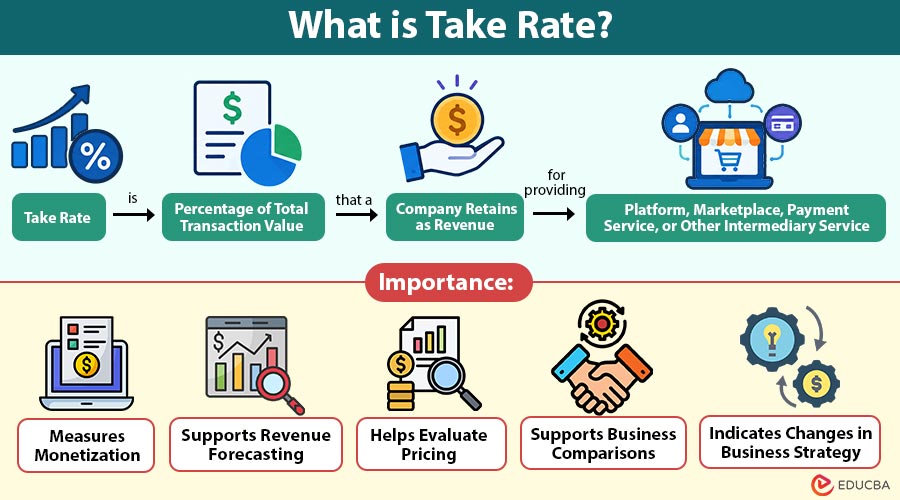
Take rate is the percentage of the total transaction value that a company retains as revenue for providing a platform, marketplace, payment service, or other intermediary service. Businesses such as e-commerce marketplaces, food-delivery platforms, ride-hailing companies, payment providers, and online marketplaces commonly use it. The metric helps businesses understand how effectively they convert the transaction value flowing through their platform into revenue.
For example, suppose an online marketplace facilitates ₹10,00,000 worth of transactions during a month and earns ₹1,00,000 in platform fees. Its take rate is:
Take Rate = (₹1,00,000 ÷ ₹10,00,000) × 100 = 10%
Therefore, the company has a 10% take rate.
A higher take rate does not always mean better performance. Companies must consider transaction volume, customer acquisition costs, competition, operating expenses, and the value provided to users.
Table of Contents:
- Meaning
- Formula
- Importance
- Working
- Types
- Factors that Affect Take Rate
- Example
- Difference
- How Can Companies Improve Take Rate?
- Limitations
Key Takeaways:
- Take rate measures how effectively a company converts transaction value into revenue through its platform.
- A higher take rate does not always indicate better performance because profitability and transaction volume also matter.
- Pricing, competition, product mix, customer incentives, and value-added services can significantly influence a company’s take rate.
- Businesses should analyze take rate alongside profitability, transaction volume, customer acquisition costs, and long-term customer value.
Take Rate Formula
The standard take rate formula is:
The total transaction value is often called Gross Merchandise Value (GMV) in marketplaces and e-commerce businesses.
Why is Take Rate Important?
Take rate is an important performance metric because it shows how effectively a business monetizes transaction activity.
1. Measures Monetization
It shows how effectively a platform converts transaction volume into revenue, helping businesses evaluate their monetization efficiency and overall financial performance.
2. Supports Revenue Forecasting
Businesses can estimate future transaction-related revenue by applying the expected take rate to projected transaction value, supporting financial planning and forecasting decisions.
3. Helps Evaluate Pricing
It helps companies assess whether their commissions and fees reflect value of the services provided while remaining competitive in their markets.
4. Supports Business Comparisons
Investors and analysts can compare take rates across similar platforms to evaluate monetization efficiency, while accounting for differences in calculation methods and business models.
5. Indicates Changes in Business Strategy
Changes in take rate can signal shifts in pricing, product mix, customer behavior, competitive pressure, or strategic decisions that affect platform monetization.
How Does Take Rate Work?
It generally compares the money a platform generates with the total value of transactions it handles.
The process usually involves the following steps:
1. Customers Make Transactions
Customers purchase products, services, rides, subscriptions, or other offerings through the platform, creating transaction value that contributes to the overall calculation.
2. Platform Facilitates Transactions
The company provides technology, payment processing, customer support, logistics, discovery, or other services that enable customers and sellers to complete transactions.
3. Platform Collects Fees
The platform charges commissions, service fees, listing fees, payment fees, or other transaction-related charges for facilitating customer transactions through its services.
4. Revenue Is Measured
The company calculates transaction-related revenue earned from customers or sellers, excluding revenue that does not directly arise from platform transactions.
5. Take Rate Is Calculated
The platform divides transaction-related revenue by total transaction value and multiplies the result by 100 to determine the take rate percentage.
Types of Take Rate
It can vary depending on business model and the fees included in the calculation.
1. Gross Take Rate
Measures total transaction-related revenue against total transaction value, showing the percentage of transaction value converted into platform revenue.
2. Net Take Rate
Accounts for refunds, incentives, discounts, processing costs, and adjustments, showing the revenue a platform effectively retains from transactions.
3. Commission Take Rate
Represents the percentage of each transaction that a platform receives as commission for facilitating sales between buyers and sellers.
4. Payment Take Rate
Measures transaction-related revenue against the total payment value processed, indicating the percentage earned from facilitating payment transactions through systems.
Factors that Affect Take Rate
Several factors can influence a company’s take rate.
1. Pricing Strategy
Increasing commissions or transaction fees can raise take rates, but excessive charges may discourage customers or sellers from using the platform regularly.
2. Competition
Strong competition can pressure platforms to reduce commissions, offer discounts, or provide incentives, potentially lowering take rates and affecting overall monetization levels.
3. Product Mix
Different products and services often have varying commission structures, so shifting toward lower-fee categories can reduce the platform’s overall take rate.
4. Customer Incentives
Discounts, promotional offers, subsidies, and cashback programs can reduce effective revenue, affecting the take rate and the amount companies ultimately retain.
5. Transaction Size
Transaction size can influence take rates, especially when platforms combine fixed fees with percentage-based commissions across different transaction values and customer segments.
6. Value-Added Services
Advertising, logistics, payment processing, premium subscriptions, and other value-added services can increase monetization beyond basic transaction commissions and improve overall take rates.
Example
Suppose an online food-delivery platform facilitates ₹20 lakh worth of restaurant orders in one month.
The platform earns:
- Restaurant commissions: ₹2,00,000
- Delivery-related fees: ₹50,000
- Other transaction-related fees: ₹30,000
Total revenue from these transactions is:
₹2,00,000 + ₹50,000 + ₹30,000 = ₹2,80,000
Therefore:
Take Rate = (₹2,80,000 ÷ ₹20,00,000) × 100
Take Rate = 14%
The platform has a 14% take rate based on the revenue and transaction value included in this calculation.
Difference Between Take Rate and Margin
The table below highlights the key differences between the two:
| Feature | Take Rate | Margin |
| Meaning | Percentage of transaction value captured as revenue | Percentage of revenue remaining after specified costs |
| Main Focus | Monetization of transaction volume | Profitability or cost efficiency |
| Formula | Transaction Revenue ÷ Transaction Value × 100 | Profit ÷ Revenue × 100 |
| Common Users | Marketplaces and platforms | Most businesses |
| Costs Included | Depends on company definition | Depends on margin type |
How Can Companies Improve Take Rate?
Businesses can improve take rates without necessarily increasing basic transaction fees.
1. Introduce Premium Services
Platforms can offer advertising, analytics, logistics, payment processing, premium placement, and other services to generate additional transaction-related revenue.
2. Improve Product Mix
Encouraging customers toward higher-value or higher-margin products and services can increase overall monetization and improve the platform’s effective take rate.
3. Reduce Revenue Leakage
Better payment collection, fraud controls, refund management, and transaction tracking can help companies minimize revenue losses and retain more transaction income.
4. Use Tiered Pricing
Businesses can introduce different pricing levels based on transaction volume, seller performance, service requirements, or customer needs to optimize monetization across segments.
5. Increase Customer Value
Improving discovery, convenience, logistics, technology, and customer support can increase perceived value, making users more willing to accept platform fees.
Limitations of Take Rate
It is a useful monetization metric, but it has several limitations:
1. Does Not Measure Profitability
A high take rate does not necessarily indicate higher profitability because it does not directly account for operating costs, marketing expenses, or customer acquisition costs.
2. Can Differ Across Business Models
Take rates may not be directly comparable between companies because businesses can include different types of fees, commissions, incentives, or transaction-related revenue in their calculations.
3. May Hide Revenue Quality
A rising take rate may result from higher fees rather than genuine business growth, potentially affecting customer satisfaction, transaction volume, or long-term platform usage.
4. Does Not Reflect Transaction Volume
It focuses on the percentage of transaction value captured as revenue and does not show the absolute size or growth of the transaction volume a company handles.
5. Can Be Affected by Product Mix
Changes in the mix of products, services, customers, or transaction sizes can change the take rate, making it hard to tell whether the underlying monetization strategy has improved.
Final Thoughts
Take rate is a valuable metric for evaluating how effectively a business monetizes transaction activity. However, analyze it alongside transaction volume, profitability, customer acquisition costs, competition, and business model differences. A balanced view helps companies make better pricing, growth, and monetization decisions while maintaining long-term customer value.
Frequently Asked Questions (FAQs)
Q1. What is considered a good take rate?
Answer: There is no universal benchmark. An appropriate take rate depends on the industry, competitive environment, operating costs, customer expectations, and the services the company provides.
Q2. Can a company have a low take rate and still be successful?
Answer: Yes. A low take rate can be sustainable when a company processes a very large transaction volume, operates efficiently, and generates sufficient revenue from its overall business model.
Q3. Does the take rate change over time?
Answer: Yes. It can change because of pricing adjustments, changes in customer behavior, new revenue streams, promotional programs, or shifts in the products and services being sold.
Q4. Who typically monitors take rate?
Answer: Management teams, financial analysts, investors, and business strategists commonly monitor take rate to understand platform monetization and assess changes in revenue generation.
Recommended Articles
We hope that this EDUCBA information on “Take Rate” was beneficial to you. You can view EDUCBA’s recommended articles for more information.


