
What is a Bolt-On Acquisition?
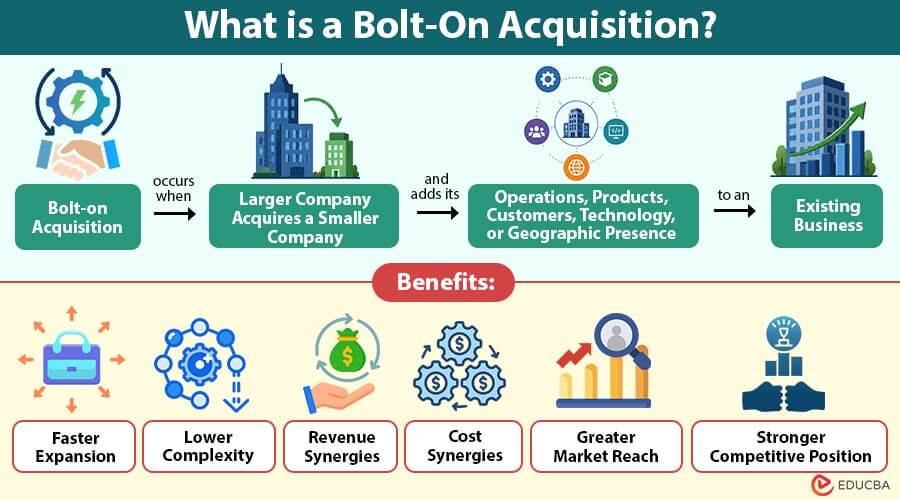
A bolt-on acquisition occurs when larger company acquires a smaller company and adds its operations, products, customers, technology, or geographic presence to an existing business.
The acquired company is generally smaller than the acquiring platform and is selected because it can contribute specific strategic or financial value. The term is particularly common in private equity, where an investment firm first acquires a larger business known as the platform company. It can then acquire smaller businesses and integrate them into that platform as part of a buy-and-build strategy.
For example, suppose a private equity firm owns a regional healthcare services company. Instead of building new locations from scratch, the company could acquire several smaller healthcare providers in nearby markets. These businesses become bolt-ons to the existing platform, allowing the combined company to expand faster.
Table of Contents:
- Meaning
- Working
- Why Do Companies Use Bolt-on-Acquistions?
- Example
- Benefits
- Risks
- Difference
- What Makes a Bolt-on-Acquisition Successful?
- How Do Investors Evaluate A Bolt-on-Acquistion?
Key Takeaways:
- Bolt-on acquisitions help companies expand markets, customers, products, capabilities, and revenues through targeted purchases.
- Successful bolt-ons require strategic fit, disciplined valuation, effective due diligence, integration, and customer retention.
- Private equity firms commonly use bolt-ons within buy-and-build strategies to accelerate platform company growth.
- Investors evaluate bolt-ons using financial performance, synergies, acquisition costs, debt levels, returns, and cash flow.
How Does a Bolt-On Acquisition Work?
The process generally begins with an established company identifying a smaller business that fits its growth strategy. The buyer evaluates the target’s financial performance, customers, products, management, technology, market position, and potential synergies.
A typical bolt-on acquisition follows these steps:
1. Establish a Platform
In private equity, the buyer first acquires a larger company that can serve as the foundation for future expansion. This business already has management, infrastructure, customers, systems, and operating capabilities.
2. Identify Suitable Targets
The platform company searches for smaller businesses that complement its existing operations. Targets may provide new products, customers, geographic markets, technology, talent, or specialized capabilities.
3. Conduct Due Diligence
The buyer examines the target’s financial statements, contracts, liabilities, customer relationships, employees, technology, intellectual property, tax position, and legal matters.
4. Determine the Valuation
The buyer estimates the target’s value using methods such as EBITDA multiples, discounted cash flow analysis, comparable company analysis, or precedent transactions.
5. Complete the Transaction
The acquisition may be financed through cash, debt, equity, or a combination of funding sources. The structure depends on the buyer’s financial position and the transaction’s size and characteristics.
6. Integrate the Business
After closing, the acquired company is integrated into the platform. Integration may involve consolidating finance, human resources, technology, procurement, sales, marketing, and other functions.
Why Do Companies Use Bolt-On Acquisitions?
Companies use bolt-on acquisitions because they can provide targeted growth without requiring a large-scale transformation.
1. Expand Market Share
Acquiring a smaller competitor can provide immediate access to its customers and market presence. This can be faster than developing the same customer base organically.
2. Enter New Geographic Markets
A company can use bolt-ons to enter new cities, states, or countries. Instead of establishing new facilities and building relationships from the beginning, it can acquire an established local business.
3. Add Products and Services
A target company may offer products or services that complement the buyer’s existing portfolio. Combining the offerings can create cross-selling opportunities.
4. Acquire Technology and Expertise
Companies may acquire smaller businesses to obtain specialized technology, intellectual property, data, or technical expertise.
5. Achieve Economies of Scale
Combining operations can reduce duplicated costs. For example, the combined business may consolidate accounting, purchasing, administration, or technology systems.
6. Accelerate Growth
Acquisitions can provide immediate revenue and customers, allowing a company to expand more quickly than through organic growth alone.
Example of a Bolt-On Acquisition
Consider ABC Industrial Services, a company that provides equipment maintenance to manufacturing businesses across western India.
ABC has an established customer base, sales team, accounting system, and management structure. It wants to expand into southern India but does not want to spend several years building a new customer network.
ABC identifies XYZ Maintenance, a smaller company operating in Bengaluru and Chennai with 50 industrial customers.
ABC acquires XYZ for ₹20 crore and integrates its operations into the existing business.
Following the acquisition:
- ABC gains access to XYZ’s customers.
- The company expands into new geographic markets.
- ABC can cross-sell its existing services to XYZ customers.
- Administrative functions can be consolidated.
- Procurement may become more efficient because of higher purchasing volumes.
- XYZ’s technical expertise can complement ABC’s existing capabilities.
In this situation, XYZ is the bolt-on, while ABC is the platform company.
Benefits of Bolt-On Acquisitions
Bolt-on acquisitions can provide several strategic and financial benefits.
1. Faster Expansion
Acquiring an established business can immediately provide customers, employees, infrastructure, and market presence.
2. Lower Complexity
Because the target is generally smaller than the platform, integration may be simpler than a large transformational merger.
3. Revenue Synergies
The combined company may generate additional revenue through cross-selling, upselling, broader product offerings, and access to new customers.
4. Cost Synergies
Companies can eliminate overlapping expenses by combining administrative, technology, procurement, and other functions.
5. Greater Market Reach
Bolt-ons can help businesses expand into new geographic regions or customer segments.
6. Stronger Competitive Position
A series of well-selected acquisitions can increase scale and make the combined company more competitive.
Risks of Bolt-On Acquisitions
Despite their advantages, bolt-on acquisitions can create significant risks.
1. Integration Risk
The acquired business may use different systems, processes, technologies, or management practices. Poor integration can reduce expected synergies.
2. Cultural Differences
Employees from the two businesses may have different working styles, values, and management expectations. Cultural conflicts can affect employee retention and productivity.
3. Overvaluation
A buyer may overpay for a target and find that the expected financial benefits do not justify the purchase price.
4. Customer Loss
Customers may leave following the acquisition if they dislike changes in pricing, service quality, personnel, or branding.
5. Management Challenges
Integrating multiple businesses requires strong leadership and clear responsibilities. Rapid acquisition activity can place significant pressure on management teams.
6. Excessive Debt
If acquisitions are financed heavily with debt, the combined company may face higher interest costs and financial risk.
Difference Between Bolt-On Acquisition and Platform Acquisition
Below is a comparison of the key differences between Bolt-On Acquisition and Platform Acquisition:
| Feature | Bolt-On Acquisition | Platform Acquisition |
| Target size | Usually smaller | Usually larger |
| Purpose | Expand an existing business | Establish the core business |
| Buyer | Existing platform company or strategic buyer | Private equity firm or strategic buyer |
| Role | Adds to an existing platform | Becomes the platform |
| Integration | Usually integrated into existing operations | Establishes systems and infrastructure |
| Strategy | Buy-and-build | Foundation for future acquisitions |
What Makes a Bolt-On Acquisition Successful?
A successful bolt-on acquisition generally has strong strategic and operational alignment. Key factors include:
1. Strategic Fit
The target should align with the platform’s long-term objectives and strengthen its competitive position and growth strategy.
2. Financial Discipline
The buyer should maintain valuation discipline and pay a reasonable price based on realistic financial assumptions.
3. Clear Synergies
Expected revenue growth and cost savings should be clearly identified, measurable, achievable, and supported by credible assumptions.
4. Cultural Compatibility
Management teams and employees should share compatible values, communication styles, and working practices to support collaboration.
5. Integration Planning
Integration planning should begin during due diligence to identify challenges, responsibilities, timelines, and required resources before closing.
6. Customer Retention
The buyer should protect key customer relationships by maintaining service quality, communication, and trust throughout the integration.
7. Experienced Management
The platform should have experienced managers and sufficient resources to oversee additional businesses while maintaining operational performance and growth.
How Do Investors Evaluate a Bolt-On Acquisition?
Investors typically examine both the standalone target and its contribution to the combined platform.
Important metrics may include:
1. Revenue Growth
Investors assess historical and projected revenue growth to determine whether the target demonstrates sustainable expansion and future growth potential.
2. EBITDA and EBITDA Margin
Investors evaluate EBITDA and margins to understand profitability, operating efficiency, and the target’s potential contribution to overall platform earnings.
3. Customer Retention
Investors examine customer retention rates to assess loyalty, revenue stability, and potential risks associated with customer losses after acquisition.
4. Recurring Revenue
Recurring revenue indicates predictable cash flows and helps investors evaluate the target’s earnings quality and long-term financial stability.
5. Purchase Price Multiple
Investors compare the acquisition price with EBITDA, revenue, or other metrics to determine whether the target is reasonably valued.
6. Expected Cost Synergies
Investors estimate savings from combining operations, eliminating duplicate expenses, consolidating suppliers, or improving efficiency across the combined business.
7. Revenue Synergies
Investors evaluate opportunities to increase sales through cross-selling, expanded distribution, new customers, complementary products, and broader market access.
Final Thoughts
A bolt-on acquisition occurs when an established company acquires and integrates a smaller business to expand its customer base, enter markets, add products, gain capabilities, achieve economies of scale, and accelerate growth. Common in private equity, successful bolt-ons require careful target selection, valuation, due diligence, financing, and effective integration.
Frequently Asked Questions (FAQs)
Q1. Are bolt-on acquisitions limited to private equity firms?
Answer: No. Strategic companies, corporations, and other investors can also use bolt-on acquisitions to support expansion and business development.
Q2. How is a bolt-on acquisition different from a merger?
Answer: A bolt-on acquisition involves adding a smaller business to an existing platform, while a merger generally combines two businesses into one organization.
Q3. Can a bolt-on acquisition be completed without fully rebranding the target?
Answer: Yes. The buyer may retain the target’s existing brand when it has strong customer recognition or operates effectively as a separate business.
Q4. What industries commonly use bolt-on acquisitions?
Answer: Bolt-on acquisitions are common in healthcare, software, manufacturing, business services, consumer products, and other fragmented industries.
Recommended Articles
We hope that this EDUCBA information on “Bolt-On Acquisition” was beneficial to you. You can view EDUCBA’s recommended articles for more information.


