


What is a 3-Statement Model?
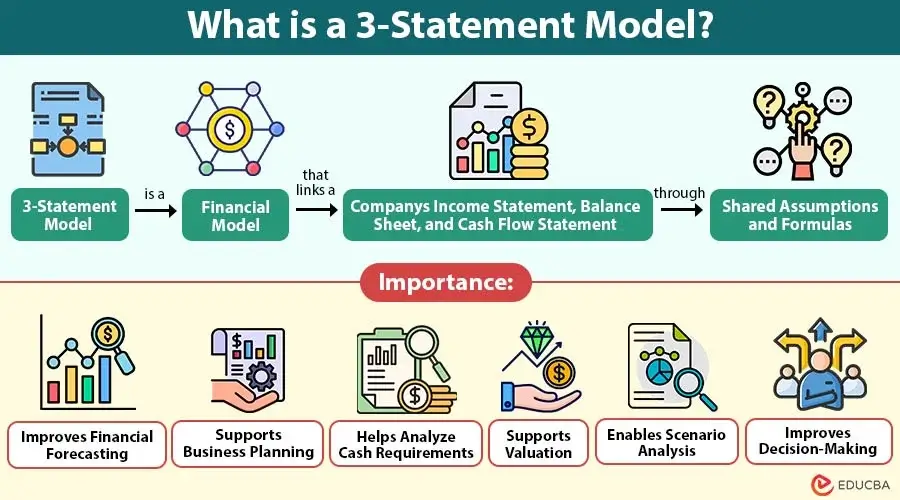
A 3-statement model is a financial model that links a companys income statement, balance sheet, and cash flow statement through shared assumptions and formulas. Instead of analyzing each financial statement separately, the model shows how changes in one statement affect the others.
For example, an increase in sales affects revenue and profit on the income statement. Higher sales may increase accounts receivable on the balance sheet, while the resulting change in receivables affects operating cash flow. Because the statements are connected, an assumption’s effect flows throughout the model.
A 3-statement model is commonly used for financial forecasting, budgeting, business planning, valuation, investment analysis, and strategic decision-making. It also provides the foundation for more advanced models such as discounted cash flow (DCF), merger, and leveraged buyout models.
Table of Contents:
- Meaning
- Importance
- What are the Three Statements in a 3-Statement Model?
- How Do the Three Statements Connect?
- How to Build A 3-Statement Model?
- Common Mistakes
- Example
- Best Practices
Key Takeaways:
- A 3-statement model connects financial statements to provide an integrated view of business performance.
- It supports forecasting, planning, valuation, cash management, scenario analysis, and informed financial decision-making.
- Accurate statement links ensure changes in revenue, expenses, assets, liabilities, and cash flow are consistent.
- Separating assumptions, using supporting schedules, and checking balances improves model accuracy, transparency, and reliability.
Why is a 3-Statement Model Important?
A 3-statement model provides a more complete view of a company’s financial position than analyzing individual statements separately.
1. Improves Financial Forecasting
The model helps companies estimate future revenue, profitability, cash flow, assets, liabilities, and funding requirements.
2. Supports Business Planning
Management can evaluate how decisions such as increasing expenses, purchasing equipment, hiring employees, or raising debt may affect future financial performance.
3. Helps Analyze Cash Requirements
A company can report strong profits while still experiencing cash shortages. A 3-statement model helps identify when additional funding may be required.
4. Supports Valuation
Three-statement models are commonly used as the foundation for valuation techniques such as DCF analysis.
5. Enables Scenario Analysis
Users can change assumptions such as revenue growth, margins, capital expenditure, or debt levels and observe how those changes affect the company’s financial statements.
6. Improves Decision-Making
By connecting profitability, financial position, and cash flow, the model gives decision-makers a broader understanding of the potential consequences of business decisions.
What are the Three Statements in a 3-Statement Model?
A 3-statement model contains three core financial statements.
1. Income Statement
A company’s financial performance during a given time period is displayed in the income statement. Profit is calculated by deducting costs and expenses from revenue.
Common items include:
- Revenue
- Cost of goods sold
- Gross profit
- Operating expenses
- EBITDA
- Depreciation and amortization
- EBIT
- Interest expense
- Taxes
- Net income
In a financial model, revenue and expense assumptions forecast future profitability.
2. Balance Sheet
The balance sheet displays the financial situation of a business at a certain moment in time. It consists of shareholders’ equity, assets, and liabilities.
The fundamental accounting equation is:
Typical balance sheet items include cash, accounts receivable, inventory, property and equipment, accounts payable, debt, and retained earnings.
The balance sheet is particularly important in a 3-statement model because it must remain balanced in every forecast period.
3. Cash Flow Statement
The cash flow statement explains how cash moves into and out of a business during a period. It generally includes three sections:
- Cash flow from operating activities
- Cash flow from investing activities
- Cash flow from financing activities
Operating cash flow includes items such as net income and changes in working capital. Investing cash flow commonly includes capital expenditures, while financing cash flow can include debt and equity transactions and repayments.
The cash flow statement ultimately determines the company’s ending cash balance, which flows back to the balance sheet.
How do the Three Statements Connect?
The main strength of a 3-statement model is the connection between the statements.
Income Statement → Cash Flow Statement
Net income from the income statement generally becomes the starting point for the operating section of the cash flow statement.
Income Statement → Balance Sheet
Net income affects retained earnings, which is part of shareholders’ equity.
Balance Sheet → Cash Flow Statement
Operating cash flow is impacted by changes in working capital accounts such as accounts payable, inventory, and accounts receivable.
Cash Flow Statement → Balance Sheet
The ending cash calculated on the cash flow statement becomes the cash balance on the balance sheet.
Capital Expenditure → Cash Flow Statement and Balance Sheet
Capital expenditures reduce cash through investing activities and increase property, plant, and equipment on the balance sheet.
Debt → Income Statement, Cash Flow Statement and Balance Sheet
Debt affects debt levels on the balance sheet, borrowing or repayment on the cash flow statement, and interest expense on the income statement.
These connections allow the model to behave as an integrated system rather than three separate spreadsheets.
How to Build a 3-Statement Model?
Building a 3-statement model involves using historical financial data, forecasting assumptions, and linked formulas to project a company’s financial performance. Startup financial projection templates can also help organize key assumptions, projected financial statements, and supporting calculations when preparing an initial model for a new business.
Step 1: Collect Historical Financial Data
Gather several years of income statements, balance sheets, and cash flow statements. Focus on revenue, expenses, assets, liabilities, equity, depreciation, capital expenditure, debt, and cash flow.
Step 2: Create Forecast Assumptions
Set assumptions for revenue growth, margins, operating expenses, taxes, depreciation, capital expenditure, working capital, debt, interest, and dividends. Keep assumptions separate from calculations.
Step 3: Forecast the Income Statement
Forecast revenue using historical trends, market expectations, pricing, or operating drivers. Then estimate COGS, operating expenses, depreciation, interest, and taxes to calculate projected net income.
Example:
Revenue = Previous Revenue × (1 + Growth Rate)
If revenue is ₹50 crore and expected growth is 10%, projected revenue is ₹55 crore.
Step 4: Forecast the Balance Sheet
Project working capital using assumptions such as receivable, inventory, and payable days. Forecast PP&E using capital expenditure and depreciation. Model debt through borrowings and repayments, and link retained earnings to net income and dividends.
Step 5: Build the Cash Flow Statement
Start with net income and make the adjustments for working capital changes and non-cash expenses. To determine ending cash, include investing activity like capital expenditures and financing activities like debt and stock transactions.
Step 6: Link the Statements
Connect the three statements so changes flow through the model correctly.
- Net Income → Cash Flow Statement and Retained Earnings
- Depreciation → Income Statement and Cash Flow Statement
- Capital Expenditure → Cash Flow Statement and PP&E
- Debt Borrowing → Cash Flow Statement and Balance Sheet
- Ending Cash → Balance Sheet
Step 7: Check the Balance Sheet
Confirm that:
Assets − Liabilities − Equity = 0
A balance check helps identify errors in formulas, assumptions, links, or accounting treatments.
Common Mistakes in 3-Statement Modeling
Several mistakes can reduce a 3-statement model’s accuracy.
1. Hardcoding Assumptions
Centralize important assumptions in one place rather than entering them repeatedly in formulas throughout the model.
2. Incorrect Statement Links
Missing or incorrect links between statements can create inconsistencies and reduce the overall accuracy of financial projections.
3. Ignoring Working Capital
Changes in receivables, inventory, and payables can significantly affect cash flow and overall financial performance projections.
4. Failing to Model Debt
Debt affects the balance sheet and financing cash flow, while interest expenses directly affect profitability.
5. Incorrect Depreciation Treatment
Depreciation affects net income, cash flow adjustments, and fixed assets, so it must be treated consistently across all statements.
6. Not Checking the Balance Sheet
A model should include a balance check for every forecast period to identify potential errors.
7. Overcomplicating the Model
A model should contain enough detail to support accurate analysis without adding unnecessary complexity or difficult-to-maintain calculations.
3-Statement Model Example
Suppose a company generates ₹100 crore in revenue and expects revenue to grow by 10% next year.
The projected revenue would be:
₹100 crore × 1.10 = ₹110 crore
Assume the company expects a 40% gross margin and ₹25 crore in operating expenses.
Gross profit would be the following:
₹110 crore × 40% = ₹44 crore
Operating profit before other items would therefore be:
₹44 crore − ₹25 crore = ₹19 crore
Retained earnings and the cash flow statement use net income after interest and taxes are deducted.
If the company also spends ₹8 crore on capital expenditure, cash decreases through investing activities while property, plant, and equipment increase on the balance sheet. Similarly, if accounts receivable increase because of higher sales, the company may not have collected all the revenue in cash yet. The increase in receivables therefore affects operating cash flow.
This example shows why you must model the three statements together, not independently.
Best Practices for Building a 3-Statement Model
A reliable model should be organized, transparent, and easy to audit.
1. Separate Assumptions from Calculations
Keep assumptions clearly separated from calculations so users can easily understand, update, and audit model inputs.
2. Use Consistent Historical and Forecast Periods
Maintain consistent historical and forecast periods across statements to ensure accurate comparisons and reliable financial projections.
3. Link Statements Rather than Manually Duplicating Values
Link financial statements directly to avoid duplication, reduce errors, and ensure changes flow consistently throughout the model.
4. Create Supporting Schedules when Needed
Build supporting schedules for debt, depreciation, and working capital to improve accuracy and strengthen connections between statements.
5. Avoid Unnecessary Hardcoded Numbers
Minimize hardcoded numbers by using formulas and centralized assumptions to make the model easier to update and maintain.
6. Include Balance Checks
Add balance checks to confirm assets equal liabilities plus equity and quickly identify potential modeling errors.
Final Thoughts
A 3-statement model provides an integrated view of a company’s financial performance, position, and cash flows. By linking assumptions, financial statements, and supporting schedules, it helps improve forecasting, valuation, scenario analysis, and decision-making. Accurate formulas, consistent assumptions, and regular balance checks are essential for building a reliable model.
Frequently Asked Questions (FAQs)
Q1. Who typically uses a 3-statement model?
Answer: Financial analysts, investment bankers, corporate finance teams, business owners, and investors commonly use 3-statement models.
Q2. How far into the future should a 3-statement model forecast?
Answer: The forecast period depends on its purpose, but many models project three to five years for planning and analysis.
Q3. What software is commonly used to create a 3-statement model?
Answer: Microsoft Excel and Google Sheets are widely used because they support formulas, linked statements, assumptions, scenarios, and financial calculations.
Q4. What information do you need before creating the model?
Answer: You typically need historical financial statements, operating data, accounting information, debt details, and assumptions about future business performance.
Recommended Articles
We hope that this EDUCBA information on “3-Statement Model” was beneficial to you. You can view EDUCBA’s recommended articles for more information.

