


What is Microlending?
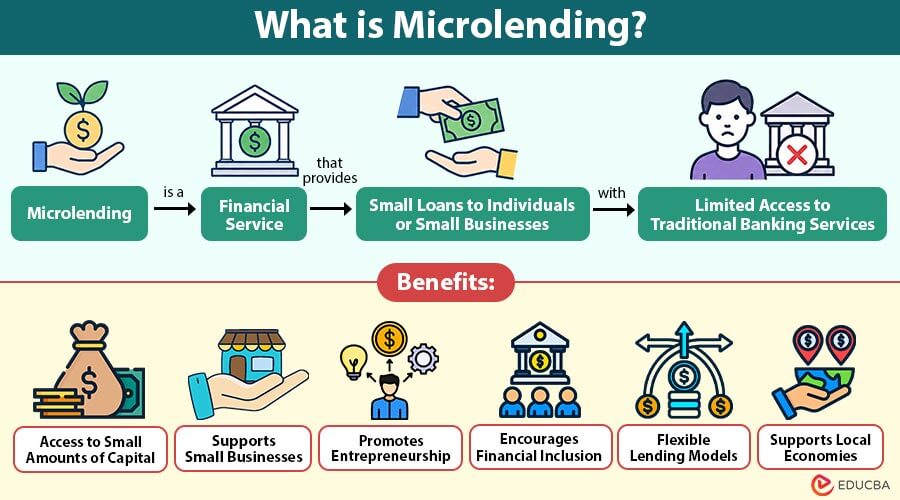
Microlending is a financial service that provides small loans to individuals or small businesses with limited access to traditional banking services. These loans are generally used to start or expand businesses, purchase equipment, manage working capital, pay education expenses, or meet other essential financial needs.
Microlending is closely associated with financial inclusion because it helps underserved individuals access credit without depending entirely on conventional banks. Borrowers may include low-income individuals, small entrepreneurs, farmers, self-employed workers, and people operating informal businesses.
Unlike traditional loans, microlending often involves smaller loan amounts and may use alternative approaches to assess borrowers. Depending on the lender and program, loans can be provided individually or through groups.
Table of Contents:
Key Takeaways:
- Microlending improves financial inclusion by providing small loans to underserved individuals and businesses.
- It supports entrepreneurship, income generation, agriculture, employment, and local economic development through accessible financing.
- Responsible lending helps reduce risks such as over-indebtedness, defaults, high borrowing costs, and privacy concerns.
- Transparent terms, financial education, technology, and effective risk management improve microlending sustainability and borrower outcomes.
Importance of Microlending
Microlending plays an important role in expanding access to financial services. Many individuals and small businesses may not meet the eligibility requirements of conventional financial institutions because they have limited credit histories, irregular income, or insufficient collateral.
Microlending can help address these gaps by offering smaller loans designed around the needs of underserved borrowers. It can contribute to:
1. Financial Inclusion
Gives underprivileged people and communities without access to conventional banking institutions access to credit.
2. Entrepreneurship
Helps individuals start, operate, or expand small businesses by providing capital for equipment, inventory, and other needs.
3. Income Generation
Enables borrowers to invest in productive activities that can increase earnings, improve livelihoods, and support household financial stability.
4. Employment Creation
Growing microenterprises can create local jobs and increase demand for workers.
5. Economic Participation
Access to finance enables individuals and small businesses to participate actively in formal economic activities and markets.
6. Financial Independence
Provides borrowers with capital while reducing their dependence on informal lenders, family members, or other funding sources.
How Does Microlending Work?
The microlending process generally begins when a borrower applies for a small loan. The lender evaluates the applicant based on factors such as income, business activity, repayment capacity, credit history, and the intended use of funds.
If the lender approves the application, it provides the agreed loan amount. The borrower then repays the principal and applicable interest over a predetermined period.
A typical microlending process includes the following:
1. Loan Application
The borrower submits personal, business, income, and financial information to the lender to apply for a small loan.
2. Borrower Assessment
The lender evaluates the borrower’s creditworthiness, income, business activity, repayment capacity, credit history, and intended use of funds.
3. Loan Approval
Based on the evaluation, the lender approves the application and sets the loan amount, interest rate, repayment period, and payment schedule.
4. Fund Disbursement
After approval, the lender transfers the agreed loan amount to the borrower’s account for the specified personal or business purpose.
5. Repayment
The borrower makes regular payments toward the principal and applicable interest according to the agreed repayment schedule until the loan is repaid.
6. Monitoring
The lender monitors repayment performance and may provide financial guidance, business support, or assistance to help borrowers manage their loans.
Types of Microlending
Microlending can take different forms depending on the borrower, lending structure, and loan purpose.
1. Individual Microlending
Individual microlending provides financing directly to one borrower. The borrower must follow the loan terms. Lenders often evaluate a borrower’s income, credit history, business performance, and repayment capacity.
2. Group Microlending
Group microlending provides loans to group members, with borrowers sometimes sharing responsibility for repayment. This model can reduce lending risks where borrowers have limited credit histories or collateral.
3. Business Microlending
Business microlending provides small loans to entrepreneurs and microenterprises. Borrowers may use the funds to purchase inventory, equipment, raw materials, or other resources needed for business operations.
4. Agricultural Microlending
Agricultural microlending provides small loans to farmers and agricultural workers. Funds may support the purchase of seeds, fertilizers, tools, livestock, irrigation equipment, or other farming requirements.
5. Peer-to-Peer Microlending
Peer-to-peer microlending connects borrowers with individual or institutional lenders through online platforms. Technology allows these platforms to facilitate loan applications, funding, repayments, and borrower communication.
Benefits of Microlending
Microlending offers several benefits that support individuals, small businesses, and local economic development.
1. Access to Small Amounts of Capital
Provides small loans to individuals and microentrepreneurs who may struggle to obtain financing from traditional financial institutions.
2. Supports Small Businesses
Helps small businesses finance inventory, manage operating expenses, purchase equipment, and expand their business activities.
3. Promotes Entrepreneurship
Provides capital that helps aspiring entrepreneurs launch businesses and enables existing businesses to expand operations and enter markets.
4. Encourages Financial Inclusion
Connects underserved borrowers with formal financial services and helps them establish financial records for future borrowing opportunities.
5. Flexible Lending Models
Offers repayment structures that can accommodate borrowers’ income patterns, making financing more manageable for individuals with irregular earnings.
6. Supports Local Economies
Investments in local businesses, agriculture, and services can stimulate economic activity and create opportunities for surrounding communities.
Difference Between Microlending and Traditional Lending
The table below highlights the key differences between microlending and traditional lending across various aspects.
| Aspect | Microlending | Traditional Lending |
| Loan Size | Focuses on smaller loan amounts. | Generally provides larger loan amounts. |
| Target Borrowers | Often serves underserved individuals, microentrepreneurs, and small businesses. | Primarily serves individuals and businesses with established financial profiles. |
| Credit Assessment | May consider business activity, cash flows, community relationships, alternative data, or group structures. | Commonly evaluates credit scores, income, financial statements, collateral, and documentation. |
| Collateral | May require limited or no traditional collateral, depending on the lender. | Often requires collateral, especially for larger loans. |
| Documentation | Usually involves simpler documentation and assessment processes. | Generally requires more extensive financial and legal documentation. |
| Purpose | Often used for small businesses, working capital, household needs, or entrepreneurship. | Used for business expansion, property purchases, personal needs, and other larger financing requirements. |
| Financial Inclusion | Helps bridge the gap between informal borrowing and formal financial services. | Primarily serves borrowers who already meet conventional lending requirements. |
Common Uses of Microlending
Below are some of the common uses of microlending:
1. Starting a Small Business
Microlending provides entrepreneurs with initial capital to launch small businesses and establish sustainable income sources.
2. Purchasing Business Inventory
Small business owners use microloans to buy merchandise, maintain sufficient stock levels, and meet client demand.
3. Buying Equipment or Tools
Borrowers can finance essential equipment, machinery, or tools needed to improve business operations and productivity.
4. Expanding an Existing Enterprise
Microloans help established businesses expand operations, increase production capacity, reach new markets, and generate additional revenue.
5. Purchasing Agricultural Supplies
Farmers can use microloans to purchase seeds, fertilizers, pesticides, irrigation materials, and other essential agricultural supplies.
6. Managing Seasonal Working Capital
Microlending provides working capital during seasonal periods when businesses need additional funds for operations and expenses.
Risks of Microlending
Although microlending can improve access to finance, it also involves risks for both borrowers and lenders.
1. High Borrowing Costs
Some microloans may carry relatively high interest rates or fees because lenders face higher administrative and credit risks when providing many small loans.
2. Over-Indebtedness
Borrowers who take multiple loans without sufficient repayment capacity may experience financial stress. Responsible lending and careful borrowing are therefore important.
3. Default Risk
Borrowers with unstable incomes may struggle to make regular repayments. Economic downturns, business losses, natural disasters, or unexpected expenses can affect repayment capacity.
4. Limited Financial Literacy
Some borrowers may not fully understand interest calculations, fees, repayment schedules, or loan conditions. Borrowers can make wise judgments with the aid of financial education.
5. Operational Costs
Processing numerous small loans can create high administrative costs for lenders. Digital technologies can help reduce these costs, but effective systems and risk controls are still required.
6. Data and Privacy Risks
Digital microlending platforms may collect significant amounts of personal and financial information. Weak cybersecurity or poor data-management practices can expose borrowers to privacy and fraud risks.
7. Regulatory Challenges
Microlending institutions must comply with applicable lending, consumer protection, data privacy, and financial regulations. Regulatory requirements can vary across jurisdictions.
Final Thoughts
Microlending provides small-scale financing to underserved individuals and businesses, supporting entrepreneurship, agriculture, income generation, and financial inclusion. However, challenges include high borrowing costs, over-indebtedness, repayment risks, privacy concerns, and regulation. Responsible lending, transparent terms, financial education, risk management, and technology can make microlending more sustainable and impactful.
Frequently Asked Questions (FAQs)
Q1. Who can provide microlending services?
Answer: Microlending services can be provided by microfinance institutions, banks, nonprofit organizations, fintech companies, and specialized lending platforms, depending on local regulations.
Q2. How do lenders reduce the risk of microlending?
Answer: Lenders may reduce risk through borrower screening, repayment history analysis, cash-flow assessment, credit checks, portfolio diversification, monitoring, and appropriate loan limits.
Q3. How much money can a borrower receive through microlending?
Answer: The loan amount depends on the lender, the borrower’s profile, location, repayment capacity, and the specific microlending program.
Q4. Is microlending available in rural areas?
Answer: Yes, microlending can serve rural communities by providing financing to farmers, self-employed individuals, small traders, and rural entrepreneurs.
Recommended Articles
We hope that this EDUCBA information on “microlending” was beneficial to you. You can view EDUCBA’s recommended articles for more information.


