


What is Ex-Ante?
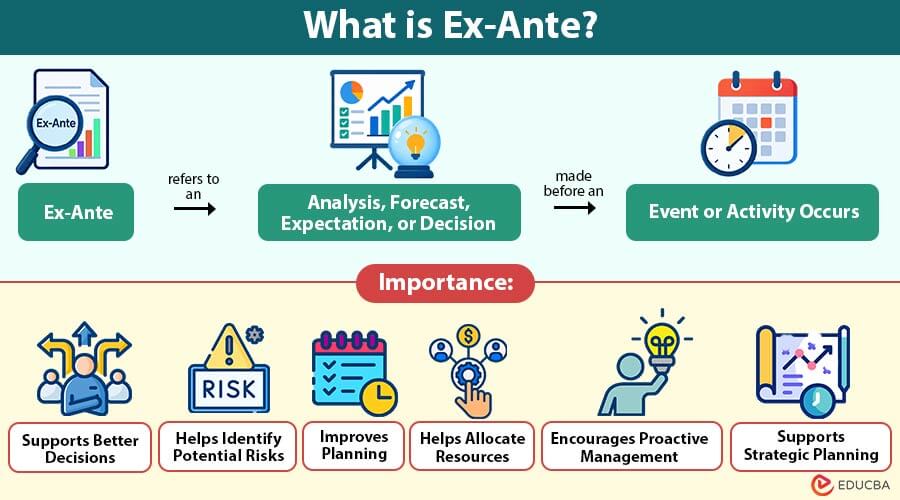
Ex-Ante refers to an analysis, forecast, expectation, or decision made before an event or activity occurs. It uses available information, assumptions, historical data, and expectations to estimate what may happen.
The main purpose of ex-ante analysis is to support forward-looking decision-making. Since the actual outcome is not yet known, decision-makers must work with estimates and assumptions.
For example, suppose a company expects a new product to generate ₹50 lakh in sales during its first year. This expected sales figure is an ex-ante estimate. After the year ends, the company can compare the forecast with its actual sales.
Ex-ante analysis therefore focuses on expected outcomes, while later analysis can determine whether those expectations were accurate.
Table of Contents:
- Meaning
- Importance
- Key Characteristics
- Difference
- Examples
- Applications
- Benefits
- Limitations
- How to Improve Ex-Ante Analysis?
- Process
- Why it May Change?
Key Takeaways:
- Ex-ante analysis supports informed decisions by estimating possible future outcomes before events or activities occur.
- It helps organizations identify potential risks, allocate resources, improve planning, and prepare proactive strategies.
- Its estimates rely on available information, assumptions, forecasts, and expectations, making uncertainty unavoidable.
- Regularly comparing forecasts with actual results improves forecasting accuracy, decision-making, and future organizational planning.
Importance of Ex-Ante Analysis
Ex-ante analysis plays an important role in decision-making because organizations often need to act before they know the final outcome.
1. Supports Better Decisions
Ex-ante analysis gives decision-makers a structured way to evaluate possible outcomes before taking action. It lets them compare alternatives and choose the option that best fits the available information.
2. Helps Identify Potential Risks
Organizations can examine possible problems before they occur. This allows them to develop preventive measures and contingency plans.
3. Improves Planning
Businesses can use future estimates to plan budgets, staffing, production, marketing activities, and resource requirements.
4. Helps Allocate Resources
It analysis can help organizations decide where to invest money, time, employees, and other resources based on expected results.
5. Encourages Proactive Management
Organizations can anticipate possible changes and develop suitable answers rather than waiting for issues to arise.
6. Supports Strategic Planning
Long-term business strategies often depend on expectations about future demand, competition, costs, technology, and market conditions. Ex-ante analysis helps organizations evaluate these factors before making strategic decisions.
Key Characteristics of Ex-Ante
Ex-ante analysis has several important characteristics that distinguish it from analysis based on historical or completed events.
1. Forward-Looking
Ex-ante analysis focuses on future events and possible outcomes. It helps decision-makers prepare for what may happen rather than simply examining what has already happened.
2. Based on Expectations
Because the future is uncertain, ex-ante analysis relies on expectations, forecasts, assumptions, and estimates.
3. Uses Available Information
Decision-makers use information available before the event, such as historical data, market conditions, business trends, and existing plans.
4. Involves Uncertainty
An ex-ante estimate may not match the eventual outcome because unexpected changes can occur.
5. Supports Planning
Organizations use ex-ante analysis to develop strategies, budgets, forecasts, contingency plans, and operational decisions.
Difference Between Ex-Ante and Ex-Post
Ex-ante and ex-post describe two different stages of analysis.
Ex-ante refers to an assessment made before an event occurs, while ex-post refers to an assessment made after the event has occurred.
For example, suppose a company expects its revenue to increase by 15% during the next financial year. The 15% forecast is an ex-ante estimate.
At the end of the year, the company discovers that revenue actually increased by 12%. The 12% result is an ex-post outcome.
The difference can be summarized as follows:
| Ex-Ante | Ex-Post |
| Made before an event | Made after an event |
| Focuses on expectations | Focuses on actual results |
| Uses forecasts and assumptions | Uses observed data |
| Helps with planning | Helps with evaluation |
| Forward-looking | Historical or retrospective |
Examples of Ex-Ante
Below are some common examples showing how businesses make estimates and decisions before actual outcomes occur.
1. Business Forecast
A business anticipates selling 10,000 pieces of a product in the upcoming year. Since the actual sales have not yet happened, this sales estimate is an ex-ante forecast.
2. Project Planning
A business estimates that a new project will cost ₹20 lakh and generate ₹30 lakh in expected benefits. These estimates are ex-ante assessments used to determine whether the project should proceed.
3. Hiring Decision
A company expects that hiring additional employees will increase productivity and support future growth. This expectation is an ex-ante assessment because the actual impact has not yet been observed.
4. Marketing Campaign
A business predicts that a new advertising campaign will increase website traffic by 25%. The prediction is an ex-ante estimate.
Applications of Ex-Ante Analysis
Ex-ante analysis applies across many areas of business and decision-making.
1. Budgeting
Organizations estimate future revenue and expenses before preparing budgets. These estimates help determine how to distribute resources.
2. Forecasting
Businesses forecast sales, demand, costs, staffing requirements, and other future conditions using available information.
3. Project Evaluation
Before starting a project, organizations estimate its costs, benefits, timeline, and potential risks. These estimates support investment and approval decisions.
4. Strategic Planning
Companies evaluate possible future market conditions before developing long-term strategies.
5. Risk Management
Organizations assess potential risks before taking action and develop measures to reduce their possible impact.
6. Performance Planning
Managers establish expected targets before a performance period begins. They can later compare actual performance with these expectations.
Benefits of Ex-Ante Analysis
It offers several benefits to organizations and decision-makers.
1. Better preparation
Organizations can prepare for potential future conditions, helping them respond effectively rather than reacting after unexpected changes occur.
2. Improved resource allocation
Resources can be directed toward activities with favorable expected outcomes, improving efficiency and supporting better organizational performance.
3. Early risk identification
By identifying possible hazards before they become serious issues, organizations can create effective mitigation plans.
4. More structured Decisions
Decision-makers can compare options using forecasts, assumptions, and expected outcomes to make informed, consistent choices.
5. Greater Strategic Clarity
Future expectations provide organizations with a clear foundation for developing effective business strategies, priorities, and objectives.
6. Performance Measurement
Organizations can later compare forecasts with actual outcomes, helping them evaluate planning accuracy and improve future decision-making.
Limitations of Ex-Ante Analysis
Although ex-ante analysis is useful, it has certain limitations.
1. Future Uncertainty
The future cannot be predicted with complete accuracy. Unexpected events can significantly change expected outcomes.
2. Dependence on Assumptions
It estimates depend on assumptions about future conditions. Incorrect assumptions can produce unreliable results.
3. Limited Information
Decision-makers may not have complete information when making an ex-ante assessment.
4. Forecasting Errors
Even well-designed forecasts can be inaccurate because market conditions, customer behavior, technology, and other factors can change unexpectedly.
5. Overconfidence
Decision-makers may place too much confidence in forecasts and underestimate uncertainty. This can result in poor decisions if actual conditions differ significantly from expectations.
How to Improve Ex-Ante Analysis?
Organizations can improve ex-ante analysis by using reliable information and regularly reviewing their assumptions.
First, decision-makers should clearly identify the analysis objective. They should determine what outcome they are trying to estimate and which factors could influence it.
Second, they should use relevant and reliable data. Historical information, current trends, market research, and internal business data can improve forecast quality.
Third, organizations should consider multiple scenarios instead of relying on a single prediction. For example, they can prepare best-case, expected-case, and worst-case scenarios.
Fourth, organizations should review assumptions regularly. If market conditions or business circumstances change, organizations should update forecasts accordingly.
Finally, organizations should compare their ex-ante estimates with actual outcomes. This comparison helps identify weaknesses in forecasting methods and improves future planning.
Ex-Ante Decision-Making Process
A simple ex-ante decision-making process can include the following steps:
1. Define the Objective
Clearly identify the decision and the desired outcome.
2. Gather Information
Collect relevant data, facts, market information, and other available evidence before making the decision.
3. Identify Assumptions
Determine the expected conditions, factors, and assumptions that may influence the decision and its outcome.
4. Estimate Possible Outcomes
Forecast the potential results of different options based on available information and reasonable assumptions.
5. Assess Risks
Identify uncertainties and potential risks that could cause actual results to differ from expected outcomes.
6. Compare Alternatives
Evaluate each option based on its expected benefits, costs, risks, and potential impact on objectives.
7. Make the Decision
Select the option with the most favorable expected outcome and the best support for the defined objective.
8. Review the Outcome
Compare actual results with original expectations to evaluate decision accuracy and improve future planning.
Why it May Change?
Ex-ante expectations are not fixed. They can change when new information becomes available.
For example, a company may initially expect strong demand for a product. Later, new competitors may enter the market, customer preferences may change, or economic conditions may weaken. The company may then revise its original forecast.
Updating expectations matters because outdated information can lead to poor decisions.
Final Thoughts
Ex-ante refers to forecasts, estimates, expectations, or decisions made before an event occurs. It supports planning, budgeting, risk management, and strategic decision-making by anticipating possible outcomes. However, forecasts may differ from actual results because of uncertainty. Combining ex-ante analysis with regular monitoring and ex-post evaluation improves future decisions and forecasting accuracy.
Frequently Asked Questions (FAQS)
Q1. What is an ex-ante estimate?
Answer: An ex-ante estimate is a prediction about a future result based on available information, assumptions, expectations, and relevant data.
Q2. How does ex-ante analysis handle uncertainty?
Answer: It considers possible future conditions and uses assumptions, probability estimates, scenarios, and risk assessments to account for uncertainty.
Q3. Can ex-ante analysis be revised?
Answer: Yes. Organizations can revise ex-ante estimates when new information, changing market conditions, or unexpected developments affect the original assumptions.
Q4. Who uses ex-ante analysis?
Answer: Business managers, investors, financial analysts, economists, project managers, policymakers, and other decision-makers use ex-ante analysis for future-oriented decisions.
Recommended Articles
We hope that this EDUCBA information on “Ex-Ante” was beneficial to you. You can view EDUCBA’s recommended articles for more information.


