
What is Revenue Leakage?
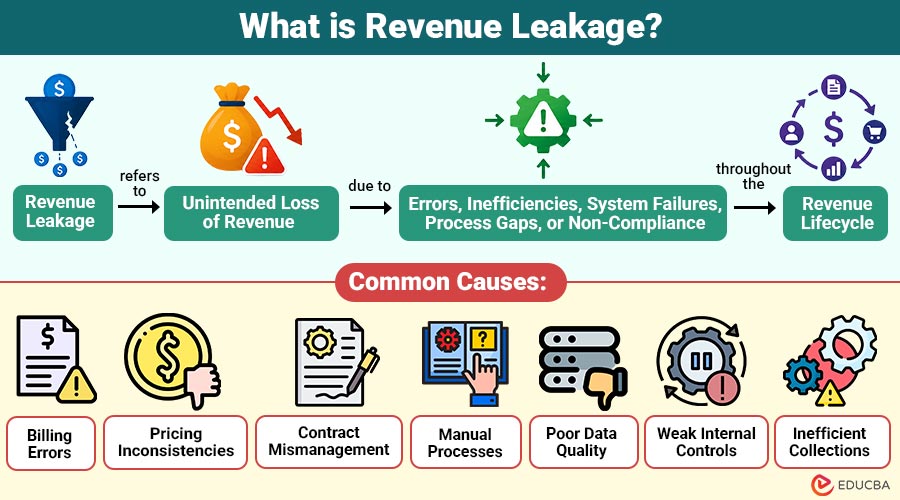
Revenue leakage refers to unintended loss of revenue due to errors, inefficiencies, system failures, process gaps, or non-compliance throughout the revenue lifecycle. It occurs when a business fails to collect the full amount it has rightfully earned from its products or services.
Revenue leakage may happen during pricing, quoting, contract management, order processing, invoicing, billing, collections, or revenue recognition. Because these losses often occur gradually and across multiple departments, they can remain unnoticed for months or even years. Unlike bad debt or declining sales, revenue leakage involves revenue that should have been earned but is lost due to preventable operational issues.
Table of Contents:
- Meaning
- Importance
- Common Causes
- Types
- Examples
- Impact of Revenue Leakage
- How to Prevent Revenue Leakage?
- Technologies that Help Reduce Revenue Leakage
- Challenges
Key Takeaways:
- Revenue leakage reduces profitability through errors in billing, pricing, contracts, and processes across business operations.
- Automation, accurate data, and strong controls significantly minimize preventable revenue losses and operational inefficiencies.
- Regular audits, contract management, and billing accuracy improve compliance, cash flow, and the reliability of financial reporting.
- AI-powered revenue assurance tools effectively detect anomalies, recover lost revenue, and support sustainable business growth.
Why is Revenue Leakage Important?
Managing revenue leakage is essential because every missed invoice, pricing error, or contract discrepancy directly affects business profitability. Identifying and eliminating leakage improves operational efficiency while strengthening financial performance.
Key reasons why revenue leakage matters include the following:
1. Protects Profit Margins
Consistently recovers lost revenue, strengthens profit margins, and improves overall financial performance across business operations.
2. Improves Cash Flow
Enhances cash flow by consistently ensuring timely invoicing, accurate collections, and reduced outstanding payment delays.
3. Enhances Billing Accuracy
Improves billing accuracy by effectively eliminating invoicing errors, duplicate charges, and missed billable transactions.
4. Strengthens Customer Trust
Builds customer trust through transparent billing, accurate invoices, and consistent adherence to agreed pricing terms.
5. Supports Accurate Financial Reporting
Ensures reliable financial reporting by accurately recording revenue and consistently minimizing accounting discrepancies.
6. Reduces Compliance Risks
Minimizes compliance and audit risks through accurate documentation, billing practices, and regulatory reporting processes.
7. Improves Operational Efficiency
Streamlines operational processes by reducing manual errors, improving workflows, and significantly increasing overall business productivity.
8. Enables Better Forecasting
Supports better forecasting and budgeting through accurate revenue data, financial insights, and predictable income trends.
Common Causes of Revenue Leakage
Revenue leakage usually results from multiple operational issues rather than a single mistake. Some of the most common causes include:
1. Billing Errors
Billing errors, including incorrect, duplicate, delayed, or missing invoices, reduce revenue through inaccurate charges, overlooked services, and payment delays.
2. Pricing Inconsistencies
Pricing inconsistencies arise from outdated policies, manual calculations, or unauthorized discounts, causing underbilling, reduced margins, and lost revenue opportunities.
3. Contract Mismanagement
Contract mismanagement regularly causes revenue loss through missed renewals, incorrect pricing, unbilled changes, expired agreements, and overlooked contractual obligations.
4. Manual Processes
Manual processes increase human errors, resulting in incorrect data entry, missing orders, duplicate records, inaccurate invoices, and revenue leakage.
5. Poor Data Quality
Poor data quality leads to billing inaccuracies due to duplicate records, missing information, incorrect tax codes, invalid pricing, and reporting errors.
6. Weak Internal Controls
Weak internal controls lead to unauthorized discounts and refunds, manual adjustments, insufficient approvals, audit failures, and preventable revenue losses across operations.
7. Inefficient Collections
Inefficient collections delay payments due to weak follow-ups, unresolved disputes, overdue invoices, poor recovery efforts, and rising outstanding receivables.
Types of Revenue Leakage
Below are the major types of revenue leakage that commonly impact business profitability and cash flow.
1. Pricing Leakage
Pricing leakage occurs when products or services are sold below approved prices due to incorrect discounts or pricing errors.
2. Billing Leakage
Billing leakage occurs when billable products or services are omitted, delayed, or inaccurately invoiced, reducing overall revenue collection.
3. Contract Leakage
Contract leakage occurs when agreed contractual terms, pricing, renewals, or adjustments are not correctly enforced during billing processes.
4. Usage Leakage
Usage leakage occurs when customer consumption exceeds billed amounts due to inaccurate measurement or capture of actual usage data.
5. Collection Leakage
Collection leakage occurs when issued invoices remain unpaid due to ineffective follow-ups, disputes, or weak payment collection processes.
6. Revenue Recognition Leakage
Revenue recognition leakage occurs when revenue is recorded incorrectly because of accounting errors, timing differences, or compliance issues.
Examples of Revenue Leakage
Below are common real-world examples of revenue leakage across various industries.
1. Telecommunications Company
A telecom provider fails to bill customers for international roaming charges because of a system integration issue. Thousands of transactions remain unbilled, resulting in significant revenue loss.
2. SaaS Company
A software company allows customers to exceed subscription usage limits without automatic billing adjustments. The business provides additional services without generating additional revenue.
3. Manufacturing Company
A manufacturer offers negotiated pricing to large customers but continues using outdated pricing tables. Products are consistently sold below contractual prices.
4. Professional Services Firm
Employees record billable consulting hours, but project managers fail to approve all timesheets before invoicing. Several hours of completed work remain unbilled.
5. Healthcare Provider
Medical services are delivered successfully, but coding errors prevent insurance claims from being submitted correctly, delaying or reducing reimbursements.
Impact of Revenue Leakage
Below are the key impacts of revenue leakage on business operations and financial performance.
1. Reduced Profitability
Revenue leakage reduces profitability by lowering earned income while operating expenses remain unchanged, significantly shrinking overall business margins.
2. Cash Flow Problems
Missed invoices and delayed collections reduce cash availability, limit working capital, and significantly affect daily business operations.
3. Inaccurate Financial Reporting
Revenue leakage distorts financial reports, causing consistent inaccuracies in budgeting, forecasting, performance analysis, and decision-making across the organization.
4. Customer Disputes
Incorrect invoices create customer disputes, payment delays, reduced trust, dissatisfaction, and increased administrative effort to resolve billing issues.
5. Compliance Risks
Improper billing and accounting practices increase compliance risks, resulting in penalties, audits, legal issues, and potentially regulatory violations.
6. Operational Inefficiencies
Billing errors require additional manual corrections, reducing employee productivity, increasing costs, and delaying essential business processes significantly overall.
7. Poor Business Decisions
Incomplete revenue data leads to inaccurate planning, misguided investments, inefficient resource allocation, and weakened long-term business growth strategies.
How to Prevent Revenue Leakage?
Preventing revenue leakage requires a combination of technology, process improvements, and governance.
1. Automate Billing
Automate billing processes to reduce manual errors, improve invoice accuracy, and accelerate payment collection efficiently.
2. Standardize Pricing
Centralize pricing policies with automated approvals to ensure consistent, compliant, and accurate customer billing.
3. Strengthen Contract Management
Digitally manage contracts to track renewals, pricing changes, and service agreements without missing critical deadlines.
4. Improve Data Quality
Regularly validate and update master data to prevent billing inaccuracies and revenue-related reporting errors.
5. Conduct Regular Audits
Perform routine financial audits to consistently identify billing discrepancies before significant revenue losses occur.
6. Implement Approval Controls
Require approval for discounts, refunds, pricing exceptions, and invoice adjustments to prevent unauthorized revenue losses.
Technologies that Help Reduce Revenue Leakage
Modern businesses use advanced technologies to detect, prevent, and eliminate revenue leakage across financial processes.
1. Enterprise Resource Planning Systems
Integrate financial processes, automate transactions, and improve billing accuracy across business operations.
2. Customer Relationship Management Platforms
Maintain accurate customer records, pricing, contracts, and sales information to reduce billing errors.
3. Revenue Assurance Software
Continuously monitors transactions to proactively detect revenue leakage, billing discrepancies, and compliance issues.
4. Billing and Invoicing Automation Tools
Automate invoice generation, validation, and payment tracking to minimize manual processing errors.
5. Contract Lifecycle Management Solutions
Manage contracts, renewals, pricing updates, and obligations to effectively prevent revenue losses.
6. Artificial Intelligence
Identifies anomalies, predicts revenue risks, and automates decision-making for improved financial accuracy.
7. Machine Learning
Learns transaction patterns to automatically detect billing irregularities and prevent recurring revenue leakage.
Challenges in Managing Revenue Leakage
Below are the key challenges organizations face in effectively managing revenue leakage.
1. Complex Pricing Structures
Multiple pricing models increase billing complexity, making errors and revenue leakage more likely across transactions.
2. Legacy Systems with Limited Integration
Outdated systems create data silos, reducing visibility and increasing reconciliation errors between departments.
3. High Volumes of Manual Processes
Manual data entry and approvals significantly increase processing time, introduce inaccuracies, and lead to missed revenue opportunities.
4. Poor Visibility Across Departments
Disconnected teams limit collaboration, causing billing inconsistencies and delayed identification of revenue losses.
5. Inconsistent Data Quality
Inaccurate or outdated data leads to billing errors, reporting issues, and revenue leakage risks.
6. Frequent Contract Modifications
Constant contract changes increase the likelihood of missed updates, incorrect billing, and compliance issues.
Final Thoughts
Revenue leakage reduces profitability through billing errors, pricing inconsistencies, contract issues, and manual processes. Preventing it requires automation, strong governance, accurate data, and modern technologies to improve financial accuracy, enhance operational efficiency, ensure compliance, recover lost revenue, and support sustainable business growth.
Frequently Asked Questions (FAQs)
Q1. How is revenue leakage different from bad debt?
Answer: Revenue leakage refers to revenue that is never billed or collected due to internal process failures, whereas bad debt occurs when customers fail to pay invoices that were correctly issued.
Q2. Which industries are most affected by revenue leakage?
Answer: Industries with complex billing and contract processes—such as telecommunications, SaaS, healthcare, manufacturing, utilities, logistics, and professional services—are particularly vulnerable to revenue leakage.
Q3. What are the signs of revenue leakage in a business?
Answer: Frequent billing disputes, delayed invoicing, pricing errors, missed contract renewals, increasing accounts receivable, revenue discrepancies, and declining profit margins may indicate revenue leakage.
Q4. How can businesses identify revenue leakage?
Answer: Businesses can identify revenue leakage by conducting regular financial audits, monitoring billing accuracy, reviewing contracts, analyzing revenue trends, reconciling transactions, and using revenue assurance tools.
Recommended Articles
We hope that this EDUCBA information on “Revenue Leakage” was beneficial to you. You can view EDUCBA’s recommended articles for more information.


