


When a Working Demo Fails in the Real World?
A demo that runs smoothly in front of an investor or a beta tester tells you almost nothing about whether a product can survive contact with real users. That’s the uncomfortable truth behind many fast-built MVPs today. Between AI coding assistants, no-code builders, and “vibe-coded” prototypes, it is now possible to go from idea to working app in days instead of months.
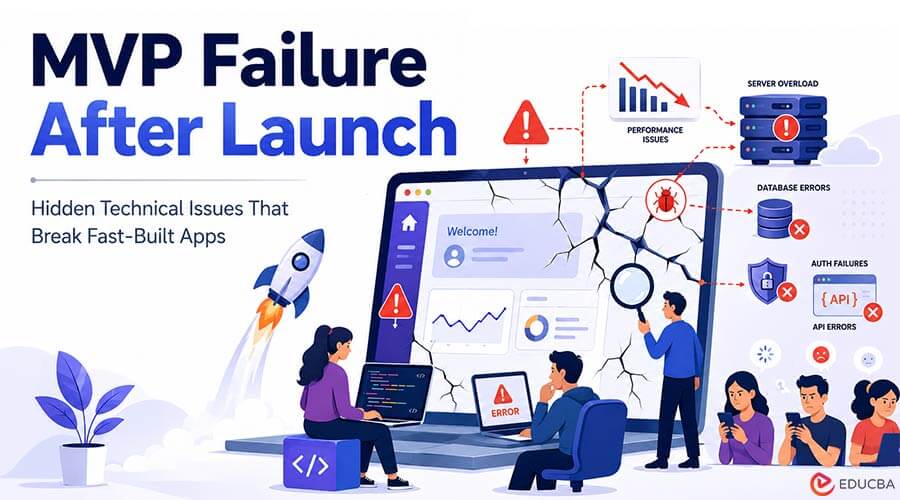
The problem usually shows up later, right after launch, when traffic stops behaving politely. This is where MVP failure after launch becomes a reality for many startups, as hidden technical issues begin affecting performance, reliability, security, and user experience. A payment flow that worked for one test card starts failing on edge cases. A feature ships, and something unrelated quietly stops working.
None of this means the team did anything wrong at the MVP stage; speed was the whole point of building fast. It simply means the codebase was never designed to be examined closely because, until now, nobody had a reason to.
Where the Cracks Actually Start
Most of what breaks after launch is not a single bug. It is accumulated technical debt the gap between the fastest way to ship something and the most maintainable way to build it. Stripe’s Developer Coefficient study, based on a survey of over 1,000 developers and 1,000 C-level executives, found that the average developer loses 17.3 hours of a roughly 41-hour work week to technical debt and bad code. That is about 42% of the week spent patching the past instead of building anything new, amounting to nearly $85 billion in lost productivity globally.
For a quickly built app, especially one generated largely by AI tools without a senior engineer reviewing the output, that debt tends to concentrate in predictable areas: authentication, data validation, database structure, and anything involving multiple users accessing the system simultaneously.
While rapid development helps startups validate ideas quickly, MVPs often fail after launch when technical debt, weak architecture, and rushed development decisions prevent the product from handling real-world demands.
These problems rarely appear as an immediate crash. Instead, they show up as strange, hard-to-reproduce behavior that consumes support time and gradually damages user trust.
This is usually the point where founders stop guessing and bring in a second set of eyes. A structured AI code review services engagement exists precisely to address this gap – reviewing the architecture and code quality line by line to identify what’s stable, what’s fragile, and what needs improvement before it becomes more expensive to fix than building it correctly from the beginning.
The Startups That Scaled Too Soon
Timing matters as much as code quality. Startup Genome’s research on high-growth startups found that 74% of them fail because they scale prematurely – expanding the user base, marketing spend, or feature set faster than the underlying product can handle.
Separately, CB Insights’ analysis of VC-backed startups found poor product-market fit to be one of the leading reasons for startup failures, with running out of cash often becoming the final symptom rather than the root cause.
When these factors combine, a clear pattern appears: a product that isn’t structurally ready gets pushed to scale anyway because growth pressure does not wait for a codebase to mature.
The solution isn’t always to slow down. Instead, startups need a clear understanding of what their application can handle before increasing users, features, or investment. Identifying technical weaknesses early can help prevent MVP failure after launch and reduce expensive rebuilding efforts later.
Common MVP Failure Signals That Lead to Failure After Launch
Not every warning sign is obvious from the outside. Many issues may seem minor during early development but become major obstacles once real users interact with the product.
Understanding these warning signs can help teams prevent MVP failure after launch and identify problems before they impact customers, revenue, or investor confidence.
| Symptom | What’s Actually Happening | Risk If Ignored |
| Fixing one bug creates another | Tightly coupled code with no clear module boundaries | Every future feature gets slower and riskier to ship |
| App works, but no one can explain how | No documentation, logic buried across AI-generated sessions | Any new developer needs weeks just to get oriented |
| UI looks polished, backend feels vague | Frontend built ahead of backend logic and data handling | Data integrity issues surface only under real load |
| Security wasn’t part of the original plan | Auth and validation added as an afterthought | Vulnerabilities discovered by users, not by the team |
| Investors ask technical questions no one can answer | No audit trail or structured review has ever been done | Due diligence stalls or collapses mid-round |
A few of these on their own are not alarming. Three or more at once usually means the product has quietly outgrown its design.
Final Thoughts
Fast-built apps and AI-assisted development are not the problem. They help startups test ideas quickly, reduce development costs, and bring products to market faster. The challenge begins when speed replaces proper planning, testing, and technical review.
Speed gets a product to launch. It doesn’t automatically make that product ready for what comes after. Without proper testing, documentation, and technical planning, an MVP failure after launch can become a costly challenge rather than a temporary setback.
Before pushing further growth, marketing spend, or a funding round, founders should answer a few important questions:
- Can anyone on the team explain how the core features actually work under the hood, not just what they look like?
- Has the app been tested under real concurrent usage, not just individual demo runs?
- Would the codebase survive a technical due diligence review from an investor tomorrow?
- Is there a clear fix-or-rebuild plan for the parts that feel the most unstable?
If two or more answers are uncertain, it is a signal to investigate further before scaling. The founders who avoid major setbacks are usually the ones who get an honest, structured look at their codebase before growth pressure forces the issue, not after a feature breaks in production or a technical question delays funding.
An early, short technical review is almost always cheaper than a complete rebuild later.
Recommended Articles
We hope this guide on MVP failure after launch helps you identify hidden technical challenges, avoid common development mistakes, and build products that are ready for real-world users. Explore these recommended articles for additional insights and strategies to improve MVP development, scalability, and long-term product success.

