


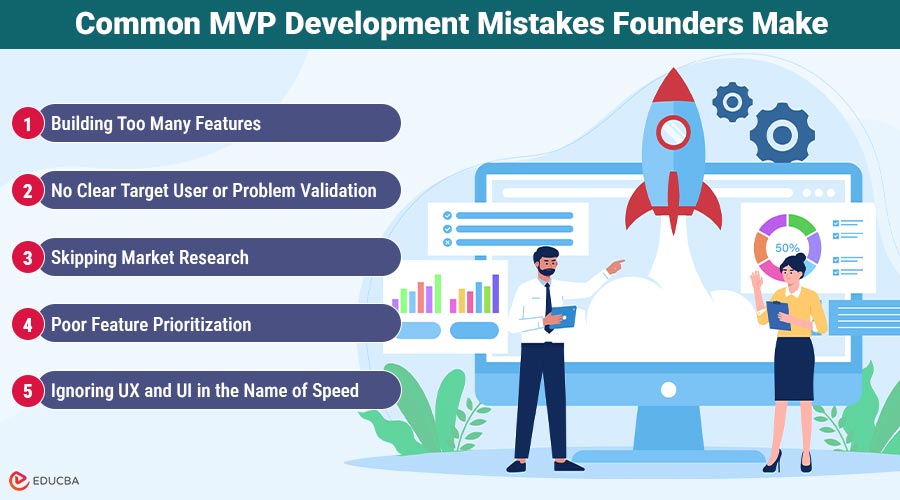
MVP Development Mistakes: Overview
Developing a Minimum Viable Product (MVP) is a smart way to validate your business idea while saving time and money. However, many founders misunderstand what an MVP truly is and end up building either too little or too much. The purpose of an MVP is not to launch a polished product, but to test assumptions, learn from real users, and iterate quickly. When done right, an MVP accelerates product-market fit. When done wrong, it drains the budget and delays success. To help you avoid the most common pitfalls, this guide highlights key MVP development mistakes founders commonly make, explains why they occur, and guides you on how to prevent them, thereby increasing your chances of launching a product that users genuinely value.
Common MVP Development Mistakes Founders Make
Here are some of the most common MVP development mistakes founders make that can hinder product success and delay market validation.
1. Building Too Many Features
Many founders make the mistake of treating their MVP like a “small version of the full product.” Instead of focusing on the core problem and testing one key value proposition, they try to add multiple secondary features. This leads to higher development costs, longer timelines, and unclear feedback because users are unsure which feature to respond to. An MVP should be simple, focused, and designed to validate one main assumption.
Common Issues When Overbuilding an MVP:
- Adding unnecessary features that do not contribute to learning or validation
- Increasing design and development complexity is causing late launches
- Confusing users with too many options or an unclear product purpose
- Collecting scattered feedback instead of focused product insights
- Higher maintenance and iteration time due to extra features
- Losing the “lean” nature of an MVP by aiming for perfection early
If you struggle with narrowing down your feature list, this guide on choosing MVP features will help you prioritize what truly matters. Focus on validating one core problem first; everything else can be addressed later.
2. No Clear Target User or Problem Validation
A major mistake founders make is building based on assumptions rather than real user insights. Without a clear target user or a validated problem, you risk launching a product that people neither need nor are willing to pay for. Many founders fall in love with their idea and skip the essential research step, assuming users will see the value just because they do. But validation is the backbone of successful MVPs.
Why Lack of Validation Leads to MVP Failure:
- Building a product for “everyone” leads to unclear messaging and weak user adoption
- Solving a problem that users do not consider a priority results in low engagement
- Without user conversations, assumptions go untested, and risky decisions increase
- Validation helps uncover real behaviors, not guesses about user needs
- Ignoring feedback early leads to expensive rework after launch
- Clear validation helps define your core MVP scope and value proposition
Start with one well-defined audience and validate their pain points through conversations, surveys, or landing page tests. A validated idea provides direction, clarity, and confidence as you enter the development phase.
3. Skipping Market Research
Even if you believe your idea is unique, conducting market research is essential to confirm demand and identify potential competitors. Failing to complete this step is one of the most damaging mistakes in MVP development, as it can lead to poor positioning and wasted effort. Market research is not about killing your idea; it is about shaping it to win.
Why Market Research Matters for MVP Success:
- Helps you understand what solutions already exist and customer satisfaction levels
- Identifies gaps or weaknesses in the current market that you can capitalize on
- Provides insights into pricing expectations and user buying behavior
- Reveals what users dislike about competitors, guiding smarter MVP choices
- Helps shape positioning, differentiation, and marketing messages
- Prevents building features that do not offer a competitive advantage
By analyzing the market before development, you can build an MVP that truly stands out and motivates users to choose it over existing alternatives. This makes your MVP more strategic, relevant, and competitive.
4. Poor Feature Prioritization
Even when founders avoid overbuilding, many still select the wrong first set of features. Poor prioritization leads to an MVP that fails to test the core value or provide meaningful learning. MVP development requires discipline and clarity every feature should serve a purpose.
How Poor Prioritization Hurts MVPs:
- Building features that users do not care about wastes time and budget
- Missing critical core features results in a product that feels incomplete
- “Nice-to-have” features distract from what truly matters in early tests
- Wrong prioritization slows down iteration and decision-making
- Users may fail to recognize the product’s primary value
- It becomes harder to measure results and validate assumptions
Use frameworks like MoSCoW or simple prioritization exercises to select only the must-have features. Your MVP should deliver one clear and compelling outcome to users. Once your hypothesis is validated, add more features gradually based on real user data, not assumptions.
5. Ignoring UX and UI in the Name of Speed
While an MVP does not require a perfect interface, it still needs to be user-friendly. Some founders go to the extreme of launching a product with poor usability, thinking, “it is just an MVP.” But if users find it confusing or difficult to use, they would not provide helpful feedback they will simply leave.
Why Basic UX/UI Still Matters in an MVP:
- A confusing product gives a false impression that the idea is bad
- A simple design helps users understand the core value faster
- Clear navigation improves usability and engagement
- Good UX reduces friction and increases feedback quality
- Early users form strong first impressions that influence adoption
- Poor UI can overshadow even the strongest core idea
Aim for a clean, minimal, and intuitive design not polished branding. Clarity is more important than aesthetics at this stage. A friction-free MVP allows users to focus on the functionality and share honest feedback.
6. Building Without Feedback Loops
Some founders build their MVP, launch it, and hope feedback comes naturally. But without intentional feedback channels, valuable insights are lost. MVP success depends on continuous learning, not a one-time release. Feedback loops ensure you build with users, not for them.
Why Feedback Loops Are Essential for MVP Growth:
- Help identify which features users love, dislike, or ignore
- Provide direction for improving user experience and product value
- Prevent building features based on assumptions instead of evidence
- Allow faster iterations and learning cycles for better product-market fit
- Early testers become advocates and long-term supporters
- Collecting feedback early prevents expensive changes later
Include feedback methods within your MVP from day one, such as user interviews, surveys, feedback widgets, or onboarding calls. Making feedback a habit ensures your product evolves in the right direction.
7. Choosing the Wrong Development Partner
Selecting the wrong team is one of the most underestimated mistakes in MVP development. Some development teams focus only on coding what you ask for, without understanding strategy, lean development, or product-market testing. You need a partner who thinks beyond development and helps shape your MVP to validate your idea effectively.
Risks of Choosing the Wrong Partner for MVP Development:
- Developers may build unnecessary features instead of focusing on validation
- Lack of MVP experience results in slow iterations and unclear product decisions
- Low-cost vendors often sacrifice quality, clarity, and long-term support
- Poor communication leads to misalignment and rework
- Traditional dev agencies may lack lean startup or product-led thinking
- The process becomes expensive and frustrating when guidance is missing
If you need expert guidance, consider exploring the top MVP development agencies that specialize in lean product development. The right partner will challenge your assumptions, focus on learning outcomes, and accelerate validation not just development.
8. Treating the MVP as the Final Product
Many founders expect their MVP to succeed immediately and treat it as a complete launch. When results are slow, they assume the idea failed. But an MVP is a starting point not the finish line. It should evolve based on learning, testing, and feedback.
Why Treating an MVP as Finished is a Mistake:
- MVP is meant for experimentation, not perfection
- Expecting revenue and scale instantly creates unrealistic pressure
- Iteration after launch is essential to improve product-market fit
- Learning from user behavior is more important than early growth
- A “done” mindset stops innovation and improvement
- Scaling prematurely causes overspending and misalignment
Think of your MVP as Version 0.1. As user insights come in, refine, improve, and expand gradually. Successful products evolve they do not launch fully formed.
Final Thoughts
An MVP is not about building fast for the sake of speed it is about building smart to learn. The goal is to validate assumptions, collect insights, and iterate toward a product that users truly want. When founders avoid common MVP development mistakes and prioritize clarity, validation, usability, and feedback, they significantly increase the chances of achieving product-market fit. Stay focused on solving one core problem, build only what you need to test it, and learn as much as possible from early users. With the right mindset and strategic approach, your MVP can become a powerful stepping stone toward a successful and scalable product.
Recommended Articles
We hope this guide on MVP development mistakes helps you build smarter and more effective products. Explore these articles for more insights on achieving product-market fit.

