


IPv4 leasing has become essential for businesses, hosting companies, ISPs, cloud providers, and enterprises that need additional IP address space without the high cost of purchasing permanent allocations. Instead of investing thousands of dollars in IPv4 blocks, organizations increasingly opt for IPv4 address leasing, which offers flexibility, predictable monthly costs, and easier scalability. However, not all IPv4 leasing providers operate in the same way. Some own and lease addresses from their own infrastructure, while others function as automated marketplaces or enterprise brokers specializing in large-scale transactions. This guide compares the best IPv4 leasing providers based on their operating model, pricing transparency, setup speed, geographical coverage, and ideal use cases.
Why lease IPv4 in 2026?
The free pool is gone. IANA handed out its last blocks in 2011, and ARIN ran out in 2015, so every address now comes from the secondary market via transfer or lease. Leasing keeps capital free and lets you scale as projects come and go.
The market cooled in 2026. Transfer prices softened from their 2021 and 2022 peaks, and lease rates drifted down with them. IPv6 passed roughly 50 percent of Google user reachability in early 2026, but most networks still run dual-stack. What varies is how each provider delivers that space, which is why this guide sorts them by model instead of a flat ranking.
The Three Categories of IPv4 Leasing Providers
- Infrastructure operators: Infrastructure operators own data centers and networks and lease IPv4 addresses from their own allocations. You get addresses already announced on a real network, plus support. The strongest let you lease standalone.
- Self-serve marketplaces: Marketplaces connect address holders with lessees through automation. Fast, broad in coverage, priced in the open. You usually handle your own routing.
- Brokers and transfer facilitators: Brokers specialize in arranging leases and transfers, often for larger blocks or specific registry regions, through a quote-based process.
Category 1: Infrastructure Operators
The differentiator here is standalone leasing, since most operators bundle IPs with servers.
1. ServerMania
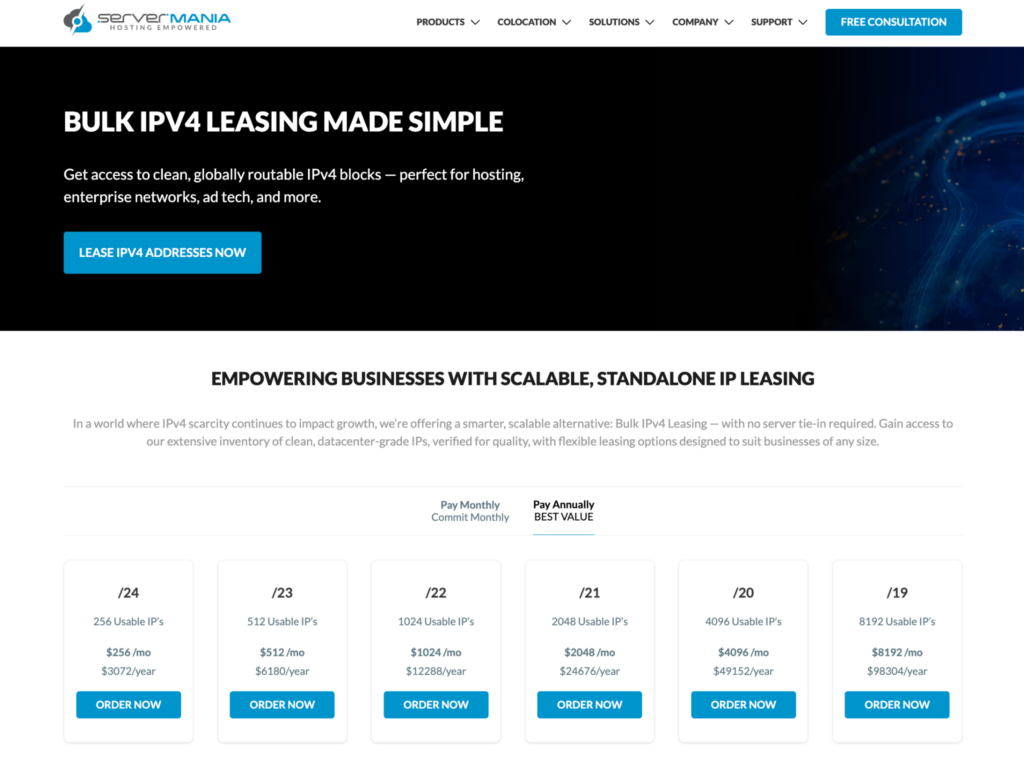
Image Source: ServerMania
ServerMania has run its own Canadian hosting platform since 2002, and it is the only provider here with a fully published, standalone rate card.
- Published pricing at every block size: Fixed rates from a /24 to a /19, no sales inquiry. Most competitors quote or float with the market.
- Standalone leasing: No server purchase. Blocks route to the infrastructure you already run.
- Pre-screened, data center-grade IPs: Checked against major blocklists before delivery.
- Global footprint with geo-targeting: Europe, North America, and Asia, with 24/7 support and room to add servers later.
Pricing: Published and fixed. A /24 is 256 US dollars monthly, halving to an effective 128 on an annual term, and the card scales the same way to a /19. That is about 0.50 US dollars per IP per month on an annual /24, all-in, from the operator announcing the block. Setup runs 24 to 48 hours.
Best for: Teams that need clean, routable space on a real network without having to buy hardware.
2. Cogent Communications
Image Source: Cogent
Cogent is a Tier 1 backbone operator, publicly traded as CCOI, and among the first carriers to lease addresses independently of internet access.
- Standalone by origin: Cogent pioneered the separation of address space from connectivity, so no transit purchase is required.
- Scale visible in the financials: IPv4 leasing brought in 64.5 million US dollars across 2025, up 43.8 percent on 2024, and 18.0 million in Q1 2026 alone.
- Address space as a financial asset: It issued 206 million US dollars of IPv4-backed secured notes in 2024 and another 174.4 million in 2025.
- Carrier-shaped process: The space comes off a Tier 1 network, but you buy through enterprise sales rather than self-serve checkout.
Pricing: Roughly 0.30 US dollars per IP per month, reportedly unchanged since 2015. No public rate card.
Best for: Larger operators buying in volume who can work a carrier sales cycle.
Category 2: Self-Serve Marketplaces
Marketplaces suit you when you want speed and broad registry coverage, and can handle routing yourself.
1. IPXO
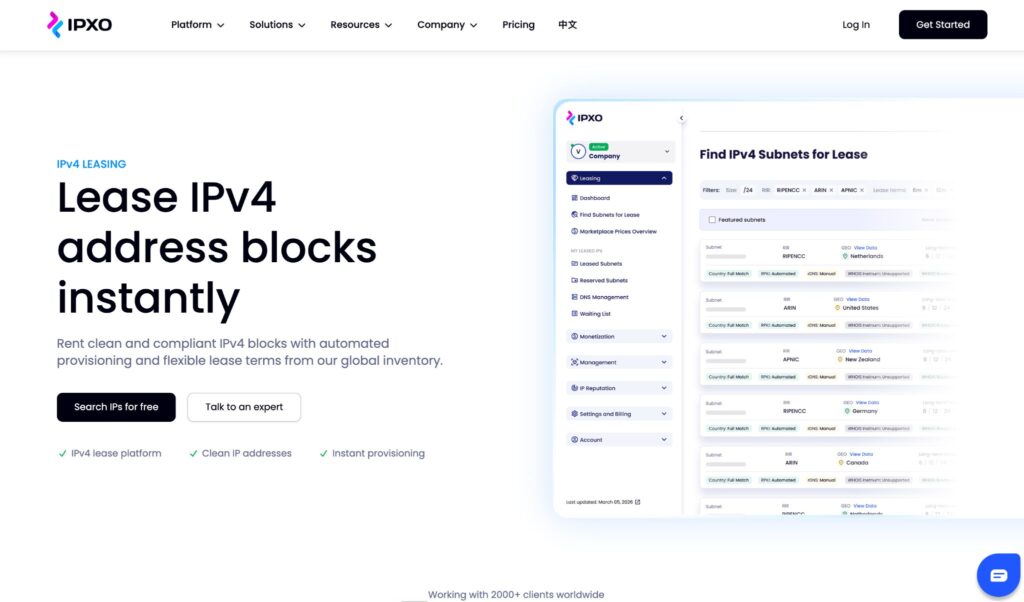
Image Source: IPXO
IPXO is the largest dedicated IPv4 leasing platform in operation, built on automation rather than account management.
- The deepest inventory: More than 6 million addresses across all five RIR regions.
- Automation end-to-end: LOA, ROA, and WHOIS updates are issued programmatically, and IPXO reports that roughly 97-98% of abuse cases are auto-handled.
- Fast setup and live rates: Provisioning can be completed in under 24 hours, and a public market-stats dashboard shows real-time pricing.
- Watch the fee layer: Holders pay a platform fee, and lessees pay an additional fee starting around 9 US dollars per /24, which should be included in any cost comparison.
Pricing: IPXO’s own research puts average lease rates near 0.35 US dollars per IP per month in 2026, down from 0.40 to 0.50 across 2024 and 2025.
Best for: Operators who want speed and scale and can route their own space.
2. IPbnb
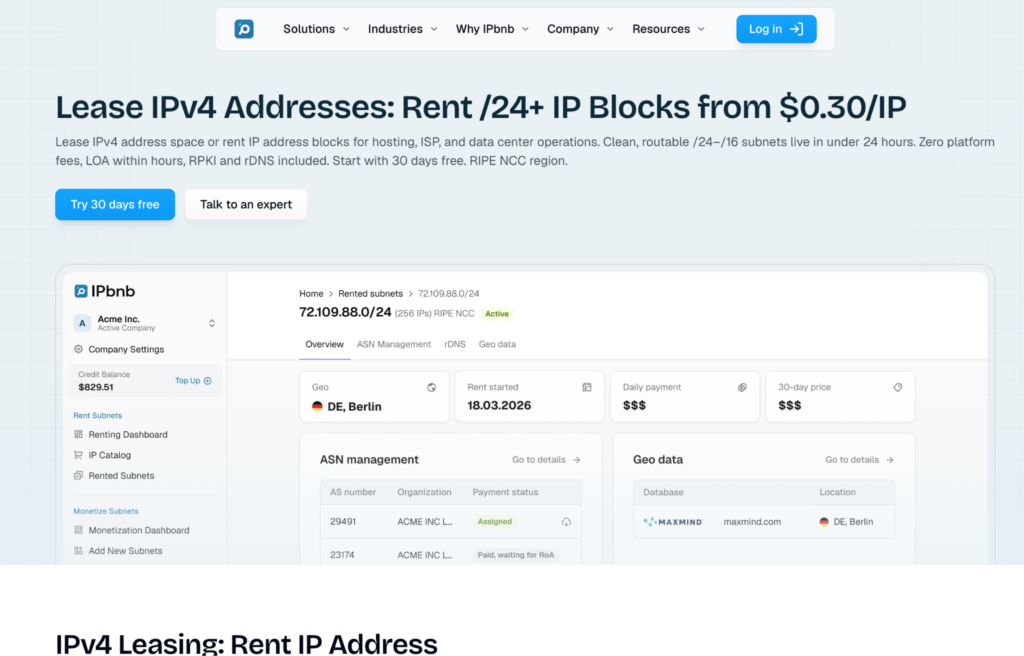
Image Source: IPbnb
IPbnb is a purpose-built marketplace aimed at LIRs, hosting providers, ISPs, and enterprises that treat IPv4 as infrastructure capital.
- Lease, buy, sell, or transfer: One platform for all four, so you can move between renting and owning without changing vendors.
- No platform fees: You pay the holder’s listed monthly rate, so the headline number reflects the actual cost.
- Public pricing calculator: Live per-block rates by size and region, with no quote gate.
- Operational layer includes: Reputation screening, monitoring, policy enforcement, and routing authorization guidance.
Pricing: Roughly 0.30 to 0.35 US dollars per IP each month, putting a /24 in the 77 to 90 dollar range.
Best for: Buyers who want benchmarkable economics and the option to buy later.
3. IPv4Center
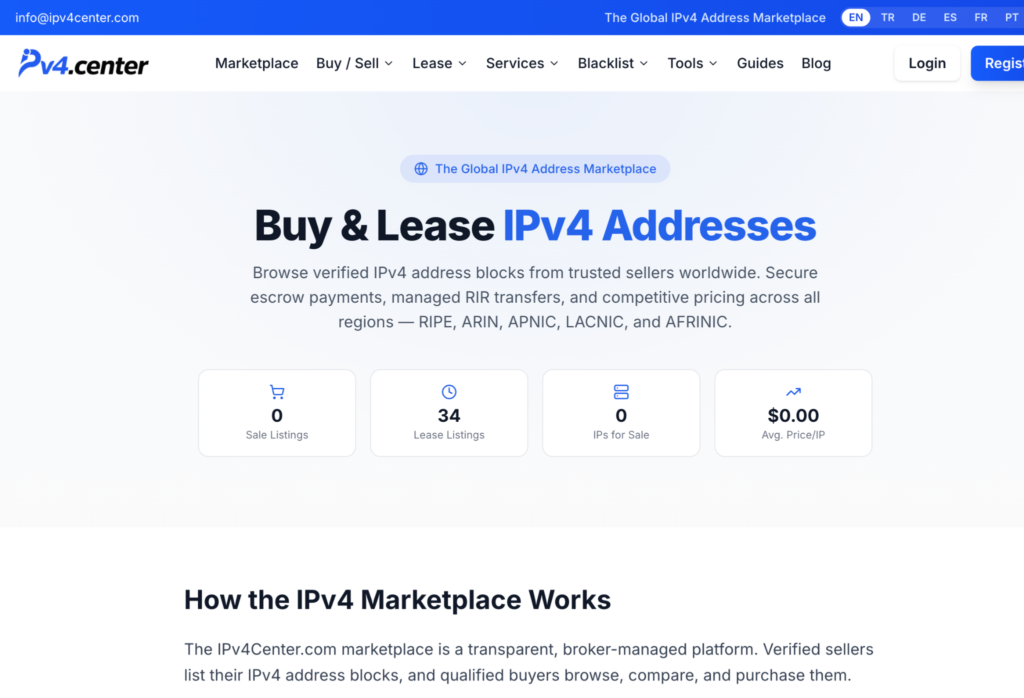
Image Source: IPv4Center
IPv4Center is a marketplace spanning all five RIR regions, with a single-platform model covering both leasing and purchases, and the heaviest reputation screening of the three marketplaces here.
- Full registry coverage: All five RIR regions are useful when you need regional breadth rather than relying on a single
- Heavy reputation screening: Blocks are checked against more than 300 blacklist databases, the deepest published screen on this list.
- Automated provisioning: LOA and ROA are issued automatically, with no manual back-and-forth to slow delivery.
- Escrow on purchases: Buying and leasing are handled through one platform, with escrow protection for transfers if you convert.
Pricing: Starts around 0.40 US dollars per IP each month, varying by region and block reputation.
Best for: Organizations that want options across regions without engaging a broker.
Category 3: Brokers and Transfer Facilitators
Brokers earn their place on larger deals and region-specific needs. The setup typically takes 3 to 7 days because a transaction needs to be arranged.
1. IPv4.Global
Image Source: IPv4.Global
IPv4.Global, a division of Hilco Streambank, is a large-block broker and auction platform built for acquisitions and divestitures at scale.
- The market’s price benchmark: Its auction platform has operated since 2014, and its published sale ledger serves as the market’s reference point for transfer pricing.
- Built for scale: Auctions handle/17 and smaller blocks, while larger blocks go through private brokerage. The company has passed 1 billion US dollars in IPv4 sales.
- Credentialed and escrowed: An ARIN Qualified Facilitator, with escrow included and no hidden fees.
- Beyond the transaction: It also leases standalone, offers ProVision IPAM software, and lends against IPv4 blocks as collateral.
Pricing: Auction-driven or privately quoted, depending on block size.
Best for: Enterprise-scale operators needing large contiguous blocks or transfer-market price visibility.
2. LARUS
Image Source: LARUS
LARUS is a Hong Kong company specializing in the APNIC region, and it leases from its own address pool rather than matching you to a third-party holder.
- Asia Pacific depth: Long registry experience in the region, including the first recorded inter-RIR transfer from LACNIC to APNIC.
- First-party pool: Leasing from space LARUS holds itself shortens the accountability chain compared with a broker match.
- RIR membership management included: It will walk you through becoming a member and holding your own space, if that suits you better in the long term.
- Broader service set: IP management and IPv6 training sit alongside the leasing product.
Pricing: Quote-based and usually multi-year. APNIC blocks can lease above 0.60 US dollars per IP per month in some markets because regional supply is tighter.
Best for: Asia Pacific operators for whom continuity and registry compliance are priorities.
3. Prefixx
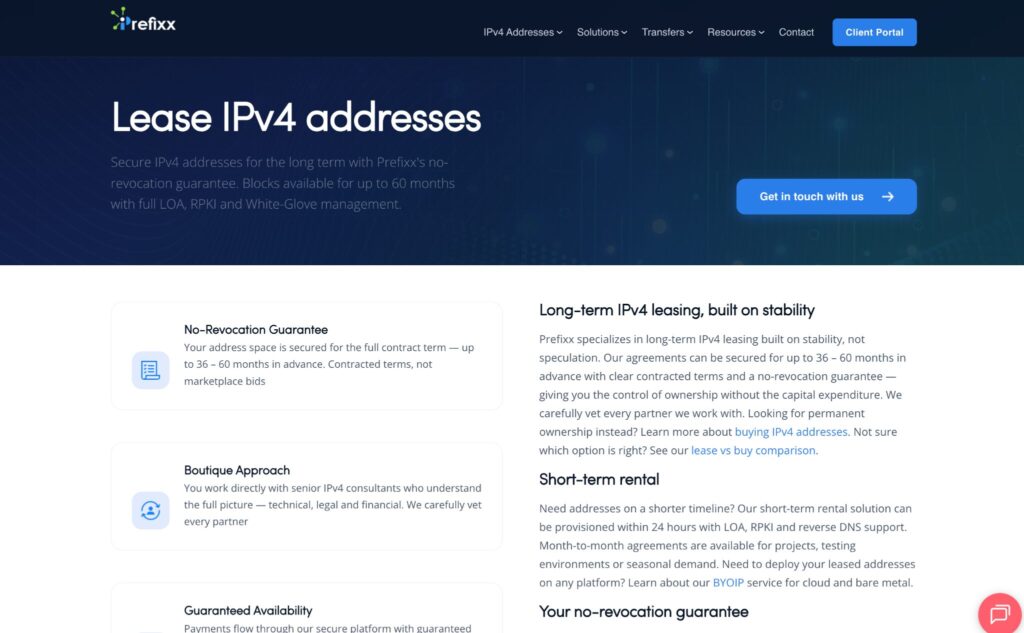
Image Source: Prefixx
Prefixx is a boutique broker headquartered in Miami, founded in 2018 by a team working in data centers and networking since 2007. It states plainly that it is not a marketplace.
- Long, contracted terms: Agreements run 36 to 60 months with a no-revocation guarantee, the primary differentiator.
- Curated, not self-serve: Prefixx vets both sides rather than offering open access to a spot market.
- White-glove management included: Route object and POC updates, RPKI, reverse DNS, geolocation, abuse handling, and reputation monitoring are all bundled in.
- Multi-registry credentials: A registered broker with RIPE NCC, ARIN, and APNIC, and it facilitates LACNIC transfers.
Pricing: Quote-based with no public rate card, so budget planning requires direct engagement.
Best for: Operators with multi-year commitments who value stability over speed. A poor fit for short-term or on-demand needs.
Comparison of the Best IPv4 Leasing Providers
Setup times and pricing reflect 2026 market ranges and vary by block size, region, and term.
| Provider | Category | Standalone | Setup speed | Pricing model | Coverage |
| ServerMania | Operator | Yes | 24 to 48 hrs | Published, /24 to /19 | NA, Europe, Asia |
| Cogent | Operator | Yes | Varies | Quote-based | Tier 1 global backbone |
| IPXO | Marketplace | Yes | Under 24 hrs | Market rate plus fees | All 5 RIRs |
| IPbnb | Marketplace | Yes | Fast | Listed rate, no fees | Global |
| IPv4Center | Marketplace | Yes | Fast | From 0.40 USD per IP | All 5 RIRs |
| IPv4.Global | Broker | Yes | 3 to 7 days | Auction or quote | Global, large blocks |
| LARUS | Broker | Yes | 3 to 7 days | Quote, multi-year | APNIC focus |
| Prefixx | Broker | Yes | 3 to 7 days | Quote, 36 to 60 months | RIPE, ARIN, APNIC |
Sources: Provider pricing pages and 2026 IPv4 market reporting, including IPXO Market Stats and industry analyses.
How to Choose the Right Provider?
Match the provider to the job rather than chasing the lowest per-IP headline.
- Clean IPs on a real network, fast, without buying a server: An operator that leases standalone, such as ServerMania.
- Volume, and you can work on a carrier sales cycle: A Tier 1 operator like Cogent.
- Speed and self-service, and you route your own space: A marketplace like IPXO, IPbnb, or IPv4Center.
- Large contiguous blocks or a specific registry region: A broker, such as IPv4.Global, LARUS, or Prefixx.
Whatever the category, check three things before signing: that blocks are screened against major blocklists, that pricing stays transparent once fees and routing are counted, and that terms fit the real duration of your need.
Final Thoughts
The best IPv4 leasing providers serve different business requirements. Marketplaces win on speed, brokers win on large blocks and registry-specific deals, and operators win when you want clean, routable addresses backed by a real network. For most businesses needing standalone IPv4 space without operational headaches, ServerMania is the standout: published pricing from a /24 to a /19, pre-screened, data center-grade IPs, no required server purchase, and a provider that has run its own infrastructure since 2002.
Frequently Asked Questions (FAQs)
Q1. How much does it cost to lease a /24 in 2026?
Answer: A /24 holds 256 addresses. Typical pricing lands around 0.38 to 0.50 US dollars per IP each month in the ARIN and RIPE regions, so a /24 falls in the low hundreds per month.
Q2. Can I lease IPv4 without buying hosting?
Answer: Yes. Standalone leasing is available from every provider on this list. It is useful when you already run infrastructure and simply need a routable address space.
Q3. Why does IP reputation matter so much?
Answer: Industry estimates suggest 50 to 60 percent of IPv4 addresses appear on at least one blocklist. A poor history can wreck email deliverability, so pre-delivery screening is a real buying criterion, not a formality.
Q4. Is leasing still worth it as IPv6 grows?
Answer: For now, yes. Most networks still run dual-stack and depend on IPv4 for reachability, legacy systems, and email.
Recommended Articles
We hope this guide to IPv4 leasing providers helped you compare your options. Check out these recommended articles for more insights into networking and infrastructure.


