


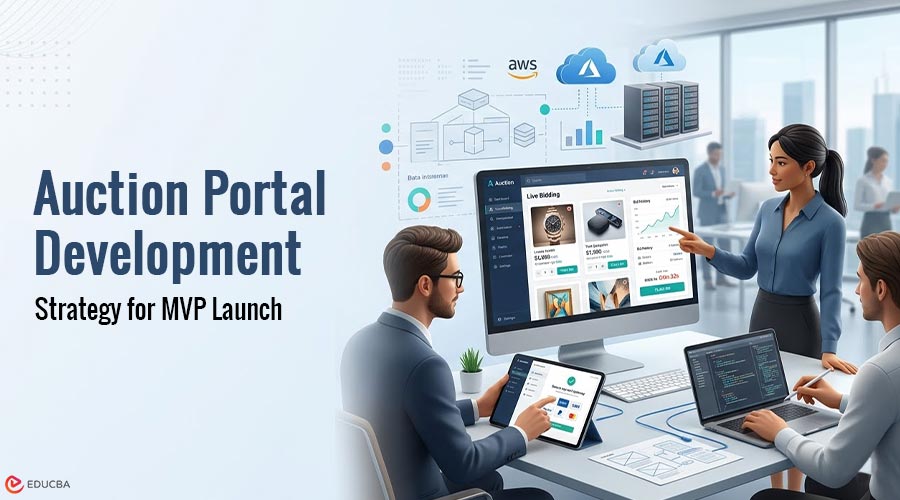
A lot of entrepreneurs who decide to build an online auction platform make the same mistake: they try to build everything at once. They spend months developing advanced features, only to discover that the core bidding experience is broken, user onboarding is confusing, or the payment flow loses buyers at the final step. The result is a delayed launch, wasted budget, and a product that never gets real market validation. The smarter path is to define a focused minimum viable product, launch it, gather data, and scale with confidence. This requires a clear understanding of which features should be prioritized in the initial phase of the auction portal development and which can be postponed to later stages.
What Is an Auction Portal?
An auction portal is a web-based platform that connects buyers and sellers through a competitive, time-limited bidding process. Unlike fixed-price marketplaces, an auction portal creates dynamic pricing: the final sale value is determined by demand, not a preset number. In other words, the platform itself becomes the mechanism for price discovery.
The scope of auction portal development can vary significantly depending on the target market. A general consumer platform resembles eBay in structure, while a niche B2B portal focused on, say, surplus industrial equipment or foreclosed real estate operates with entirely different workflows, user roles, and compliance requirements. As a result, the exact scope of a viable MVP may vary by project, but the core foundational components generally remain the same.
When Does an MVP Approach Make Sense in Auction Portal Development?
Here’s when an MVP strategy can enter the game: when the business model has not yet been validated against real user behavior. Launching a feature-complete platform without market feedback is significantly riskier than launching a lean version, collecting data, and iterating.
You should attentively analyze whether a full-featured launch is actually necessary at your current stage. An MVP is the right approach when:
- The target audience and niche have been identified, but not yet tested
- Budget or timeline constraints exist and need to be managed carefully
- The team wants to test a specific auction format before committing to multiple formats
- Early user acquisition and feedback are higher priorities than feature completeness
The majority of successful auction platforms in auction portal development launched as lean products. They validated core mechanics first and layered complexity on top of a working foundation.
Core MVP Features for Auction Portal Development
User Registration and Verification
Every auction portal needs a reliable identity layer from day one. Without it, fraudulent listings and fake bids will undermine user trust before the platform gains momentum. What reliable user registration should have:
- Email and phone verification at signup
- Seller identity confirmation (document upload or third-party KYC integration)
- Role separation between buyers and sellers
- Basic profile pages with rating placeholders for future reviews
Pay attention to verification flow design. If the process feels too long or intrusive at signup, conversion rates drop significantly.
Listing Creation and Management
Sellers need a straightforward interface for creating auction listings. This functionality is designed to be simple enough for non-technical users while capturing all the data buyers need to make bidding decisions. Core listing fields include title, description, category, starting bid, reserve price (optional), auction duration, and image upload.
What is also important here is that listings should support draft saving. Sellers who lose their work mid-form rarely return to complete the listing.
Real-Time Bidding Engine
The bidding engine is the technical heart of auction portal development. It needs to handle concurrent bids, validate increment rules, enforce auction deadlines, and update all active participants in real time. This is not optional functionality; it is the core value proposition of the entire product.
The most highly demanded options for the MVP bidding engine include:
- Timed auction closing with automatic winner determination
- Minimum bid increment enforcement
- Proxy bidding (automated re-bidding up to a user-defined maximum)
- Outbid notifications via email or push notification
- Anti-sniping logic that extends the auction when a bid arrives in the final minutes
Payment Processing
From a financial perspective, payment handling needs to be production-ready before launch, not added as a post-MVP feature. Buyers need confidence that their funds are protected, and sellers need assurance that payment will be collected. Typical integrations include Stripe and PayPal for consumer platforms, with escrow services added for high-value or B2B transactions.
The MVP payment flow should cover deposit collection at the bidding stage (to prevent fake bids), final payment at auction close, and basic refund handling for canceled auctions.
Search and Basic Filtering
Buyers need to find relevant listings quickly. Even at the MVP stage, search functionality should support keyword queries, category filtering, and sorting by auction end time or current bid price. It will be helpful to implement this on a simple relational database index at launch, then migrate to Elasticsearch once catalog volume justifies the infrastructure investment.
Admin Panel
An internal administration interface is a non-negotiable MVP component in auction portal development. The team needs to be able to moderate listings, manage user disputes, issue refunds, and monitor bidding activity without accessing the database directly. A basic admin panel saves significant operational time from the first week of launch.
How to Structure Auction Portal Development for MVP Launch?
We recommend organizing the build into two clearly separated tracks: core infrastructure and user-facing features.
Track 1: Infrastructure (Weeks 1 to 6)
- Set up a cloud hosting environment with staging and production separation
- Build an authentication service with role management
- Develop the bidding engine with WebSocket support for real-time updates
- Integrate the payment gateway with sandbox testing
- Configure database schema for users, listings, bids, and transactions
Track 2: User-Facing Features (Weeks 3 to 10)
- Design and build registration and onboarding flows
- Develop a listing creation and management interface for sellers
- Build auction browsing, search, and listing detail pages for buyers
- Implement bidding interface with real-time bid feed
- Build a notification system for outbid alerts and auction outcomes
- Develop an admin panel for moderation and reporting
Thanks to this parallel approach, auction portal development can reduce total development time without creating dependencies that block progress. A focused team of four to six engineers can deliver a launchable MVP in approximately 10 to 14 weeks.
What to Leave for Post-MVP?
Scope discipline is what separates teams that launch on time from those that spend months building features nobody asked for. The following capabilities are valuable but should be deferred:
- Seller subscription tiers and premium listing options
- Advanced analytics dashboards for sellers
- Mobile native applications (a responsive web design covers launch needs)
- Multi-currency and multi-language support
- Social sharing and referral mechanics
These mechanics boost engagement and revenue, but they require a user base to generate meaningful impact. Building them before launch means building them without real usage data.
Final Thoughts
A successful auction portal launch does not depend on having every possible feature from day one. What matters most is delivering a reliable bidding experience supported by secure payments, real-time updates, and a platform users can trust. Your MVP should prioritize the essential mechanics that define the auction experience, listing creation, bidding functionality, and transaction processing, while treating non-essential enhancements as future roadmap items.
With a focused strategy, auction portal development can move from concept to market in just a few months, allowing teams to gather real user feedback and refine the platform based on actual demand. Taking this approach helps refine product-market fit while establishing a stronger foundation for future scalability and sustained business growth.
Recommended Articles
We hope this guide on auction portal development helps you plan and launch an MVP that balances speed, scalability, and user trust. Explore these recommended articles for additional insights and strategies to strengthen your online auction platform strategy.

