
What is the Multiplier Effect?
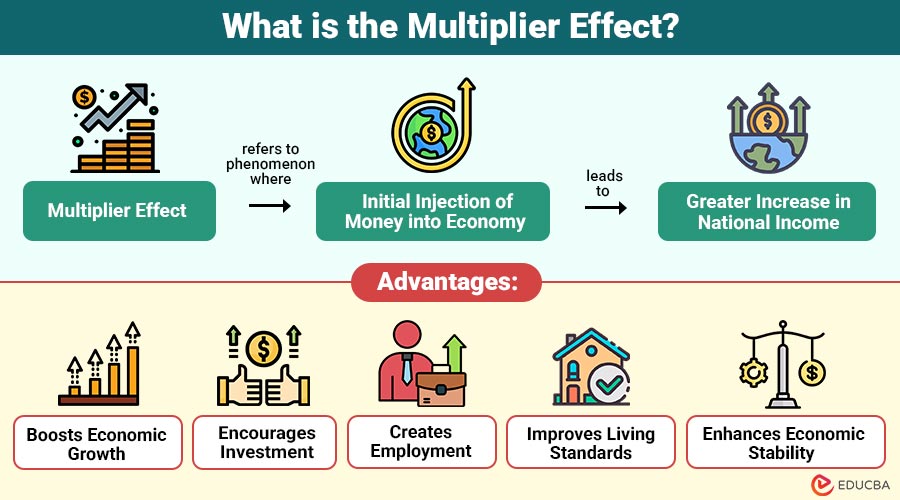
The multiplier effect refers to phenomenon where an initial injection of money into an economy leads to a greater increase in national income. In simple terms, one person’s spending becomes another person’s income, which is then spent again, creating a chain reaction.
Table of Contents:
- Meaning
- Working
- Formula
- Types
- Real-World Example
- Use Cases
- Advantages
- Limitations
- Factors Affecting the Multiplier Effect
- Difference
Key Takeaways:
- The multiplier effect explains how initial spending generates a larger overall income through the economic cycle.
- Multiplier size depends mainly on the marginal propensity to consume and leakages such as taxes, savings, and imports.
- It helps governments design fiscal policy, stimulate demand, create jobs, and support economic growth and stability.
- Leakage, inflation, and low consumer confidence can reduce multiplier impact and slow economic expansion.
How Does the Multiplier Effect Work?
The multiplier effect operates through repeated cycles of income and spending. Here is how it unfolds:
1. Initial Spending
The government or businesses inject money into the economy through investments like infrastructure, creating a wave of economic activity and demand.
2. Income Generation
Workers, contractors, and suppliers receive wages and payments from the initial investment, increasing their disposable income and overall financial stability.
3. Consumption
People spend a portion of their earned income on goods and services, boosting demand and supporting businesses across different sectors.
4. Further Income Creation
Businesses that receive this spending generate revenue, pay employees and suppliers, and distribute income, expanding economic activity throughout the economy.
5. Repeated Rounds
The cycle repeats many times as money circulates, but gradually weakens due to leakages such as savings, taxes, and spending on imports.
Example:
If the government spends ₹1,000 on construction:
- Workers earn ₹1,000 and spend ₹800.
- Shop owners receive ₹800 and spend ₹640.
- This continues, gradually decreasing but still contributing to total income.
This chain of spending creates a multiplied impact on the economy.
Multiplier Effect Formula
The multiplier is calculated using the marginal propensity to consume (MPC).
Formula:
Where:
- MPC (Marginal Propensity to Consume) = proportion of income spent on consumption.
Example Calculation:
If MPC = 0.8:
Multiplier = 1 / (1 – 0.8) = 1 / 0.2 = 5
This means ₹1 of initial spending generates ₹5 in total economic output.
Types of Multiplier Effect
Here are the main types of multiplier effect that show how different sources of spending influence economic growth.
1. Investment Multiplier
An increase in investment raises income, employment, and output, as spending circulates repeatedly, significantly boosting overall economic activity.
2. Government Spending Multiplier
Higher government spending increases demand, creates jobs, and stimulates economic growth, especially during recessions or economic slowdowns.
3. Tax Multiplier
Changes in taxes impact disposable income; tax cuts increase spending, while higher taxes reduce consumption and slow economic growth.
4. Export Multiplier
Growth in exports brings foreign income into the economy, increasing domestic production, employment, and overall economic activity through repeated spending cycles.
Real-World Example
Here is a simple real-world example showing how the multiplier effect works in practice through government investment in infrastructure.
Infrastructure Development
Suppose the government invests ₹10 crore in building roads:
- Construction workers earn wages.
- Workers spend money on food, housing, and services.
- Businesses experience increased demand.
- More jobs are created.
If the multiplier is 4, the total economic impact becomes ₹40 crore.
Use Cases of Multiplier Effect
Here are the key use cases of it, showing how it is applied in economics, business, and policymaking to drive growth and development.
1. Economic Policy Making
Governments apply the multiplier effect to shape fiscal policies, especially during downturns, to stimulate demand, investment, and economic recovery.
2. Business Expansion
Businesses use the multiplier effect to evaluate how investments and expansion plans generate additional income, demand, and long-term profitability.
3. Public Infrastructure Projects
Infrastructure projects like roads, railways, and airports rely on the multiplier effect to justify spending through widespread economic benefits.
4. Employment Generation
Increased spending boosts production, encouraging businesses to hire more workers and thereby reducing unemployment and improving overall income levels.
5. Foreign Investment Impact
Foreign direct investment creates a multiplier effect by bringing capital, technology, and jobs, thereby boosting local income, spending, and overall economic development.
Advantages of the Multiplier Effect
Here are the key advantages, highlighting how it contributes to economic growth, employment, and overall economic stability.
1. Boosts Economic Growth
It accelerates overall economic growth by increasing output, income levels, and demand across multiple sectors through repeated spending cycles.
2. Encourages Investment
It motivates businesses and governments to invest more, as initial spending generates amplified returns and wider economic benefits over time.
3. Creates Employment
Growing consumer demand for products and services pushes companies to grow, which reduces unemployment and creates jobs.
4. Improves Living Standards
Higher income, better employment opportunities, and increased economic activity contribute to improved living standards and overall quality of life.
5. Enhances Economic Stability
Helps stabilize the economy by supporting demand during slowdowns, reducing the severity of recessions, and promoting steady growth over time.
Limitations of the Multiplier Effect
Here are the key limitations of the multiplier effect, explaining the factors that can reduce its impact on economic growth and overall effectiveness.
1. Leakages
Savings, taxes, and imports reduce the multiplier effect by withdrawing money from the spending cycle, significantly limiting overall economic impact.
2. Inflation Risk
Excessive spending can cause inflation when demand rises faster than supply, leading to higher prices and reduced purchasing power.
3. Time Lag
Does not occur instantly, as spending takes time to circulate and gradually influence income, output, and employment.
4. Economic Conditions
Weakens during low consumer confidence, as people save more and spend less, reducing the cycle of income generation.
5. Resource Constraints
If an economy lacks sufficient resources such as labor, raw materials, or infrastructure, increased demand may not translate into higher output, thereby limiting the multiplier effect.
Factors Affecting the Multiplier Effect
Here are the key factors affecting the multiplier effect, showing how different economic conditions influence its strength and overall impact on the economy.
1. Level of Income
Higher income levels may lead to more savings, which can reduce the multiplier effect.
2. Tax Rates
High taxes reduce disposable income, lowering consumption and weakening the multiplier.
3. Import Levels
Spending on imports causes money to leave the domestic economy, reducing the multiplier.
4. Consumer Confidence
When people feel economically secure, they are more likely to spend, increasing the multiplier.
5. Interest Rates
Lower interest rates increase the multiplier, whereas higher rates discourage borrowing and spending.
6. Marginal Propensity to Consume
A higher MPC means people spend more of their income, leading to a stronger multiplier effect
Difference Between Multiplier Effect and Accelerator Effect
Here is a clear comparison of the multiplier effect and the accelerator effect.
| Aspect | Multiplier Effect | Accelerator Effect |
| Meaning | Increase in income due to spending | Increase in investment due to demand |
| Focus | Consumption | Investment |
| Trigger | Initial spending | Change in demand |
| Impact | Expands income | Expands capital investment |
Final Thoughts
The multiplier effect explains how changes in spending lead to larger impacts on overall economic growth. It influences government policies and business investments, boosting income and employment. However, it must be managed carefully to prevent inflation and inefficiencies. It offers valuable insights into how financial decisions shape the economy.
Frequently Asked Questions (FAQs)
Q1. What determines the size of the multiplier?
Answer: The marginal propensity to consume (MPC) mainly determines its size.
Q2. Why is the multiplier effect important?
Answer: It helps governments and businesses understand how spending impacts economic growth.
Q3. Can the multiplier effect be negative?
Answer: Yes, reduced spending can lead to a reverse multiplier effect, slowing the economy.
Q4. How do taxes affect the multiplier?
Answer: Higher taxes reduce disposable income and weaken the multiplier effect.
Recommended Articles
We hope that this EDUCBA information on “Multiplier Effect” was beneficial to you. You can view EDUCBA’s recommended articles for more information.


