


How to Actually Get Paid Through Indie Game Monetization?
There is a persistent myth in indie game culture that caring about money corrupts the creative process. That “real” developers make games for passion, not profit. It is a romantic idea and a financially ruinous one. The truth is simple: if you cannot sustain yourself, you cannot keep making games. Indie game monetization is not the enemy of creativity unsustainable creativity is. The developers who keep shipping year after year are the ones who figured out how to get paid, reinvested that money into their craft, and built something durable.
This guide is for beginners with a game in development or nearly finished who are asking how to turn it into income. You do not need a publisher, a massive marketing budget, or a viral moment. You need a strategy that fits your game, your audience, and your realistic capacity as a small developer.
Understanding the Indie Game Monetization Landscape in 2026
The market has matured significantly. Players are more sophisticated, storefronts are more crowded, and the old “just put it on Steam and hope” approach has a lower ceiling than ever. But the opportunity is also broader. Mobile, PC, console, browser, subscription platforms, and direct sales are all viable channels, depending on your game type.
Before choosing a monetization model, you need honest answers to three questions. First, what platform is your game best suited for? A deep 40-hour RPG belongs on PC or console. A casual puzzle game with short sessions belongs on mobile or browser. Mismatching your game to its platform is one of the most expensive mistakes a beginner can make. Second, who is your player, and what are they already paying for? Third, what is your game’s relationship with time is it a finite experience, or something players return to repeatedly? That last question almost entirely determines which monetization models are available to you.
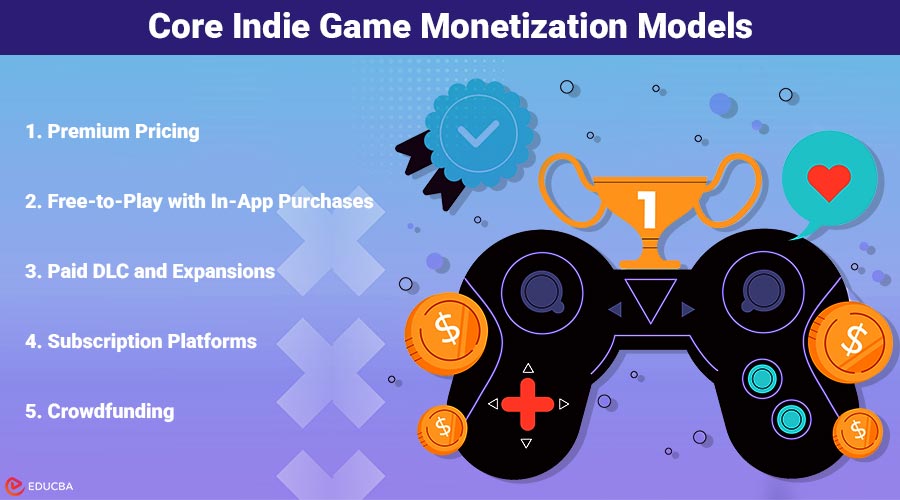
Core Indie Game Monetization Models
Here are the main indie game monetization models you can consider, along with tips on when and how to use each effectively.
1. Premium Pricing: Pay Once, Own Forever
The simplest model. Players pay a fixed price upfront and receive the complete game. No ongoing transactions, no unlock gates, no subscriptions. This model works best for games with a defined beginning, middle, and end narrative, puzzle, and action-adventure titles. It builds the strongest relationship with your players because the incentives are fully aligned: you want to make a great, complete game, and they do too.
Pricing a premium indie game correctly is harder than it looks. Beginners consistently underprice out of insecurity. Research comparable titles on your target platform and price based on the value of the experience, not just the hours of content. A tight, polished three-hour game is worth more than a bloated, mediocre ten-hour game, and your price should reflect that confidence. On Steam, the current sweet spot for debut indie titles ranges from $9.99 to $19.99, depending on scope. Going lower signals low confidence and attracts bargain hunters who are quick to refund. Going higher requires a marketing presence that most beginners do not yet have.
2. Free-to-Play with In-App Purchases
Free-to-play (F2P) is the dominant model on mobile and a significant presence on PC. Players can download and play for free; revenue comes from optional in-game purchases. Beginners widely misunderstand this model. The key distinction is between cosmetic monetization and pay-to-win monetization. Cosmetic monetization selling skins, character outfits, visual effects, and soundtrack packs is broadly accepted by players and is sustainable in the long term. Pay-to-win monetization selling gameplay advantages, progression shortcuts, or power is corrosive to your community and, increasingly, to your reputation on storefronts.
F2P is not a beginner-friendly model. It requires significant ongoing content production to keep players engaged, sophisticated analytics to understand where and why players stop spending, and a substantially larger initial player base than premium games need to generate equivalent revenue. If you are shipping your first game, F2P on mobile is a difficult mountain to climb without resources behind you.
3. Paid DLC and Expansions
DLC works as a secondary revenue layer on top of a successful premium game. You ship a complete base game, build an audience, then offer meaningful expansions to players who want more. The critical word is meaningful. Players have become highly attuned to DLC that feels like content cut from the base game and resold.
DLC that earns goodwill is DLC that genuinely expands the world new campaigns, new mechanics, substantial new story content. Day-one DLC, cosmetic-only DLC on a premium game, and thin content packs are reliably controversial and rarely worth the reputational cost for a small developer still building trust.
4. Subscription Platforms
Services like Xbox Game Pass, PlayStation Plus, and various mobile subscription platforms offer developers lump-sum licensing fees or per-play revenue in exchange for including their game in a subscription library. For beginners, getting onto a major subscription platform is more of a milestone than a primary strategy.
These platforms typically approach developers after a game has demonstrated market traction, rather than being a launch channel. However, smaller subscription services and regional platforms can be viable early revenue sources worth investigating once your game is complete.
5. Crowdfunding
Kickstarter and its equivalents serve a dual purpose: they generate development funding before launch and simultaneously validate market interest. A successful crowdfunding campaign proves to you, your future players, and potential partners that your concept has genuine demand. Crowdfunding works best when you have something tangible to show a playable demo, a clear visual identity, and a compelling pitch video.
Campaigns built on concept art and promises routinely underperform. Campaigns built on playable prototypes with passionate early communities routinely exceed their targets. Be conservative with funding goals. A fully funded campaign at a modest target is vastly more valuable than a failed campaign at an ambitious one. Failed campaigns are publicly visible and can damage launch momentum.
Where You Sell Matters as Much as How?
Here are the key platforms and storefronts where indie game monetization can succeed, and how to choose the right one for your game.
1. Steam
Steam remains the dominant PC gaming storefront. Its discovery algorithms favor games that drive strong wishlist-to-purchase conversion during their launch window, meaning your pre-launch marketing directly affects your long-term visibility. Build your Steam page early months before launch and consistently drive wishlist additions. The first 48 hours after launch are disproportionately important for algorithmic visibility. Steam takes a 30% revenue share on the first $10 million in sales, dropping to 25% and then 20% at higher thresholds. Factor this into your pricing.
2. Itch.io
Itch.io is the indie developer’s native habitat. The platform is developer-friendly and community-oriented, and it lets you set your own revenue share (including 100% to yourself). It is not a replacement for Steam’s scale. Still, it is an excellent platform for game jams, early demos, experimental projects, and building a direct relationship with your most enthusiastic early audience. Many developers use Itch.io to build momentum before a Steam launch.
3. Mobile (iOS and Android)
Mobile is a high-volume, high-competition environment where discoverability is extremely difficult without either significant marketing spend or a viral mechanism built into the game itself. The App Store and Google Play each take 30% (with reduced rates for smaller developers). User acquisition costs have risen substantially, making organic growth the only realistic path for bootstrapped indie developers. If your game is genuinely suited to mobile short sessions, portrait-friendly, touch-native mechanics it can be a strong platform. If you are porting a PC game to mobile as an afterthought, the results are almost always disappointing.
Building Revenue Beyond the Launch Window
Most games earn the majority of their lifetime revenue in the first two weeks after launch. This is a challenge, not a death sentence, if you plan for it. Seasonal sales are your most reliable ongoing revenue driver. Steam’s major sales events Summer, Autumn, Winter consistently spike purchases for discounted titles years after their original launch. Price your game strategically for these windows rather than discounting randomly. Content updates and patch notes are marketing. Every time you meaningfully update your game and communicate it to your community, you generate a new wave of attention.
Players who wishlist and wait, lapsed players who return, and press outlets that cover updates all represent second- and third-wave potential revenue. Treat your post-launch content calendar as part of your monetization strategy. Community building is compound interest. A Discord server, a development blog, or a consistent social media presence converts curious observers into invested followers, and invested followers into day-one purchasers for your next game. Your second game launches to a warm audience. Your third game launches to a community. This is how sustainable indie careers are actually built not from one hit, but from compounding goodwill.
Final Thoughts
Indie game monetization is not a necessary evil. It is the mechanism that allows you to keep making the things you love making. Every successful indie developer you admire figured this out usually the hard way, after a launch that underperformed because they treated business as an afterthought.
You do not need to become a marketer, a businessperson, or a salesperson. You need to understand enough about how money flows through this industry to put your game in a position to succeed. The strategy does not need to be complex. It needs to be intentional. Pick a model that fits your game. Choose platforms that fit your audience. Build your community before you need it. Price your work with confidence. And then make the next game better than the last one. That is the whole strategy. Everything else is details.
Frequently Asked Questions (FAQs)
Q1. Do I need a company or LLC to sell my game?
Answer: Not to start, but you should look into the requirements in your specific country or region before your first sale. In many jurisdictions, you can initially sell as a sole trader or individual, but a registered business entity offers liability protection and cleaner tax handling as revenue grows. Consult a local accountant before you launch commercially, it is worth the cost.
Q2. How much should I spend on marketing?
Answer: A general industry benchmark for indie games is 20–30% of your total development budget allocated to marketing. For a beginner with a limited budget, this might mean $0 in paid advertising and significant time invested in community building, press outreach, and social content instead. Time is a marketing budget.
Q3. Is it too late to launch on Steam, given how crowded it is?
Answer: No, but strategy matters more than it used to. Games with distinct visual identities, clear genre positioning, strong early community engagement, and robust wishlists before launch continue to perform well. Launching without those elements is harder than it was five years ago.
Q4. What’s the best pricing strategy for a first game?
Answer: Price based on comparable titles, not on your feelings about your own work. Search for games similar in scope, genre, and visual fidelity on your target platform and cluster around the median. If your game is shorter or narrower in scope, price slightly below the median. Do not launch at $0.99 hoping volume will compensate it rarely does, and it devalues the work.
Q5. Should I get a publisher?
Answer: Publishers offer funding, marketing support, platform relationships, and sometimes porting assistance in exchange for a revenue share and often some degree of creative input. For a first-time developer with a limited network and no marketing experience, a good publisher partnership can meaningfully improve outcomes. The keyword is good research, any publisher thoroughly, talk to developers they have worked with, and read every contract clause carefully before signing anything.
Q6. When is the right time to start thinking about monetization?
Answer: Before you finish your game, ideally before you start it. Your monetization model affects design decisions, your target platform affects scope decisions, and your pricing strategy affects marketing decisions. Monetization is not a layer you apply at the end. It is a design constraint that shapes everything.
Recommended Articles
We hope this guide to indie game monetization helps you understand how to turn your game into a sustainable income stream. Check out these recommended articles for more tips, strategies, and insights to maximize your revenue potential.

