


How Learning Revit and BIM for Architects Can Increase Your Salary?
Architects often feel stuck. They work long hours, handle complex projects, and still see slow salary growth. Many start with low pay and take years to see any meaningful increase. Over time, architects often put in a lot of effort but do not see their income increase in line with it.
However, the reality is that not all architects get paid low. Some move ahead faster, take on better roles, and earn significantly more within a few years. The difference is not just experience. The skills architects build and how they apply them to create real project value determine their growth.
One such high-value skill is Revit and BIM for Architects. It changes the kind of work you do and how firms see your contribution.
This guide will break down how learning Revit and BIM for Architects can directly impact your salary and what you should focus on to grow faster in your career.
Ground Reality: What Architects Are Actually Earning
If you look at real conversations on Reddit and similar forums, the salary picture becomes very clear. Fresh architects often report starting salaries in the ₹20,000 to ₹30,000 per month range.
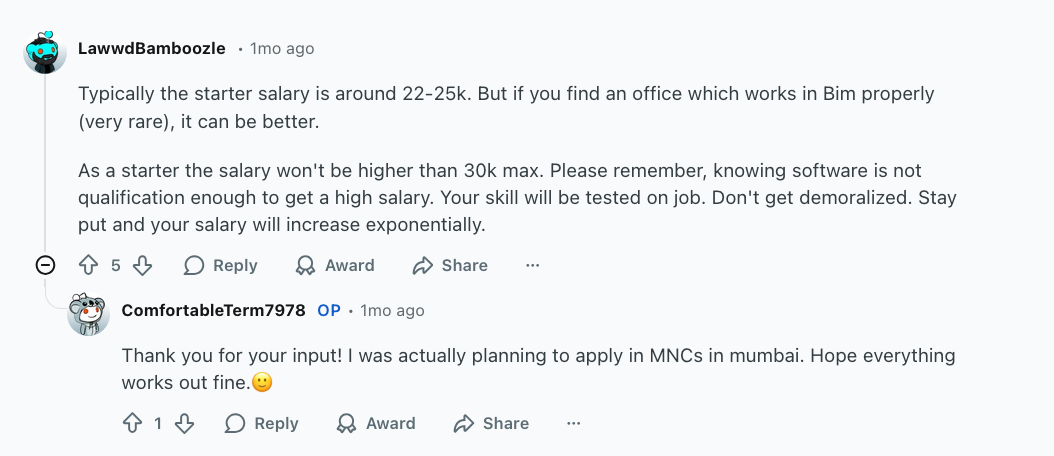
(Image Source: Reddit)
Even after a couple of years, many struggle to cross ₹40,000 to ₹50,000 unless they switch firms or move to a bigger city. These discussions also highlight an important point: architects who add Revit and BIM for Architects to their skill set tend to see better opportunities earlier. While the jump is not instant, they move into roles with higher salaries and faster growth than in traditional drafting roles.
What this shows is simple. The market does not reward effort alone. It rewards problem-solving skills combined with the ability to use tools that make projects faster, more accurate, and easier to manage. When you bring that value, your earning potential changes.
Why Revit and BIM for Architects Lead to Higher Salaries?
Let us now get to the actual reasons why Revit and BIM skills lead to higher salaries for architects. This is not just about learning a new software. It is about how your role changes within a project and the value you start to bring to a firm.
When you understand these reasons, it becomes clear why some architects grow faster, move into better roles, and earn more even with similar years of experience.
1. You Move From Drafting to Decision-Making
In traditional workflows, CAD is mostly about execution. You convert instructions into drawings. Firms make most decisions before assigning work to you, which limits your involvement.
With Revit and BIM, this changes. You are not just creating drawings. You are working with a model that carries information, which means you get involved earlier in the process. Revit users often contribute to design decisions, identify practical issues, and take part in coordination discussions with other teams.
This is where the real shift happens. Firms do not just need people who can draw. They need people who can think through problems, spot conflicts, and suggest better solutions. When you bring that level of contribution, your role moves closer to the project’s core.
Over time, this shift makes you part of the decision-making team instead of just a support function. Moreover, as your involvement increases, so does your value. That is what leads to better roles and higher pay.
2. You Help Reduce Costly Errors and Rework
The course trains architects using practical workflows, focusing on real project applications rather than just software commands. Small mistakes on paper often turn into major issues on-site. This leads to delays, rework, material waste, and increased project costs. In many cases, these problems only surface during execution, making them expensive to fix.
This is where BIM changes the game. In Revit, you work on a coordinated model where different systems come together. It enables early detection of clashes among architectural, structural, and MEP elements. Instead of discovering issues on site, teams can identify and resolve them during the design stage itself.
Better coordination between teams also means fewer misunderstandings. Everyone works on a shared model, reducing communication gaps and improving overall accuracy.
The business impact is clear. Fewer errors mean less rework, faster timelines, and lower costs. For firms, this directly affects profitability and client satisfaction.
Firms highly value professionals who reduce risk and improve efficiency. When your work helps save both time and money, firms are willing to pay more for that reliability.
3. You Become More Useful Across Teams, Not Just Architecture
Most architects see BIM as just another design tool. However, with Revit and BIM for Architects, you can expand your role across the entire project.
You are no longer limited to creating drawings for one discipline. You become someone who understands how different parts of the project connect and how decisions in one area affect others. This makes you more involved, more relevant, and more valuable across teams.
You become useful across different functions like:
- Architectural design
- Structural coordination
- MEP coordination
- Clash detection and resolution
- Project planning and sequencing
- Communication with consultants and contractors.
As your involvement expands across teams, your importance in the project increases. Moreover, with that, your earning potential also grows.
4. You Open Up Higher-Paying Roles and Career Paths
If you look at job listings on platforms like LinkedIn, the difference in roles and salary ranges becomes quite clear. Traditional architecture roles often follow a slower, incremental path. In contrast, BIM-focused roles are more specialized and pay higher salaries.
For example:
- Architect (traditional roles): ₹4–10 LPA
- BIM Architect / Revit Specialist: ₹6–15 LPA
- BIM Coordinator: ₹8–18 LPA
- BIM Manager: ₹15–30+ LPA
These roles not only pay more, but they also grow faster because they directly drive project efficiency and coordination.
There is also a strong advantage in international opportunities. Many global firms now require BIM standards by default. They prefer candidates who are already trained in Revit and understand BIM workflows, as this reduces training time and project risk.
This opens doors to:
- Remote roles with international firms
- Opportunities in markets like the UAE, UK, and US
- Higher-paying projects that require BIM expertise.
When your skillset aligns with these roles, you are not limited to one career path. You have multiple directions to grow, and each step brings better earning potential.
5. You Align With What the Industry Is Actively Demanding
More and more companies are moving towards BIM-based workflows as projects become more complex and timelines get tighter. Many firms already prefer candidates who are comfortable with Revit and understand BIM processes.
In the coming years, this will only increase as BIM becomes a standard requirement across larger projects and global markets. When your skills match what the industry is actively demanding, it becomes easier to access better roles and higher salaries.
How To Learn Revit With BIM?
This is the next step. You cannot just learn the software at a surface level and expect results. There are multiple ways to get started, but what matters is how well you understand real project workflows.
Below are some practical options:
Start with YouTube for Basics
Use YouTube to understand the interface, basic tools, and simple modeling. This helps you get comfortable, but it is usually not enough to build job-ready skills.
Enroll in a Structured Online Course
To go beyond basics, you need guided learning with a real project context. There are reputable institutes such as the Asian School of Design & Applied Vastu that offer focused training in this space. Their Professional Revit & BIM Certification Course For Architects is designed around practical workflows, not just software commands.
Many students have reported significant career growth, with some seeing salary increases of up to 350% after building the right skill set. Since it is a live course, you can ask questions, clear doubts, and learn in a more structured way. ASDAV is well known for its design and architecture training, with instructors with years of industry experience.
Get Guidance and Direction
Learning on your own can be confusing, especially when you are not sure what to focus on next. Having the right guidance helps you avoid wasting time and move faster. The ASDAV team also helps you identify the right learning path based on your current level and career goals.
The key is to move from basic tool knowledge to a real understanding of the project. That is what actually makes a difference in your career.
Focus on Skills That Move You Forward
Do not let yourself be influenced too much by everything you see online. People share both positive and negative experiences, but not all reflect the complete picture. Architecture is an important field and will always have a strong demand, but the way you grow in it depends on the skills you choose to build.
If you want better opportunities and higher pay, you will have to align yourself with what the industry needs today. Revit and BIM for Architects are no longer optional; they are becoming core to the design and execution of projects.
Platforms like ASDAV, Karwaan, Novatr, and others are helping students and professionals move in this direction by offering more practical and industry-focused learning. The key is to choose the right approach, stay consistent, and focus on building skills that create real value in projects.
Recommended Articles
We hope this guide on Revit and BIM for Architects helps you understand how these skills can accelerate career growth and increase earning potential in the architecture industry. Explore the recommended articles below for insights on BIM workflows, Revit techniques, and emerging trends in modern architectural design.

