


Updated December 31, 2025
DataOps for Developers: Overview
In the fast-paced development environment, data moves faster than ever before. You might build APIs, automate workflows, or push new features daily, but at the heart of every project lies one thing — data. Whether you are building an analytics dashboard or integrating a third-party service, the way your team manages data can make or break your project’s success. This is where DataOps for developers plays a crucial role. It is a mindset and a practice that connects developers, data engineers, and operations teams to make data delivery smoother and more reliable. Think of it as DevOps for data — but with more focus on collaboration, automation, and continuous improvement. Let us look at how developers can use DataOps to streamline their path from writing code to delivering meaningful insights.
Understanding DataOps and Why It Matters
DataOps is about improving how data flows through your systems. It brings together agile methods, automation, and collaboration to ensure data moves quickly, accurately, and securely—from the moment teams collect it to the point they use it for analysis or decision-making. For developers, this means fewer headaches waiting for clean data or stable pipelines. Instead, DataOps helps teams create processes where code, data, and analytics move together.
Many organizations take this a step further by using centralized data platforms, such as a data cloud, to unify their data. A data cloud connects data from multiple systems and gives teams a single, trusted source of truth. When your applications and pipelines pull data from a consistent platform, you spend less time fixing broken connections and more time building features that matter. With DataOps and a reliable data foundation in place, teams can deliver analytics faster, deploy updates with confidence, and maintain greater trust in the insights they produce.
Core Principles Behind DataOps for Developers
DataOps is not just a toolset; it is a culture. A few principles define it:
- Agility: Teams use small, iterative changes instead of large, infrequent updates.
- Automation: Teams automate testing, validation, and deployment processes to the greatest extent possible.
- Collaboration: Developers, data engineers, and analysts work closely to align goals and reduce miscommunication.
- Quality: Data is treated like code — reviewed, versioned, and tested before release.
When teams apply these principles, they move away from manual, error-prone processes. The result is faster delivery, fewer bugs, and more reliable data pipelines. For developers, it is the difference between spending hours debugging ETL scripts and simply pushing clean, tested code through a trusted system.
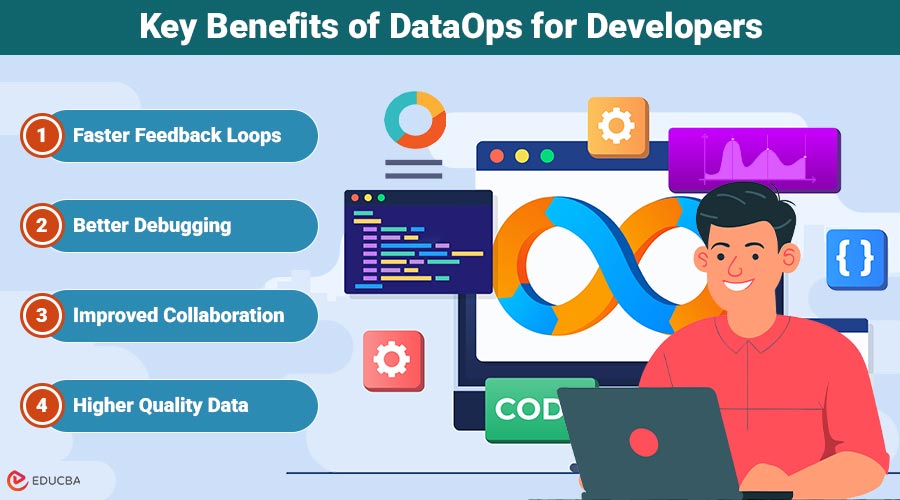
Key Benefits of DataOps for Developers
For developers, DataOps brings practical benefits that show up right away:
- Faster feedback loops: You can see how your data processes behave in real time.
- Better debugging: Errors become easier to trace and fix because logs and metrics are clear and structured.
- Improved collaboration: You no longer have to wait on the data team for every change. Shared tools and workflows make it easier to move together.
- Higher quality data: Clean, consistent data means fewer surprises during development or production.
When your data pipelines run as smoothly as your CI/CD pipelines, everything feels more connected. You build faster, deploy with more confidence, and get accurate insights without constant firefighting.
Key Tools and Technologies in DataOps
Implementing DataOps is not about buying expensive software. It is about using the right tools to create repeatable, automated processes.
- Apache Airflow for orchestrating workflows
- dbt (Data Build Tool) for transforming and testing data
- Jenkins or GitHub Actions for automating pipeline deployments
- Docker and Kubernetes for containerization and scalability
- Great Expectations for data validation and quality checks
Each of these tools supports part of the DataOps lifecycle. Together, they help teams handle version control, automate testing, and monitor pipeline performance. The key is not to overload your stack — start simple and grow as your needs evolve. For developers, the beauty of these tools is that they fit easily into familiar workflows. You can version your SQL models like code, run tests before merging, and roll back changes just as you would in a normal deployment.
Best Practices to Build a Strong DataOps Culture
Technology alone can not make DataOps successful. The culture around it matters just as much. Here are a few best practices that help teams succeed:
- Start small: Do not try to overhaul everything at once. Begin with one pipeline or process.
- Automate early: Even small automation steps, such as data validation scripts, save time in the long term.
- Communicate openly: Keep data engineers, analysts, and developers aligned through shared dashboards and regular syncs.
- Document everything: Treat data pipelines like software — every step should be tracked and documented.
- Encourage ownership: Everyone on the team should understand how their work impacts data quality.
When teams follow these habits, DataOps becomes more than a workflow — it becomes a shared language for how data is built, tested, and delivered.
Common Challenges Developers Face with DataOps
Of course, adopting DataOps is not always easy. Developers face several challenges along the way:
- Unclear roles: Sometimes it is not clear who owns what — the data engineer, the developer, or operations.
- Legacy systems: Integrating old data systems can slow everything down.
- Complex tools: Too many tools without proper integration create confusion rather than clarity.
- Resistance to change: Teams used to working in silos may hesitate to collaborate more closely.
To overcome these, teams should focus on gradual improvements. Instead of reworking the entire pipeline, start by fixing one pain point — maybe automating a manual validation task. Over time, these small wins add up, making larger changes easier. Training also helps. Developers who understand basic data principles like data lineage, transformation logic, and governance can work more efficiently in DataOps environments.
Final Thoughts
DataOps for developers provides a smarter and faster path from code to insights. It provides structure to the complex world of data engineering and makes collaboration a natural part of development. When teams automate testing, improve visibility, and share ownership of data processes, the benefits ripple across the organization. You do not need a huge transformation to get started. Begin with small steps — automate one test, track one dataset, or document one pipeline. Each step builds trust in your data and reduces friction in your workflows. Ultimately, DataOps is not just about tools or pipelines. It is about people working together to make better, faster, and more informed decisions—one commitment at a time.
Recommended Articles
We hope this guide on DataOps for developers helps you streamline data workflows and turn code into insights. Explore these recommended articles for more practical strategies and best practices in modern data operations.


